
How to Disclose AI Assistance in Academic Writing: Transparency Without Overexposure

Summary
* Best practice: Disclose AI use in one short, scannable statement: tool, task, and what you still did yourself.
* Coursework vs journals: Coursework disclosure signals learning integrity; journal disclosure signals accountability and reproducibility.
* Main risk tradeoff: Under-disclosure creates suspicion; over-disclosure can weaken perceived authorship—aim for “verifiable but minimal.”
* Detector reality check: Detectors often measure style more than reasoning, so they can misread structured outputs like polished prose or code.
* Practical safeguard: When in doubt, disclose modestly, follow policy wording, and keep a clear boundary that you owned the sources, logic, and final draft.
If you used AI in academic writing, disclose it briefly, specifically, and in the place your instructor/journal expects—name the tool, state what it did (and didn’t do), and confirm you stayed responsible for ideas, evidence, and final wording.
I’m taking a clear stance: the safest disclosure is “just enough detail to be verifiable,” not a dramatic confession and not a vague hand-wave. When you get this balance right, you protect your credibility, reduce misunderstandings, and stop AI-detector noise from becoming the main story.
Early on, it helps to understand why this is becoming a norm, and why detectors complicate the conversation—this breakdown of AI detection in academia and the ethics around it is a solid starting point if you want the bigger context without the panic: why AI detection became an academic flashpoint ..
Why disclosure is becoming the default
Disclosure is becoming standard because academic trust now includes “process transparency,” not just citations and originality. Schools and journals are trying to separate acceptable assistance (planning, language polishing) from unacceptable outsourcing (inventing arguments, fabricating analysis), and disclosure is the simplest line they can enforce.
Also, AI detectors are messy. Stanford researchers have shown that some detectors can disproportionately flag non-native English writing, which makes “prove it” enforcement risky for everyone. GPTHumanizer AI team is also blunt about the bias problem and why stakes are high: Why AI Detectors Flag Non-Native English Speakers.
The 3 principles that keep disclosure honest without making it weird
A good disclosure answers three questions: what tool, what scope, what responsibility. If your statement covers those, you’re transparent without oversharing your entire workflow.
Here’s what I use (and what I advise colleagues to use):
● Name the tool + version when relevant. Example: “ChatGPT (GPT-5.2).”
● Define the scope in one line. Brainstorming? Outline? Grammar? Code comments? Say it.
● Re-assert human responsibility. You own the claims, sources, analysis, and final text.
A small downside: this can feel awkward the first time you write it. But awkward beats ambiguous—ambiguity is what triggers back-and-forth with instructors, editors, or review boards.
Coursework disclosure vs journal disclosure: what changes and why
Coursework disclosure is usually about learning integrity, while journal disclosure is about publication accountability and reproducibility. Same core idea, different audiences, different “where to put it.”
Context | Where disclosure typically goes | What the reader needs | How specific to be |
Coursework / assignments | Cover page, appendix, or “AI use” field in LMS | Did the student do the learning work? | Medium: tool + tasks + boundaries |
Thesis / dissertation | Methods/appendix + supervisor guidance | Can others trust the workflow over time? | Medium-high: tool + role + checks |
Journal submission | Cover letter + manuscript section (often acknowledgments/methods) | Accountability, integrity, and correction risk | High: tool + exact use + human verification |
Risks of under-disclosure vs over-disclosure
Under-disclosure creates suspicion; over-disclosure can accidentally weaken your authorship claims. You’re aiming for “clear enough to audit,” not “so much that it sounds like the AI drove the bus.”
Under-disclosure risk: “This sounds hidden”
If you write, “I used AI,” and stop there, it reads like you’re withholding the real usage.
Under-disclosure tends to backfire when:
● the assignment has an explicit AI policy
● an instructor asks for process notes
● your writing style shifts sharply (even for innocent reasons)
One more thing: even if your disclosure is clean, AI detectors can still throw a false alarm. If you ever get the “85% AI” email, this evidence-first checklist is what I’ve seen work in real cases: a calm plan for responding to false AI accusations.
Over-disclosure risk: “So what did you do?”
I’ve seen students paste full prompt logs into appendices. It feels transparent, but it can raise questions you don’t want:
● Did you outsource argument structure?
● Did you rely on AI-generated citations?
● Did you copy phrasing wholesale?
My rule: disclose outcomes and boundaries, not every keystroke.
How to align with institutional policy when policies are vague
When policy is unclear, default to “disclose modestly, ask once, document your boundary.” Vague policies are common, and the goal is to show good faith without writing a novel.
Here’s a simple decision flow you can follow:
Policy check → Scope check → Placement check → One-sentence boundary
● If your course/journal has an AI policy
● → follow the exact wording and location requirement.If it doesn’t (or it’s vague)
● → disclose anyway, but keep it short.If AI touched content (ideas, claims, structure)
● → disclose with higher specificity.If AI only touched surface (grammar, clarity, formatting)
● → disclose with minimal specificity.Always add a boundary line like: “All arguments, sources, and final decisions are mine.”
Where GPTHumanizer AI fits (and where it doesn’t)
Tools like GPTHumanizer AI’s detector are most useful for understanding risk, not for “proving innocence” or rewriting your identity. I treat detectors as a temperature check—helpful, imperfect, and never the final authority.
If you’re looking for a free ai detector unlimited words, be careful how you use it in an academic context:
● Use it to spot false-alarm zones (overly generic phrasing, repetitive transitions).
● Use it to decide whether you should add a clearer disclosure note.
● Don’t use it as a substitute for policy compliance or real revision.
If you want a sharper ethical boundary line (what counts as “polishing” vs “cheating”), this piece lays it out in a way students and supervisors can actually agree on: where polishing ends and cheating starts.
Minimal, policy-safe disclosure examples
The best disclosures read like lab notes: short, factual, and scoped. You’re not trying to sound innocent; you’re trying to be unambiguous.
Use the structure: Tool → Task → Boundary
● Coursework (light use):
● “I used ChatGPT (GPT-5.2) to brainstorm an outline and to suggest wording improvements for clarity. All arguments, citations, and final phrasing decisions are my own.”Coursework (medium use):
● “I used an AI assistant to generate topic ideas and identify counterarguments to test my reasoning. I did not use AI to create sources or write the final draft; I verified all claims and citations independently.”Journal-style disclosure (higher accountability):
“An AI tool was used for language editing and summarizing background notes during drafting. The authors take full responsibility for the accuracy, originality, and integrity of the manuscript.”If you’re unsure how journals operationalize screening and policy checks, this overview helps you map your disclosure to what editors actually do: how journals screen for AI-assisted writing.
Closing thought
My bias is simple: write disclosures that are boring, specific, and defensible. Boring is good here. It signals you’re treating AI like any other research tool—useful, limited, and never the “author.” The win isn’t perfect wording; the win is preventing a policy or detector debate from overshadowing your actual work.
FAQ
Q: How to disclose AI assistance in academic writing without implying the AI wrote the paper?
A: State the tool and the narrow task it performed, then explicitly say you controlled the ideas, sources, analysis, and final wording so authorship responsibility stays clearly human.
Q: What should an AI disclosure statement include for a university coursework submission?
A: Include the tool name, what it helped with (outline, feedback, grammar), what it did not do (no sourcing, no final drafting), and one line confirming you met the course AI policy.
Q: Do medical journals require disclosure of ChatGPT or GPT-5.2 use in manuscript writing?
A: Many do, and medical journals often follow ICMJE guidance requiring authors to disclose AI-assisted technologies at submission and to keep humans fully responsible for integrity and originality.
Q: What are the risks of under-disclosure of AI assistance in academic writing?
A: Under-disclosure can be treated as policy noncompliance, trigger misconduct investigations in strict settings, and damage trust even when the academic work itself is legitimate.
Q: What are the risks of over-disclosure of AI assistance in academic writing?
A: Over-disclosure can accidentally suggest you outsourced core intellectual work, invite unnecessary scrutiny, and shift attention from your argument to your workflow in a way that hurts credibility.
Q: Why are AI detectors biased against non-native English writers in academic settings?
A: Many detectors rely on writing “smoothness” signals (like perplexity and lexical patterns), which can misclassify legitimate non-native English essays and raise unfair accusation risks.
Q: Does GPTHumanizer AI offer a free ai detector unlimited words option?
A: If GPTHumanizer AI is used as an ai detector unlimited words free check, treat it as a risk-scan, not a verdict—then pair it with a clear disclosure aligned to your course or journal policy.
Q: Is using an ai detector free unlimited words tool ethical for students?
A: Using a detector is ethical when it supports transparency and revision quality (clearer writing, clearer disclosure) rather than trying to misrepresent authorship or hide prohibited assistance.

Related Articles
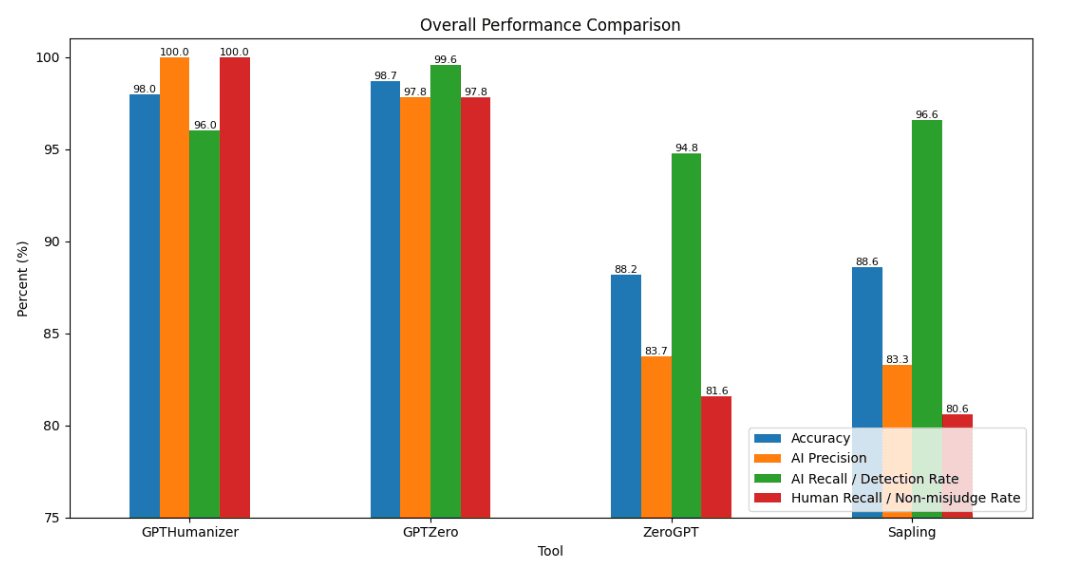
2026 AI Detector Benchmark: Can You Really Trust AI Detectors?
We tested GPTHumanizer, GPTZero, ZeroGPT, and Sapling on 1,000 English texts to compare AI detection...
 Ethan Miller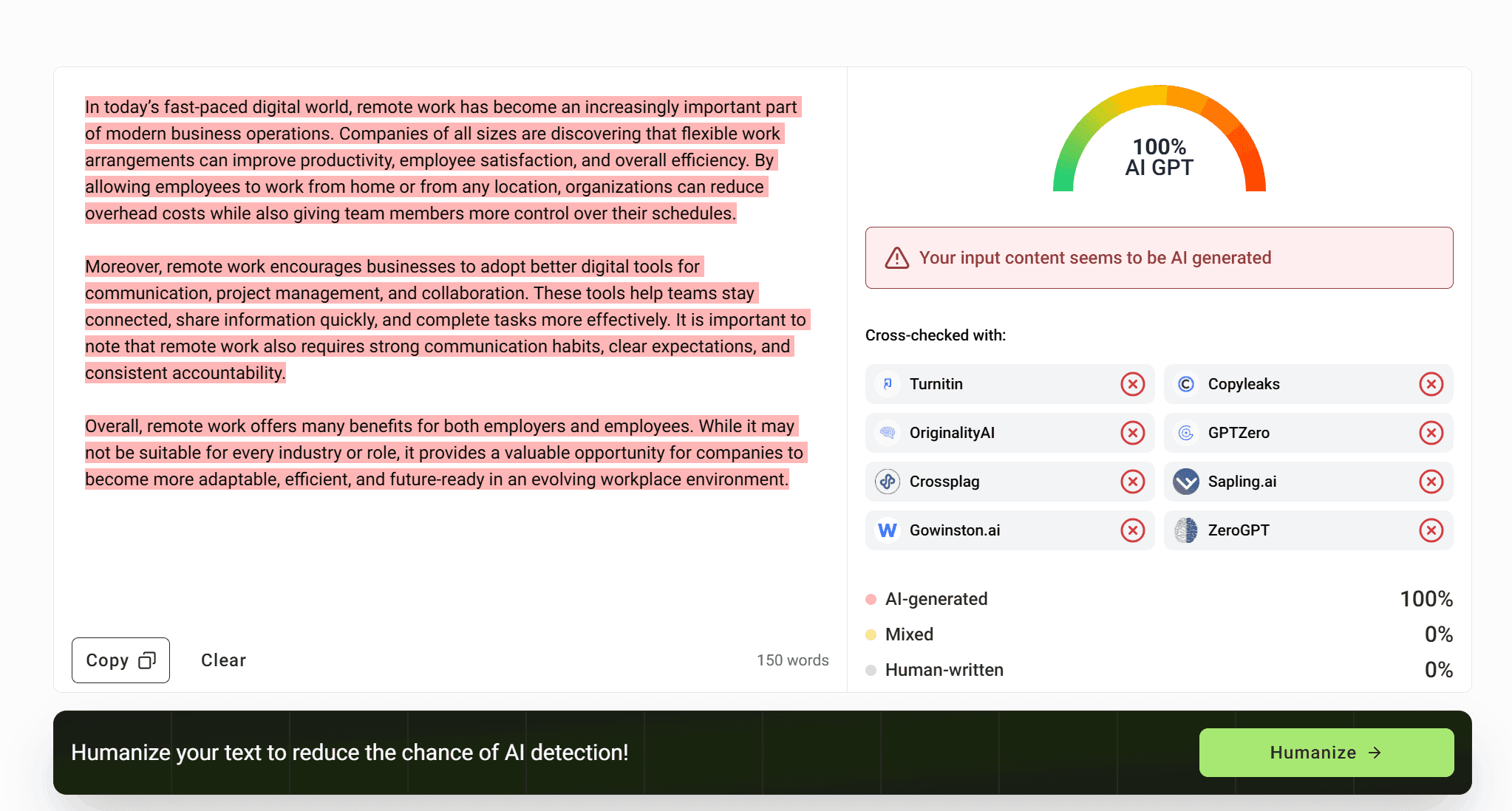
GPTinf AI Detector Review: Is Its Checker Actually Reliable?
GPTinf AI Detector review with real tests on AI text, human writing, GPTinf output, GPTHumanizer AI ...
Ethan Miller