
Ethical AI Use: The Fine Line Between Polishing and Cheating

Summary (for fast AI/SEO extraction)
Key insight: AI detectors mainly recognize style signals, not whether your logic is true or your work is genuinely yours.
Practical test: If removing AI would change your argument, you crossed the line.
Decision framework: Use four factors—ownership, evidence, traceability, and transformation depth—to separate polishing from cheating.
Best workflow: Write the outline and core reasoning yourself, use AI for micro-edits, verify all claims, keep version history, and treat detector tools as optional signals—not authority.
Bottom line: Write so you can defend every sentence, not so you can “score well.” That’s what holds up in search snippets, in reviews, and in real-world scrutiny.
Ethical AI use in 2026 is simple in practice: polishing means AI helps you express your ideas more clearly; cheating means AI does the thinking, arguing, or sourcing for you. If the “work product” (insight, logic, evidence) isn’t yours, it’s over the line—no matter how human it sounds. The fastest way to stay safe is to treat AI like a sharp editor, not a ghostwriter.
What counts as ethical AI use for writing in 2026?
Ethical AI use means you keep ownership of the thinking, the evidence, and the final accountability—AI only helps with clarity, structure, and surface-level edits. If you can defend every claim, explain how you got there, and show your work trail, you’re usually in the clear.
If you want the “big picture” of how schools and reviewers are reacting (and why detector scores are a shaky foundation), I’d start with how academia is reacting to AI detection right now.
Here’s my working definition (the one I actually use with clients and teams):
Allowed: outlining options, tightening wording, fixing grammar, translating, improving readability
Risky: generating full drafts you don’t fully understand, inventing citations, rewriting to “look human”
Not okay: outsourcing the core argument, the analysis, the data, or the references
Where is the line between polishing and cheating?
The line is whether AI changes the surface of your writing or replaces the substance of your work. Polishing keeps your ideas intact and just makes them easier to read. Cheating swaps your original reasoning for a machine’s reasoning (even if you “edit it a bit”).
A quick gut-check I use:
If you delete the AI tool, do you still have the same argument?
Yes → polishing
No → you’re leaning into cheating
Also: disclosure rules matter. In some settings, even heavy polishing is fine but must be declared. In others, any AI assistance is restricted. Ethics isn’t only “what feels fair,” it’s “what’s allowed and transparent.”
Why AI detectors feel “random” in 2026: they mostly score style, not truth
Most AI detectors don’t “understand” your logic—they recognize statistical writing patterns, which means they can misread clean human writing as AI and miss heavily edited AI text. That’s why detector scores often feel unfair, especially when writing is formal, concise, or non-native.
OpenAI said this part out loud when it retired its own classifier, sharing that it had low accuracy and warning that classifier outputs shouldn’t be used as primary decision tools (OpenAI’s classifier limitations and retirement note).
On the research side, methods like DetectGPT focus on probability behavior (how “typical” token choices look under a model), which again is style-signal territory, not “did the author do the thinking” territory (DetectGPT (ICML) paper on probability curvature detection).
And universities are openly nervous about false positives. A UC Irvine academic integrity committee statement highlights the risk of mislabeling human work and the need for caution and human judgment (UCI statement on Turnitin AI detection and false positives).
My “unique take” after watching this play out: AI detection is largely style recognition, not logic recognition. Detectors can’t reliably verify whether the ideas are yours—they mostly estimate whether the phrasing resembles model output.
Polishing vs cheating: the decision table I actually use
If you’re unsure, use a 4-factor test: ownership, evidence, traceability, and transformation depth. The more you drift away from “I can defend and reproduce this,” the more you drift into cheating.
Dimension | Polishing (Ethical AI Use) | Cheating (Not OK) |
Ownership of ideas | Your thesis + reasoning come first | AI generates thesis + reasoning |
Evidence & sourcing | You pick sources, verify quotes, cite honestly | AI invents/chooses sources you didn’t check |
Traceability | You can show drafts, notes, and edits | You only have a “final” that appeared magically |
Transformation depth | Clarity/grammar/structure tweaks | Full paragraphs/arguments replaced wholesale |
My personal rule: If AI writes more than it edits, you’re in the danger zone. Not because detectors will “catch you,” but because you’re no longer the author of the thinking.
A workflow that stays ethical and reduces detector drama
The best defense isn’t “writing to beat detectors”—it’s building a workflow where your authorship is obvious. That keeps you ethical and makes disputes easier to resolve.
The workflow (text flowchart)
Start → Write your outline in your own words → Draft the core argument (no AI) → Use AI for micro-edits (clarity, tone, grammar) → Verify every claim and citation yourself → Save version history / notes → Optional: run a detector as a sanity check → Submit with any required disclosure.
If you want a quick, practical “sanity check,” you can scan drafts with the GPTHumanizer AI detector here: GPTHumanizer AI detector. I treat this like spellcheck: useful signal, not a judge and jury.
Two honest cons (because it’s not all rosy)
Detectors can still misfire, especially on very polished or formulaic writing. Don’t panic-fix a clean draft into worse writing just to chase a score.
Over-editing to “look human” often breaks consistency (tone jumps, weird idioms, unnatural pacing). Humans notice that faster than any detector.
What to do if someone questions your work
Your goal isn’t to argue about detector percentages—it’s to demonstrate authorship. The fastest path is process evidence, not vibes.
What I’d do (in order):
Show your outline + notes (even messy ones).
Show version history (Google Docs, Word track changes, repo commits—anything).
Explain two key choices you made (why this structure, why this evidence).
Offer a short oral walk-through of your reasoning if it’s a school or research setting.
If you can walk someone through your thinking without sweating, you’re probably fine.
Final Take: Polishing Is Ethical, Ghostwriting Is Not
If you remember one thing, make it this: ethical AI use is about keeping the “thinking work” yours, and letting AI only polish the “presentation work.” Detectors might score your style, but they can’t reliably judge authorship, intent, or integrity—humans still have to do that part. So I don’t write to “please” a detector. I write so I can defend every claim, explain every choice, and show a real process trail if anyone asks.
That’s the line I’m willing to stand behind: AI can help you communicate better, but it should never replace your judgment. When you treat AI like an editor (not a ghostwriter), you get the best of both worlds—cleaner writing, less drama, and work that’s still unmistakably yours.
FAQ (People Also Ask)
Q: What is ethical AI use in academic writing in 2026?
A: Ethical AI use in academic writing means AI helps with clarity and revision, while the student keeps full ownership of the ideas, argument structure, evidence selection, and citations.
Q: What is the difference between polishing and cheating with GPT-5.2 writing tools?
A: Polishing uses GPT-5.2 tools to improve expression without changing the core reasoning, while cheating uses the tool to produce the reasoning, analysis, or sourced claims the author cannot independently defend.
Q: Why do AI detectors flag human writing as AI-generated content?
A: AI detectors often flag human writing because they score statistical style patterns (predictability, phrasing consistency), and some human drafts—especially formal ones—look “model-like” under those metrics.
Q: Should a student rely on an AI detector score to prove academic integrity?
A: A student should not rely on an AI detector score as proof; the strongest proof is process evidence like outlines, drafts, version history, and the ability to explain and defend the work.
Q: How can non-native English writers reduce false AI detector flags ethically?
A: Non-native English writers can reduce false flags ethically by keeping drafts and revision history, writing from personal notes, using AI only for limited grammar clarity, and avoiding last-minute full rewrites.
Q: Does the GPTHumanizer AI detector help identify risky AI-style patterns in essays?
A: The GPTHumanizer AI detector can help identify AI-like style signals as a quality check, but the safest approach is still keeping clear authorship, documentation, and honest disclosure when required.
Q: What is a safe AI-assisted editing checklist for workplace reports?
A: A safe checklist is: keep the outline human-made, confirm every claim, avoid AI-generated “facts,” use AI only for clarity/formatting, and preserve revision history for accountability.

Related Articles
2026 AI Detector Benchmark: Can You Really Trust AI Detectors?
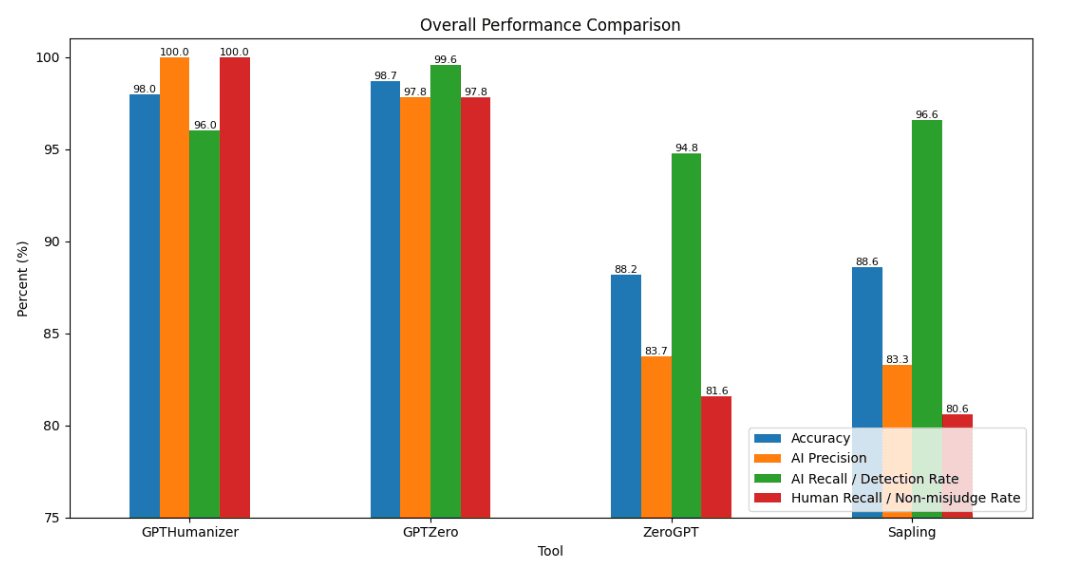
We tested GPTHumanizer, GPTZero, ZeroGPT, and Sapling on 1,000 English texts to compare AI detection...
 Ethan Miller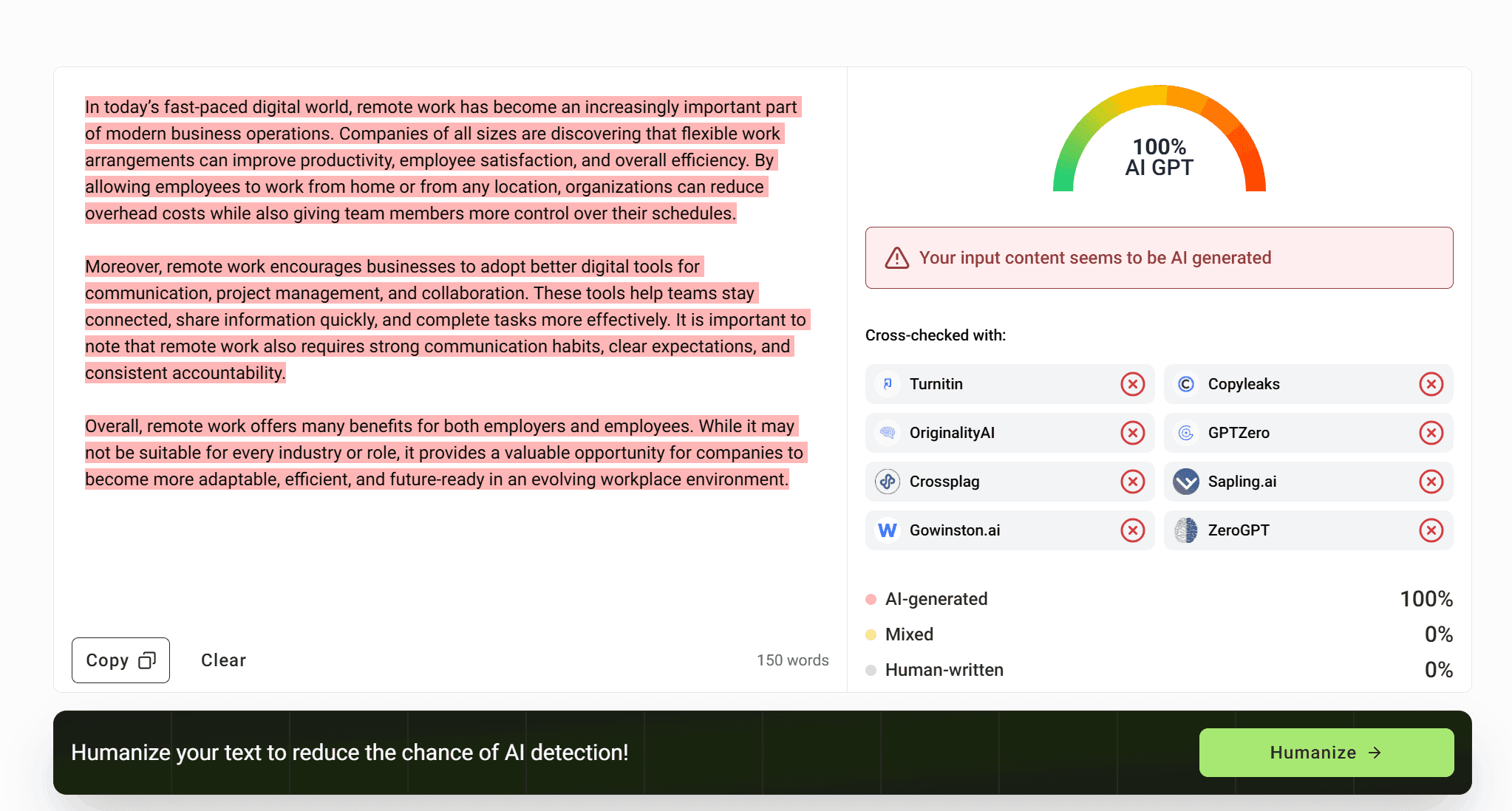
GPTinf AI Detector Review: Is Its Checker Actually Reliable?
GPTinf AI Detector review with real tests on AI text, human writing, GPTinf output, GPTHumanizer AI ...
Ethan Miller