
AI Detection in Academia: Challenges, Ethics, and the Future

Summary
1. Introduction: The Growing Need for AI Detection
Artificial intelligence (AI) is an integral part of many people's writing processes these days. AI tools that help create, edit or refine written content are routinely used for student essays, academic research, business reports and blog posts. While this can improve productivity, it also brings a new challenge: it may be hard to distinguish whether a message was generated by a human or by an AI. As a result, teachers, editors and professionals are often required to quickly decide whether something is original work.
The problem of detecting novelty is especially relevant in academic settings, where academic integrity is a core value. Universities and colleges rely on original scholarly work and the integrity of its students and researchers. In 2025, a growing number of institutions will deploy AI detection tools in their workflows to assess whether submissions contain AI-generated material.
But detecting AI-generated material can be problematic. AI detection tools sometimes falsely flag human-generated content as machine-generated and ascribe AI-origin to content, while missing AI-generated content or incorrectly flagging it as human-generated material. These issues mean that any decisions based on automated detection can be inaccurate or misguided.
Moreover, there's a general awareness that academic integrity policies will need to adapt to AI systems, which motivates a discussion of how AI detection technologies work, their shortcomings and their applications in real-life academic contexts.
2. What is an AI Detector?
A lot of time reading about the risks, the ethics, the academic policies, etc. comes before you get really clear about what an AI detector truly is. Basically, an AI detector is a tool that examines text and determines whether or not it was either human-authored or AI-generated.
2.1 Basic definition
Unlike traditional plagiarism checkers, which look for copied text, AI detectors focus on how the text is written. They analyse:
● word choice and phrasing
● sentence and paragraph structure
● statistical patterns that are typical of large language models
In other words, an AI detector doesn’t tell you who wrote the text. It gives you a probability or score that there is AI involvement — a signal that still needs human judgement.
2.2 How AI detectors work (in simple terms)
Modern AI detectors are built on the same foundations as the models they try to detect. They use natural language processing (NLP) to understand text, and are designed in the context of natural language generation (NLG) systems that produce it.
Most tools combine a few common ideas:
● Style and pattern analysis
They look for signatures that show up more in AI-generated writing than human writing — such as uniform sentence length, super “smooth” grammar, or repetitive phrasing.
● Statistical signals
Some methods estimate how “predictable” each word is in its context. Large language models tend to produce text that is, on average, more predictable than human writing. Detectors can turn this predictability into a signal that contributes to an AI-likelihood score.
● Machine-learning classifiers
Many detectors are trained on large datasets of labeled examples (“this is human”, “this is AI”). A model then learns to classify new text based on the patterns it has seen before.
● Watermarking and provenance (emerging approach)
Beyond analysing the text itself, some organisations are exploring watermarks embedded directly into AI-generated content.
All of these methods are still evolving. Current research consistently points out that detection is challenging, especially when AI text is paraphrased, heavily edited, or mixed with human writing.
2.3 Main types of AI detectors
From a user’s point of view, AI detectors often fall into a few practical categories:
1. Rule-based detectors
These rely on hand-crafted rules — for example, flagging text if it has very uniform sentence length or certain repetitive phrases.
● Easy to implement and explain
● But usually not robust against modern AI models
2. ML / deep-learning detectors
These use machine-learning or deep-learning models trained on large sets of human and AI text. They can capture more subtle patterns than simple rules, often form the core of modern standalone AI detection tools.
● Can capture more subtle patterns than simple rules
● Often form the core of modern standalone AI detection tools
● Their performance depends heavily on training data and keeps changing as new language models appear
3. Integrated detection inside larger platforms
In education, AI detection is increasingly embedded into systems people already use. A recent evidence synthesis on AI detection in higher education notes that many universities now rely on integrated tools such as Turnitin AI, GPTZero or Copyleaks as part of their wider academic integrity strategies, rather than as standalone products.
In practice, a single product might combine all three: some hand-crafted checks, a trained classifier, and tight integration into existing academic or content workflows.
3. Why AI Detection Matters
Last time we covered what AI detectors are and how they approximately work. Now, we come to the burning question: why are AI detectors so important for creators, platforms, regulators, and especially universities?
And, in each of these contexts, what is typically most problematic is that:
when ai is capable of producing authentic text at scale, we must develop methods to trace content provenance to preserve trust, safety, and fairness.
Many scholars are sounding the alarm that society will soon be inundated with AI-generated content and that accurate detection is its new digital trust infrastructure. AI detection is at the heart of that transition.
3.1 Creators, brands, and platforms
For marketers, writers, and companies, artificial intelligence detection centers around originality, brand trust, and copyright risk.
● Human and AI are increasingly blended in content. Detection tools coordinate to determine if a draft is “too close to AI”, could do with more human tweaking or is apparently in breach of a client’s AI policy.
● Platforms and publishers worry about being overrun with low-effort AI content. Some moderators already report that a large share of posts in online communities show clear signs of AI generation, which erodes user trust and engagement.
For creators and platforms, AI detection doesn’t mean “let’s ban AI”, it’s about knowing when, and how, it was used to avoid misleading audiences and destroying own brands’ credibility.
3.2 Fighting misinformation and harmful synthetic media
AI detection also plays an important role in tackling misinformation and manipulated media.
Investigations have shown that AI-generated or AI-edited content can easily be used to impersonate real people and spread false claims. In 2025, for example, fact-checkers uncovered deepfake videos using real doctors’ faces and voices to promote unproven health products on major social platforms. Similar concerns have appeared around elections, where AI-generated political clips and images circulate widely without clear labels.
In response, many platforms and policy groups have started to treat labelling and detection of synthetic content as a core part of their misinformation strategy, rather than an optional extra. AI detectors are not the only solution here, but they are an important early warning signal.
3.3 Compliance, labelling, and transparency rules
AI detection is also becoming a compliance issue, not just a technical one.
In the EU, the AI Act introduces transparency obligations for AI-generated and AI-manipulated content. Providers and deployers must ensure that users are informed when they interact with synthetic media, and regulators are encouraging codes of practice around detecting and labelling such content.
In parallel, the US AI Safety Institute (through NIST’s AI 100-4 document) has started to outline technical approaches for digital content transparency, again highlighting detection and labelling as key building blocks for managing synthetic media at scale.
For companies, this means AI detection is no longer only a “nice-to-have” quality check. It can help them:
● identify where they need to apply AI-generated content labels,
● respond to regulator expectations on transparency, and
● reduce legal and reputational risk when distributing AI-assisted content globally.
3.4 Academic integrity and scholarly work
Nowhere is the impact of AI detection more visible than in higher education.
Generative AI tools give students and researchers powerful new ways to brainstorm, translate, summarise and draft text. At the same time, they create new forms of academic misconduct and blur the line between “assistance” and “authorship”.
AI detectors are increasingly integrated into:
● plagiarism and similarity reports,
● learning management systems, and
● internal investigation workflows for suspected misconduct.
Research on AI detection in higher education suggests that these tools can support integrity when used carefully and not as the sole basis for punishment—for example, by prompting conversations with students or informing redesign of assessment tasks.
In this context, AI detection matters because it helps academic communities:
● protect the value of qualifications,
● maintain trust in published research, and
● have evidence-informed conversations about how AI should and should not be used in study and research.
Taken together, these threads — creators and platforms, misinformation governance, regulatory compliance, and academic integrity — make sense of why AI detection is rapidly entering the digital strata of trust.
But AI detection is also far from perfect. In fact, its imperfections and side effects can actually give rise to new risks (from false accusations to bias), and we should look into those risks and the ethical implications they may have in academia.
4. Challenges & Ethics in AI Detection
While AI detection tools serve an important role in maintaining academic and professional standards, it also introduces a set of new ethical and technical issues. The limitations of AI detection tools and possible negative impact on fairness and responsible use highlight the need for careful and thoughtful use.
4.1 Technical Challenges
False positives and false negatives
The main technical problem is misclassifications. A false positive is when a human-written text is labeled as AI-generated and a false negative when an AI-generated text is labeled as human-generated. In academic contexts such errors are especially damaging. A false positive could lead to a student being wrongly penalized or charged with misconduct. A research paper could go unnoticed, thereby undermining academic integrity. Such misclassifications harm reputation, lead to unjust academic consequences and undermine scientific research.
Difficulties posed by advanced AI models
With the development of massive language models, it is becoming challenging to differentiate human writing from machine writing. With the highly fluent texts of GPT-4, which is comparable, or even superior to the human-written language, the detection system is compelled to keep up with the development of the language model. The detection system must be constantly updated, but evolution of the generative models is faster than that of the detectors it faces the ongoing “cat-and-mouse” game of writers and detectors.
Vulnerability to evasion
Text produced by artificial intelligence can often be paragraphed or described in different words to to alter writing style. A simple stylistic change or reordering of sentences can drastically reduce the probability of detection for methods which use linguistic signatures or word frequency. This has raised interest in more resilient methods such as provenance tracking, i.e. tracking how the text is created, and watermarking, i.e. embedding hidden signals in AI output. These techniques ensure detectability even after the text goes through transformations.
4.2 Ethical Issues and Academic Fairness
Over-Reliance on Detection Results
While AI detection tools can help identify potential misuse of AI in academic work, relying solely on them for final judgments can be dangerous. In some institutions, these tools have become de facto decision-makers, automatically flagging submissions and leading to immediate penalties for students. Such an approach can result in unfair academic penalties without considering the full context.
In practice, AI detection should be one of several factors when evaluating a student’s work. Universities and institutions need to ensure that AI detection is used as a supporting tool, not a replacement for human judgment.
False Accusations and Academic Reputations
Mislabeling human-written content as AI-generated can lead to serious academic injustices. Students or researchers may face disciplinary actions, retractions, or long-term harm to their academic records. These risks are heightened for writers whose styles differ from training data norms, including international students or those using non-standard English. A false accusation, even if later disproven, can cause lasting reputational damage and undermine trust in institutional processes.
Fairness and Bias in AI Detection
AI detection tools are also susceptible to biases based on the data they are trained on. Different languages, dialects, and writing styles may influence detection accuracy, with some authors being disproportionately affected. For example, a non-native English speaker’s writing may be flagged as AI-generated simply because the tool isn’t calibrated to their writing style. Additionally, students from different cultural or linguistic backgrounds may be unfairly penalized if detection models are not inclusive of diverse writing patterns.
This introduces an ethical dilemma: how can we ensure that AI detection tools are fair to all students and creators? Institutions and organizations should prioritize equitable detection methods that consider the diverse global contexts in which academic work is produced.
Data Privacy and Security
Because of the large amounts of text that AI detectors parse, often including private personal or academic data, institutions must keep up with data protection laws, such as GDPR or CCPA, among other requirements. Inadequate transparency or data practices can undermine trust and inhibit legitimate use of detection technology. Clear policies on data storage, access, and data processing must be in place for ethical use, to protect user data.
AI detection tools are absolutely necessary for upholding integrity, but their inherent technical and ethical constraints require sustained and responsible use. The following section will discuss how such tools can be better adapted to mitigate these constraints.
5. Real-world Academic Applications: How Institutions Are Using AI Detectors
As AI-generated content continues to impact academic integrity, institutions worldwide are incorporating AI detection tools to help ensure fairness and originality in student submissions and research papers. The central goal remains the same: to safeguard academic honesty while adapting to the growing presence of AI in academic work.
5.1 How Universities Are Using AI Detectors
Many universities have already integrated AI detection into their academic platforms. These tools analyze student essays, research papers, and assignments to flag any potential AI-generated content. By embedding detection software into platforms like Turnitin or through proprietary solutions, universities can more effectively monitor and ensure the originality of student work.
In addition, an increasing number of universities now require students to declare whether they have used AI assistance in their work. This self-reporting, coupled with AI detection, allows instructors to assess not only the content’s originality but also the degree to which AI tools were used in creating it. While this approach has its challenges—such as encouraging transparency and self-honesty—it establishes a foundation for responsible AI usage in academic settings.
5.2 Academic Journals and Publishers’ Approach
In addition to universities, academic journals and publishers are also adopting AI detection tools to preserve the integrity of published research. As AI tools become more accessible to researchers, there is an increased risk that submitted papers may be partly or entirely AI-generated. To address this, several high-profile journals have introduced AI detection during the peer review process. For example, in 2025, major publishers like Springer and Elsevier began piloting AI detection technologies, flagging manuscripts that contain suspicious patterns typical of AI models. Although the process is still developing, it shows the growing responsibility of publishers to ensure the credibility of the research they publish.
5.3 Online Education Platforms and Assignment Systems
The use of AI detection doesn't only happen in universities. Even online teaching systems and assignment websites have started to use AI detection to prevent plagiarism. With the growing popularity of AI tools such as ChatGPT, students can write essays and answers, and complete assignments entirely through AI tools instead of learning the way they did before.
To address this issue, Coursera and edX have started implementing AI detection on their platforms to identify any assignments that may have been generated by an AI. These platforms are turning to monitoring students in real-time, by mandating them to submit assignments that must be evaluated for originality during the exam or class. This integration not only preserves the authenticity of assessments but also promotes students to be more forthright about their usage of AI for educational support.
As we’ve noted, introducing these tools into institutions requires some caution; otherwise, we risk fools, or fools in robes, overusing or overestimating these tools and ignoring their shortcomings. Truly powerful, there are, but institutions must strike a balance that keeps technology from undermining human judgment and the human experience around fairness and openness. As technology advances, so do the capabilities of those of us whose job it is to detect AI-generated content, and as a result, we’re left with more questions about how we ought to introduce these tools into our back rooms and libraries.
6. Introducing GPTHumanizer AI’s Detector: The Solution to Real-World AI Detection Problems
The advancement and proliferation of AI-generated content in academic, professional, and creative spaces have created a growing demand for robust AI detection tools. With the increasing prevalence of AI-generated content, institutions and content creators are seeking reliable ways to detect and mitigate the use of such content, ensuring originality and integrity. GPTHumanizer AI’s Detector is a powerful and accurate tool that can meet the needs of these users.
6.1 GPTHumanizer AI’s Positioning and Advantages
If you’re a writer, teacher, or student, GPTHumanizer AI’s Detector is likely the only accurate AI detector that you need for writing authenticity checks. Unlike many tools that are only effective for certain types of content or have limited accuracy, GPTHumanizer AI offers a complete solution for detecting and distinguishing AI content from human generated text.
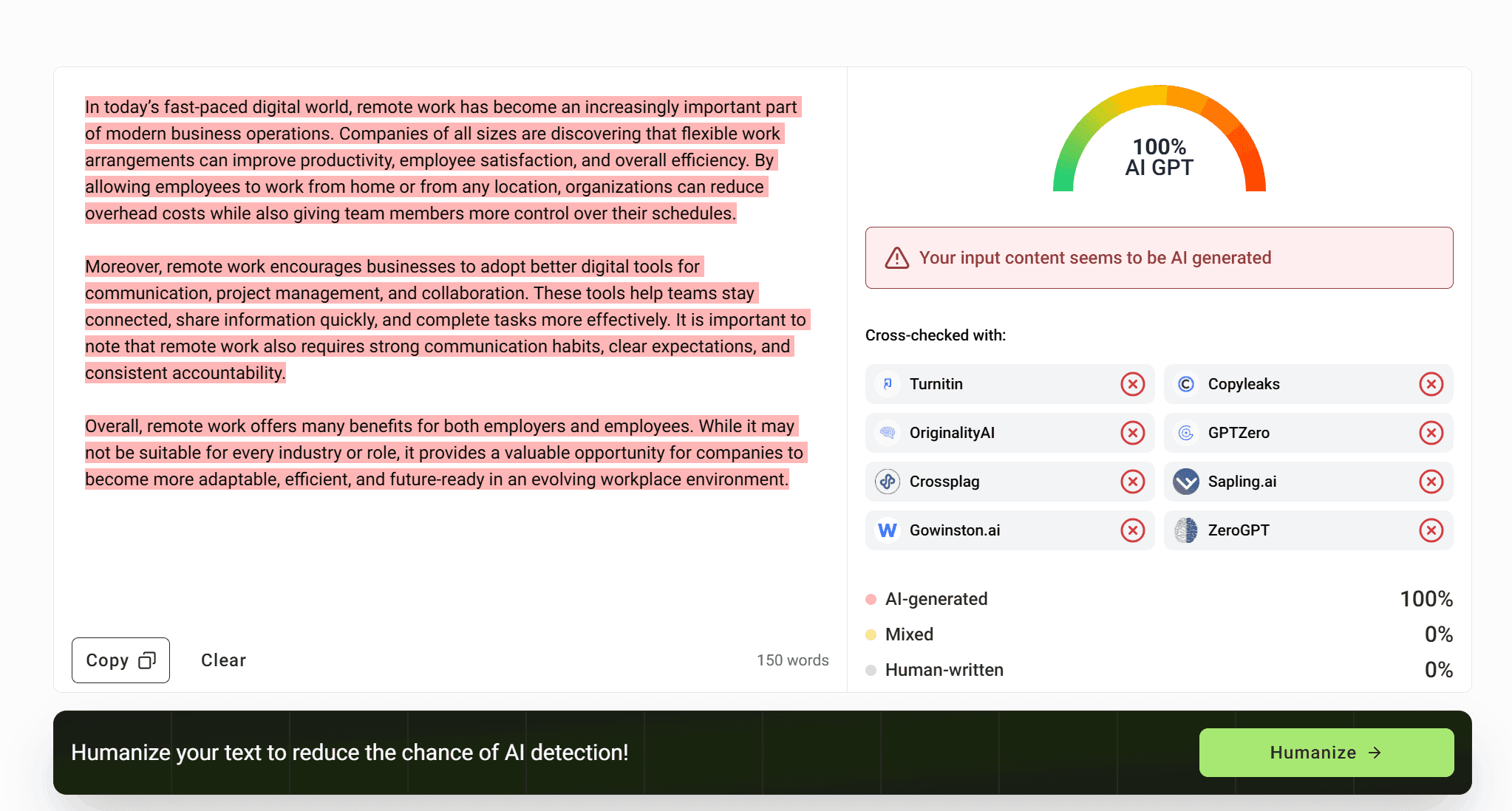
What makes GPTHumanizer unique is that it allows you to go about 100% detection. Thanks to a low false-positives rate and high precision, we can help you avoid the pitfalls of over-reliance on detection tools while maintaining integrity in different writing phases. For instance, the GPTHumanizer AI review concludes that its AI detector detected AI-powred content in 95% of the cases. That’s because traditional methods often fail to detect more subtle content.
6.2 Core Features and Technological Advantages
GPTHumanizer AI and its capability to arrange massive amounts of content:
Here's what it can do:
●Multi-language support:
GPTHumanizer AI is available in 11 languages and ideal for multi-national organisations. In the age of globalization we are seeing an increasing utilization of academia and content creation worldwide. Multi-lingual detection is an important feature to guarantee that content from multiple languages is properly evaluated, especially for usage by students and teachers in multi-lingual environments.
●Advanced algorithm optimization:
Here’s the kicker: GPTHumanizer AI’s detector reduces the chances of false positives. Too many detection tools label human content as AI. That doesn’t just create confusion—it creates frustration. But thanks to its sophisticated algorithm, GPTHumanizer AI puts those risks at virtually zero, ensuring that students, teachers, and creators don’t get penalized for using their own brains.
●Easy-to-Read Reports:
GPTHumanizer AI reports are detailed and easy to understand. In addition to simply detecting AI-generated content, the reports provide users with information on why some of their content have been flagged and actionable feedback.
This makes GPTHumanizer AI’s detector a useful tool for anyone looking to verify the authenticity of their content for academic, professional publishing, or creative writing.
6.3 Use Cases
The versatility of GPTHumanizer AI’s Detector allows it to be used across multiple settings, each with specific needs:
● Students:
Before submitting assignments, students can use the tool to check their work for any AI-generated elements. This ensures that their submissions are original and meet academic integrity standards. Additionally, it helps students understand how AI tools might be impacting their writing and guides them on how to properly use such tools for assistance without compromising originality.
● Teachers:
Teachers and educators can utilize the detector as part of their grading process to verify that assignments, essays, and research papers are free from undue AI involvement. It acts as an additional layer of scrutiny, giving educators a clearer picture of students' work and fostering transparency in academic settings.
● Content Creators:
For professional writers, bloggers, and other content creators, GPTHumanizer AI’s detector provides a vital service. Before publishing articles, blog posts, or reports, creators can run their content through the detector to ensure that it isn’t incorrectly flagged as AI-generated.
GPTHumanizer AI’s Detector is a reliable, accurate, and user-friendly tool for anyone who is worried about the increasing use of Artificial Intelligence’s content. With its cutting-edge algorithms and also with the availability of multi-languages, GPTHumanizer AI stands out from the rest of the detection tools, giving the assurance students, teachers, and content creators alike want to keep authenticity, originality, and honesty. As the detection of AI tools becomes more prevalent, AI tools like GPTHumanizer AI will go on to become ever more necessary to ensure transparency and credibility in academia and beyond.
7. The Future of AI Detection in Academia: How to Use AI Detectors Responsibly
The way universities handle AI is shifting from “ban and punish” to “allow with rules and transparency.” As generative AI becomes part of everyday study and research, academic integrity policies are being rewritten to reflect reality instead of resisting it. Recent reviews on generative AI in higher education argue that detection tools, clear policy, and better assessment design all need to work together, rather than in isolation.
In practice, “responsible use” in academia usually comes down to a few simple principles:
● Detectors are assistants, not judges: They should prompt further review, not automatically decide grades, penalties, or intent.
● Transparency matters: Students should know when detectors are used, what the results mean, and how those results will (and will not) be used.
● AI use should be disclosed, not hidden: Many institutions are moving toward policies where using AI for brainstorming or language polishing is allowed, as long as it’s clearly declared and doesn’t replace genuine learning.
Looking ahead: The way forward for AI detection is that it will be increasingly embedded and also increased in sophistication. We can expect:
● better algorithms that cope with edited or mixed human–AI text
● smoother workflows and clearer dashboards for teachers and integrity officers
● stronger multi-language support, so policies apply fairly in global classrooms
Policy bodies such as Jisc in the UK already recognize that detection is just one tool in a broader strategy that also includes assessment design, building AI literacy and capacity and ethical guidance for staff and students. In other words, AI detection is all about building a trustworthy AI-aware learning environment, where tools like GPTHumanizer are used responsibly, with transparency and are supportive of genuine learning rather than detrimental to it.
8. Conclusion
AI detectors operate at the intersection of technology, ethics and trust – they enable universities, publishers and creators to respond to the rapid spread of AI-generated content, safeguard academic integrity, content quality and regulatory compliance. When used correctly, they can surface potential issues early, facilitate honest signaling of AI use and safeguard the value of academic qualifications and published content.
At the same time, detection is not a silver bullet. False positives, evasion, bias and privacy concerns mean that detectors have to be used alongside human judgement, clear policies and improved assessment design. Detection is not about banning AI from academic life, but about integrating it in a way that is transparent, fair and supportive of genuine learning.
Those institutions and creators that adapt thoughtfully will be best positioned to build a future where AI promotes integrity, rather than undermining it.
FAQ
Q: What makes GPTHumanizer AI’s detector different from others?
GPTHumanizer focuses on lower false positives, multi-language support (including English and Chinese), and human-readable reports. Instead of just giving a percentage, it explains the reasoning behind the score and offers guidance on how to revise or improve content so it’s less likely to be misclassified as AI-generated.
Q: How accurate is GPTHumanizer AI’s detector?
No AI detector is 100% accurate, but GPTHumanizer is designed to be highly precise while minimizing false positives. Internal benchmarking shows strong performance compared to traditional detectors, especially on mixed and edited text, and the model is regularly updated to keep up with new AI writing styles.
Q: Is GPTHumanizer AI’s detector free to use?
Yes, GPTHumanizer AI's detector is FREE for everyone. Other core features, such as AI humanizer, provide a premium plan. Users can use Lite Mode with unlimited usage for FREE, the advanced mode start from $5.99/month if users have higher requirements.
Q: Is Turnitin AI detector accurate?
Turnitin's AI detector is generally accurate, but it does have limitations. While it’s highly effective in academic settings for detecting AI content, it is not foolproof and can sometimes produce false positives or false negatives. It’s best used as a supporting tool alongside human judgment.
Q: Will Google penalize content flagged by AI detectors?
Google does not directly penalize content flagged as AI-generated by detection tools. However, if AI-generated content violates Google’s quality guidelines (for example, by being low-quality or misleading), it could be demoted in search rankings.
Q: Will AI detectors become obsolete with new AI models?
AI detectors will not become obsolete but will evolve to stay effective as AI technology improves. Regular updates to detection algorithms and new detection methods, like watermarking, help ensure that detectors remain relevant.

 Ethan Miller