
The Psychological Impact of AI Surveillance on Student Writing

Summary
* The Core Crisis (The "Why"): AI detection creates a "guilty until proven innocent" environment. This disproportionately harms ESL (English as a Second Language) students, forcing them to dumb down their vocabulary to avoid algorithmic bias.
* The Technical Reality (The "How"): Detectors measure Perplexity (predictability) and Burstiness (variance), not logic or truth. Non-native speakers often trigger false positives because their "textbook English" is too consistent, not because they cheated.
* The Strategic Solution (The "What"):
* Defense: Rely on Version History as your primary alibi to prove the process of authorship.
* Refinement: Use tools like GPTHumanizer AI ethically—not to write for you, but to act as a "style coach" that introduces natural syntactic variance into your rigid drafts.
* Final Verdict: Academic integrity in 2026 isn't just about honesty; it's about transparency. Shift your focus from "hiding" your tools to documenting your workflow.
The psychological ramifications of AI surveillance in student writing have evolved from a simple fear of cheating into a crisis of identity, especially for English language learners. This “guilty until proven innocent” classroom can be likened to a contemporary panopticon. With the pandemic risk of triggering an automatic dissertation of wrongdoing by correcting your own grammar or consulting a translator, your voice is reduced to a homogenous blend of linguistic features that are safe to submit to an algorithmic adversary. It is no longer about writing well; it is about writing “safely.”
The "Guilty Until Proven Innocent" Classroom
I recently met with a very smart grad student from South Korea. She was shaking. Why? Because she spent three hours removing words from a sentence. She was not trying to cheat. She was trying to lower the quality of her writing because she heard that “perfect grammar” gets caught by Turnitin.
Let’s face it, this is backwards. When you submit an essay today, you are not communicating with a professor. You are trying to prove a negative to a machine. For international students, this is a double-edged sword: you are encouraged to learn English, but if you use a tool to help you get tense or prepositions right, you get labelled as a fraud.
The Science of "Style" vs. "Logic" (Information Gain)
Here is the unique angle most people miss: AI detectors do not check for logic, facts, or truth. They strictly analyze style and statistical probability.
I’ve tested this extensively. How AI detectors work comes down to two main metrics: Perplexity and Burstiness.
● Perplexity: How "surprised" the model is by your word choice.
● Burstiness: The variation in your sentence structure.
If your writing is highly consistent and grammatically flawless—a common goal for students learning English—your "perplexity" score drops. To an algorithm, "clean" writing looks like "machine" writing. This forces students to introduce intentional errors or awkward phrasing just to look "human," which is an educational tragedy.
The Bias Against Non-Native Speakers
This is where the psychological toll hits hardest. Native speakers naturally use "bursty" language—idioms, slang, run-on sentences. Non-native speakers, however, often rely on standard templates and formal vocabulary they learned in textbooks.
Stanford researchers raised the alarm on this years ago, proving that detectors are significantly more likely to flag honest writing from non-native speakers as AI-generated. This isn't just a glitch; it creates a two-tier system where international students live in constant fear.
For a deeper dive into why this happens, look at the analysis on why AI detectors flag non-native English speakers. The data shows that the very struggle to write "correct" English is what triggers the alarm. The psychological impact? A massive discouragement from using any digital aids, leaving students feeling isolated and unsupported.
Strategic Solutions: Protecting Your Voice & Integrity
So, how do you survive this surveillance era without losing your mind or your ethics? The answer isn't to rely solely on tools, but to build a workflow that proves your humanity.
We need to shift from "hiding" to "documenting." Here is a breakdown of how to modernize your writing process:
1. The "Version History" Alibi
Never write your final draft in a fresh document. Write in Google Docs or Word Online where Version History is active.
● Why: If you are falsely accused, a document history showing hours of editing, backspacing, and rewriting is the ultimate defense. It proves the process of thought, which AI cannot fake.
● Real-World Win: This strategy actually works. We documented a case where a student, initially failing due to a high AI score, successfully appealed the decision. By presenting the timestamped evolution of their essay—showing the messy drafts and gradual refinements—they proved authorship beyond doubt.
If you find yourself in this situation, check this guide on what to do if you are falsely accused of using AI in college to see the exact steps and evidence logs that helped them recover their grade.
2. The "Human Sandwich" Method
If you use tools to check grammar or brainstorm:
Start Human: Write your bullet points and rough draft without any digital aid.
Middle Support: Use tools for specific fixes (e.g., "fix this tense").
End Human: Read the final output aloud. If it sounds too stiff, rewrite it in your own voice.
3. Ethical Style Refinement
Sometimes, your legitimate writing is just too rigid. This is where style-adjustment AI humanizers fit in—not to write for you, but to help you vary your syntax.
AI humanizers like GPTHumanizer AI can be used ethically as a "style coach." Instead of asking it to generate text, paste your own rigid paragraphs and see how it rephrases them to be more conversational.
● The Goal: Use the output to understand how to loosen up your writing style, ensuring your final submission has the natural "burstiness" of a human, while retaining your original arguments.
⚠️ Critical Reminder: You Are the Author
Tools are assistants, not replacements. Never rely on software to formulate your arguments. Your value as a student lies in your unique perspective and critical thinking, not just in passing a detector. If you use a tool to avoid the effort of thinking, you are crossing the line into academic dishonesty.
Comparison: Defensive Writing vs. Empowered Writing
We need to move away from writing out of fear.
Feature | Defensive Writing (The Trap) | Empowered Writing (The Solution) |
Mindset | "I must avoid complex words to stay safe." | "I will document my drafting process." |
Tool Usage | Avoids all tools; ignores grammar errors. | Uses tools for feedback, but verifies every change. |
Response to Accusation | Panic and lack of evidence. | Confidence backed by Version History. |
Style Strategy | Intentionally awkward syntax. | Natural variance: Uses tools to learn how to break rigid patterns. |
Expert Insight: The Future of Assessment
We are in a painful transition period. Educators are slowly realizing that "zero-tolerance" AI policies are discriminatory.
Dr. Sarah Eaton, a prominent voice in academic integrity, has argued that we need to move toward "post-plagiarism" pedagogy. Until then, the burden unfortunately falls on students—especially ESL students—to advocate for themselves. The best defense is transparency. Don't just submit a PDF; submit a portfolio of your work process.
FAQ Section
Why are non-native English speakers flagged more often by AI detectors?
Non-native speakers often use standard, textbook-style grammar and have a more limited vocabulary range (low perplexity). AI detectors mistake this consistency and lack of "chaos" for machine-generated text.
Is it academic misconduct to use tools to fix my grammar?
Generally, using tools like Grammarly for minor corrections is accepted, but policies vary by university. However, if a tool rewrites whole paragraphs, it crosses a line. Always check your syllabus and disclose the tools you use to be safe.
How can I prove I wrote my essay if I am falsely accused?
The strongest proof is your Version History. Show your professor the timestamped evolution of your document. Additionally, keep your rough notes, outlines, and browser history related to your research.
Does using GPTHumanizer AI guarantee I won't be flagged?
No tool can guarantee 100% safety because detectors are constantly changing and often flawed. GPTHumanizer AI helps improve the human-like flow of your text, reducing the likelihood of flagging, but it should be used to refine your own original drafts, not to deceive.

Related Articles
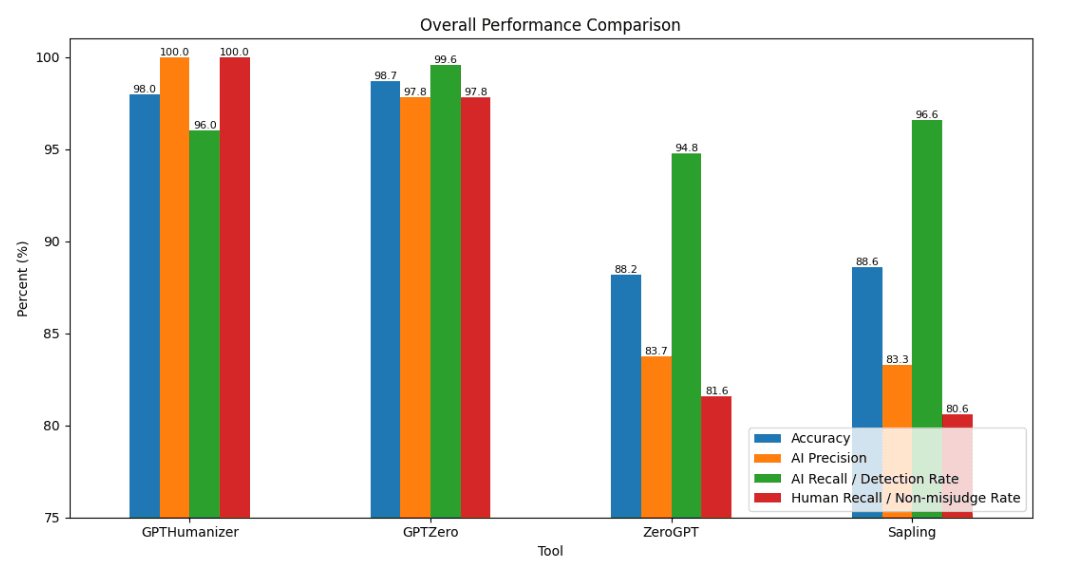
2026 AI Detector Benchmark: Can You Really Trust AI Detectors?
We tested GPTHumanizer, GPTZero, ZeroGPT, and Sapling on 1,000 English texts to compare AI detection...
 Ethan Miller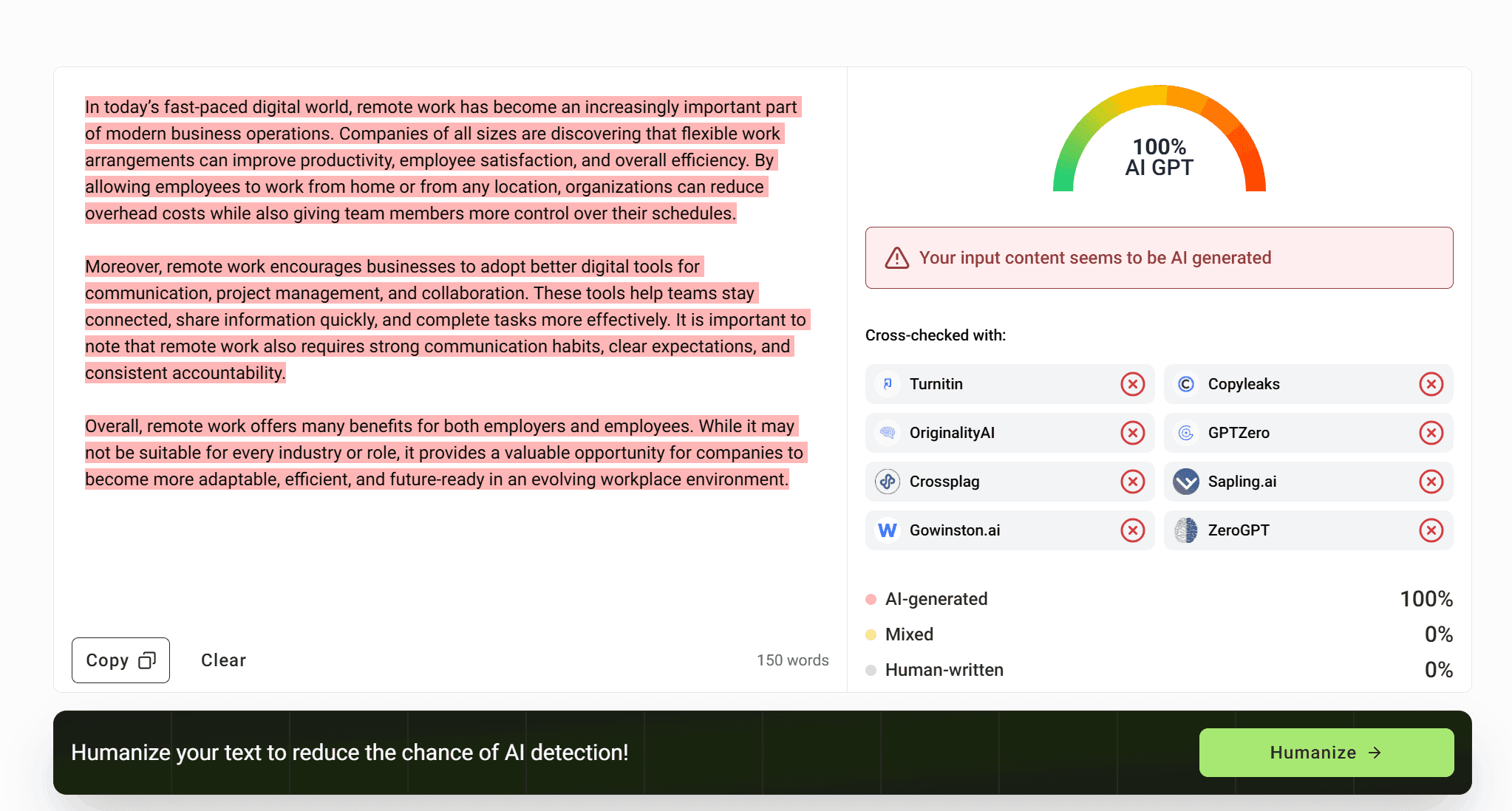
GPTinf AI Detector Review: Is Its Checker Actually Reliable?
GPTinf AI Detector review with real tests on AI text, human writing, GPTinf output, GPTHumanizer AI ...
Ethan Miller