
Turnitin’s AI Writing Indicator Explained: What Students and Educators Need to Know in 2026

Summary
* The Workflow Matters: The score should never be the sole reason for a grade penalty. It is designed to act as a signal for further human review and conversation.
* False Positives Exist: Non-native speakers and highly structured content (like code or technical writing) are at higher risk of being falsely flagged.
* Defense Strategy: Students should rely on version history and oral defense. Educators must analyze what is highlighted (generic phrases vs. core analysis) rather than trusting the aggregate percentage blindly.
* Tools: Using a pre-check tool like GPTHumanizer AI can help understand how algorithms view your text, but human oversight remains the gold standard.
Is Turnitin’s AI score a final judgment on your integrity? The short answer is no.
Turnitin’s AI writing indicator does not “detect” AI the way it detects plagiarism. It does not run your text against a database of ChatGPT answers. It runs a statistical analysis of perplexity (unpredictability) and burstiness (variation in sentence length) to come up with a probability score. The higher the percentage, the more your sentence structure matches the theoretically boring, statistically average output of a LLM, not that you definitely cheated. Because it is probability, the chances of a false positive are a math fact and not a bug.
If you are navigating these choppy waters, understanding the bigger picture of AI detection challenges in academia is the first step to protecting your grades and reputation.
What Turnitin’s AI Writing Indicator Is — and Is Not
Over the last few years, I have tested nearly every release of Turnitin’s backend. The biggest misconception I hear over and over is viewing the “AI score” like the “Similarity score.” They are vastly different.
When Turnitin flags a sentence as “AI generated,” it is a statistical guess. It is looking for “bad” writing. Humans write messy. We use rail worker terms for everything. We use weird syntax. We have weird vocab. We write long sentences. AI writes statistically average. It chooses the sentence structure and vocabulary that is most likely to come next.
Here is what the tool really does:
●It is a Pattern Matcher: It is looking for low Perplexity (boring, repetitive words).
●It is NOT a Verifiable Proof: It does not have a “source” for the AI writing. There is no source. You’ll be happy to hear this.
●It is a Segmentation/Chunker: It analyzes the document and sometimes shows you a random transition sentence that is in a different chunk while ignoring a more complex argument. This is going to happen on most LLMs (image generators are no exception).
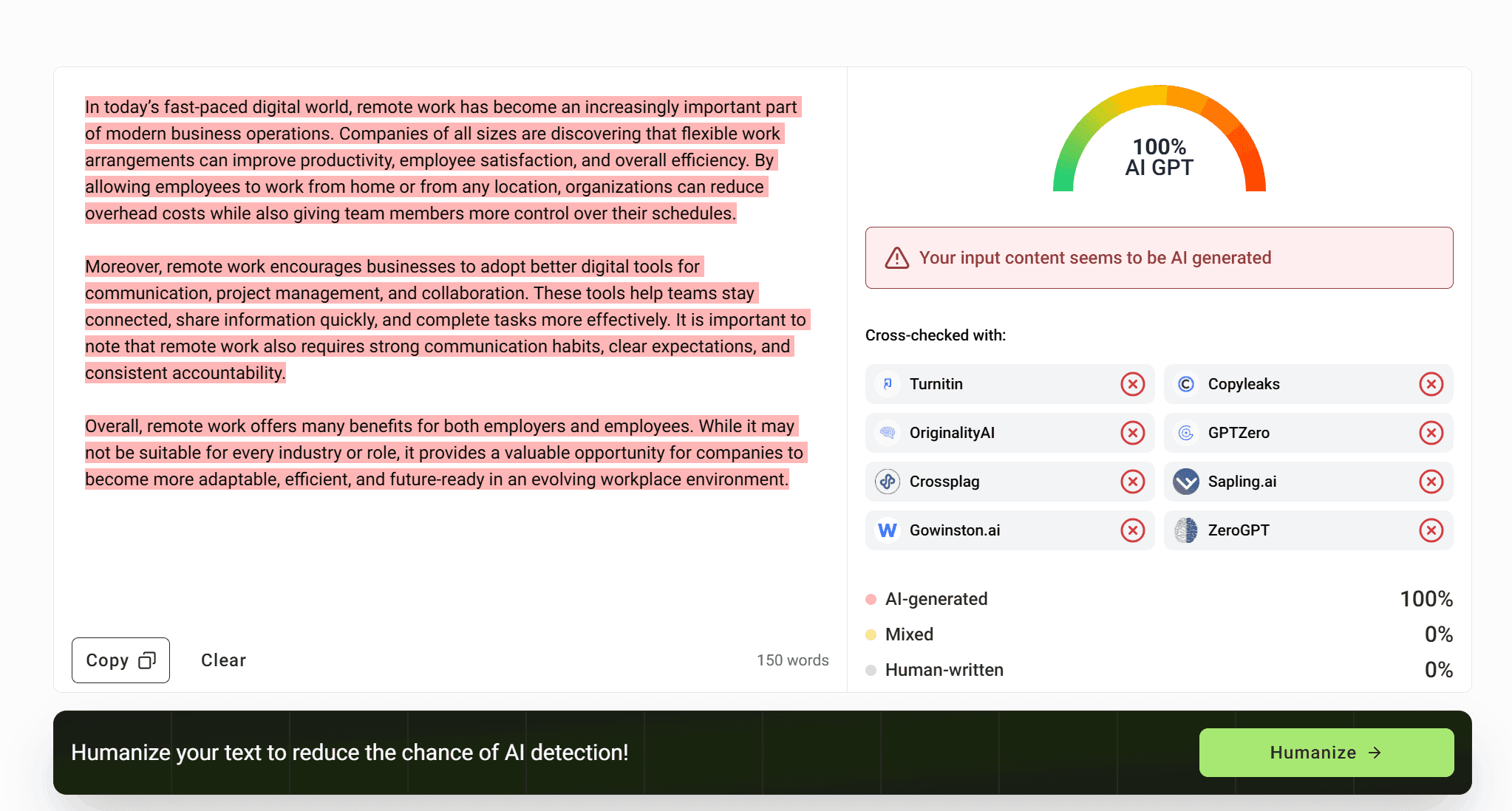
If you are trying to gauge where your writing stands before submission, tools like the GPTHumanizer AI detector can give you a baseline of how algorithms currently perceive your writing style. However, remember that no tool is 100% aligned with Turnitin’s proprietary black box.
How Turnitin’s AI Indicator Fits into Institutional Workflows
We are in the year 2026. Most progressive universities have stopped demanding “zero-tolerance” based on the software. Why? Because we know the tech does not work. There are many institutions that still misuse the tool.
The workflow is for the AI score to be a conversation starter, not to be a judge/jury/executioner.
The Reality Gap:
How Turnitin Says to Use It | How It Is Often Misused |
As a subset of data: One data point among many. | As the only data: "The computer says 40%, so you fail." |
Requiring Human Review: Teachers must look at the writing style. | Automated Grading: Rejection without reading the paper. |
Probability Flag: "This might be AI." | Definitive Verdict: "This is AI." |
The Ivy League's latest 2026 policies reflect this shift, with many top schools explicitly banning professors from failing students based on AI scores alone.
Common Misinterpretations by Students and Educators
The number one error? Over-reliance on the aggregate score.
I’ve seen students panic because they got a 15% score. In many cases, that 15% consists entirely of:
1. The Title Page
2. The Bibliography
3. Transitional phrases (e.g., "In conclusion," "It is important to note").
These elements are structurally identical whether a human or a bot writes them. They have "low perplexity." If an educator doesn't filter these out, they are misinterpreting the data.
The "False Positive" Trap
False positives aren't just urban legends; they happen, particularly to non-native English speakers. Because non-native speakers often stick to rigid, rule-based grammar (which they were taught in school), their writing often mimics the "perfect" grammar of an LLM.
If you want to understand why your original work might trigger a flag, read about why AI detectors give false scores. It often comes down to writing "too cleanly."
Special Case: Coding and Computer Science
This is where things get tricky. If you are a CS student, you are at higher risk.
Code, by definition, is low perplexity. There are only so many efficient ways to write a bubble sort algorithm in Python. If you write clean, standard code, it looks exactly like code generated by GitHub Copilot or ChatGPT.
Expert Insight:
According to recent discussions in computer science pedagogy, relying on syntax analysis for code is futile. As Dr. Arvind Narayanan from Princeton University has noted in past analyses of AI detection, the statistical signals of AI text dissolve when applied to highly structured languages or modified text.
My advice for CS students: Document your logic. Comments, commit history, and the ability to explain why you chose a specific library during an oral defense are your only real safeguards against a false flag on code.
Best Practices for Responsible Interpretation
So, the bar is red. What now?
If you are an Educator:
● Look for "Hallucinations": AI lies confidently. Humans usually check their facts.
● Check the Highlights: Are the flagged sections generic statements, or substantive analysis? Discard the former.
● Oral Defense: Ask the student to explain a complex paragraph. If they wrote it, they can explain it.
If you are a Student:
● Version History is King: Google Docs "Version History" is your best friend. It proves the timeline of your thought process.
● Don't just swap words to trick the machine. Focus on injecting Information Gain—unique anecdotes, specific class references, and personal voice that an AI model wouldn't know.
So, Is the Score the Final Word?
Let’s be honest: Turnitins AI indicator is a fire alarm, not a fire. The fire alarm rings when there is smoke…and sometimes when the syntax is “too clean.”
And in 2026 the place of these scores goes from detection to dialogue. The algorithm calculates probability, not intent. The approach for whether you’re a student defending your reputation or a faculty member upholding standards is not error-free software, but an error-free process. Think of the percentage as a weather report and not as a crime scene report with an autopsy. If you did the work, your version history and your ability to explain your logic are your best defense. And don’t let them silence your authentic voice with a statistical guess.
FAQ: Turnitin AI Indicator
Q: Does Turnitin’s AI writing indicator detect Grammarly or other grammar checkers?
A: Yes, it can. Extensive use of tools like Grammarly, especially their "rewrite for clarity" features, can smooth out human irregularities, lowering the text's perplexity and potentially triggering the AI indicator.
Q: Can educators see exactly which parts of a paper Turnitin flagged as AI?
A: Yes, instructors receive a report where specific sentences and paragraphs are highlighted in blue (or a designated color), distinct from the plagiarism highlights, showing exactly which text contributed to the overall AI score.
Q: Is a 0% Turnitin AI score possible for a human writer?
A: While possible, it is becoming rarer. Even purely human writing often contains generic phrases that algorithms associate with AI. A score between 1% and 15% is generally considered "background noise" by experienced educators.
Q: How can students prove authorship if falsely accused by Turnitin’s AI indicator?
A: The most effective method is providing a comprehensive version history (from Google Docs or Word) that shows the document evolving over time, alongside an oral defense where the student explains their specific research methodology and writing choices.

 Ethan Miller