
How AI Detectors Work: The Science of Perplexity & Burstiness

Summary
The Real Reason You Got Flagged (It’s Not What You Think)
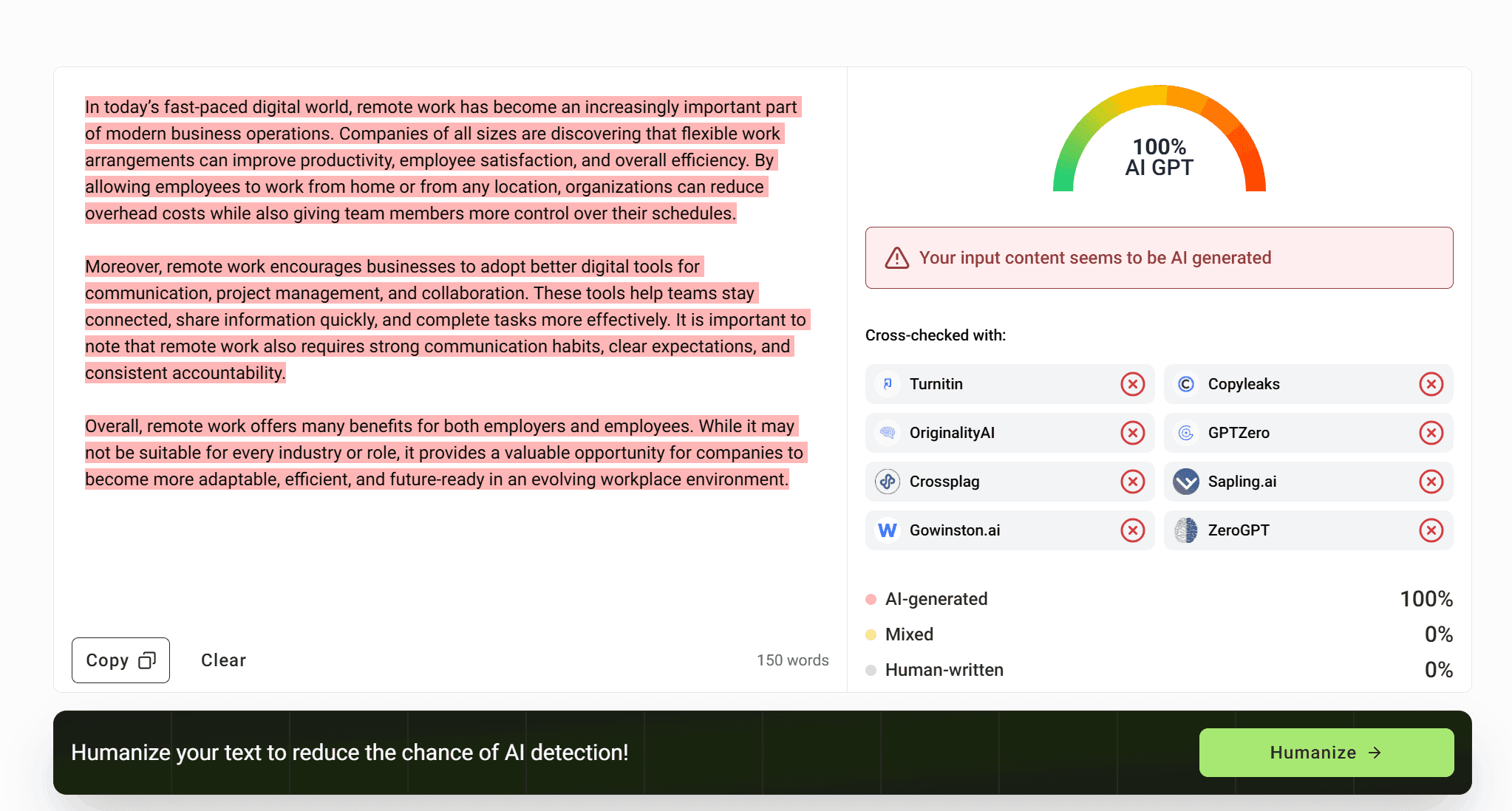
Imagine that you've just spent three hours writing a blog post or an essay. You scribbled down your own thoughts, you used Grammarly to correct your typos, and you clicked on check. The screen suddenly turns red. 80% AI Generated.
I know the feeling. It's annoying. And honestly, it feels like an accusation. But here's the reality: AI detectors are not magic. They don't "know" who wrote the text. They're calculators that are looking for VERY specific mathematical patterns.
AI detectors use two metrics: Perplexity and Burstiness. They don't check for "human soul" or whether your text is correct; they check for predictability. Perplexity shows how surprised the model is by your choice of word (low surprise = likely AI). Burstiness shows the variation of your sentence structure and length (low variation = likely AI). If your text is too grammatically perfect and too consistent, these tools mistake it as machine-generated because LLMs are built to predict the next word that has the highest statistical probability.
Why This Matters Now
Before we dive into the math, you need to understand the bigger picture. We are seeing a massive shift in how content is graded and ranked. This isn't just about passing a check; it's about understanding the "DNA" of human writing.
If you are worried about the broader implications of these tools in schools and universities, I highly recommend reading our deep dive on AI Detection in Academia: Challenges, Ethics, and the Future. It lays out exactly why these "false positives" are becoming a crisis for students and creators alike.
Perplexity: The measure of "unpredictability"
Perplexity is essentially a measurement of how likely a language model is to be confused by your text. Think of an AI model like the autocomplete on your phone. If I type "The cat sat on the...", the AI expects the next word to be "mat." That is Low Perplexity. It is statistically probable.
If I write, "The cat sat on the metaphysical concept of existential dread," the AI is confused. That is High Perplexity.
I've tested this extensively. AI models (like GPT-4) are designed to minimize perplexity. They want to be safe, clear, and accurate. Humans? We are messy. We use slang, weird metaphors, and unexpected adjectives.
● Low Perplexity: "Climate change is a significant global issue." (The AI sees this coming a mile away).
● High Perplexity: "The planet is currently cooking itself in a stew of our own making." (The AI didn't predict "stew").
Verdict: To prove you are human, you need to be statistically unlikely. You need to make choices a machine wouldn't make.
Burstiness: The "Heartbeat" of Your Text
While Perplexity looks at words, Burstiness looks at the rhythm of sentences. AI writing is extremely monotonic. It tends to write sentences of average length (15-20 words) with standard Subject-Verb-Object structure. It’s steady. It’s a metronome.
Human writing is "bursty." We write a long, complex sentence with many commas and clauses, followed by a short one. Like this. Then maybe another medium one. We are jazz musicians; AI is a drum machine.
Visualizing the Difference:
Feature | AI Writing (Low Burstiness) | Human Writing (High Burstiness) |
Sentence Length | Uniform (mostly 15-25 words) | Highly variable (2 words to 40+ words) |
Structure | Standard Grammar (S-V-O) | Fragments, run-ons, stylistic breaks |
Flow | Smooth, flat, consistent | Spiky, dynamic, erratic |
Predictability | High | Low |
I noticed that even when I write 100% original content, if I'm tired and writing in a boring "textbook" style, my Burstiness score drops, and I get flagged. It’s not about cheating; it’s about style.
The Problem with Detectors (False Positives)
Here is the kicker: because these tools rely on probability, they are often wrong.
A famous study by Stanford researchers highlighted that AI detectors are biased against non-native English speakers. Why? Because non-native speakers often stick to standard, "safe" grammar rules to avoid mistakes. To a detector, "safe" looks like "AI."
Key Takeaway:
● Detectors are checking for style, not origin.
● Legitimate, high-quality formal writing often gets flagged because it lacks "burstiness."
According to research on AI detector reliability, these tools can have high error rates when processing constrained or formal writing styles, proving that a "100% AI" score does not prove misconduct.
How GPTHumanizer AI Changes the Math
This is where tools like GPTHumanizer AI Detector come into play. I’ve seen plenty of tools that tell you it can “rewrite” into human content, but all they actually do is spin words (happy to glad). That’s not really correcting the Burstiness/Perplexity thing.
How It Works:
GPTHumanizer isn’t that wordy—It’s actually re-engineering the statistical signature of that text.
1.Adding some Perplexity: Adding in some less likely-but-appropriate words to break the AI’s predictions.
2.Modulating some Burstiness: Actively breaking up the sentence structure by throwing in some short, sharp statements alongside your longer, flowing ones.
My Verdict:
If you are writing legitimate content but getting flagged because your style is too "clean," you need a tool that understands the math behind the detection. GPTHumanizer AI targets the specific metrics (Perplexity/Burstiness) that trigger the alarms.
How to "Humanize" Your Own Writing (Manual Tips)
If you want to improve your writing style manually to avoid these false flags, here is what I recommend based on my own testing:
● Break Grammar Rules (Intentionally): Start sentences with "And" or "But." Use fragments for effect.
● Vary Your Sentence Length: Count the words in your sentences. If you see 15, 14, 16, 15... stop. Combine two. Chop one in half.
● Use Idioms and Anecdotes: LLMs are bad at genuine storytelling. A personal story ("I noticed that...") spikes perplexity immediately because it’s unique to you.
● Be Opinionated: AI hedges. It says, "Some people say X, others say Y." Humans say, "This is wrong." Be decisive.
Conclusion
AI detection is not a magic lie detector; it is a probability game based on Perplexity (word choice randomness) and Burstiness (sentence structure variance). False positives occur because formal, polite human writing often mimics the "safe" patterns of an LLM.
To avoid being wrongly flagged, your content must demonstrate high variability. You can achieve this by manually varying your sentence rhythm and vocabulary, or by using specialized tools like GPTHumanizer AI that are engineered to adjust these specific statistical markers. The goal isn't just to pass a check; it's to write content that feels engaging, dynamic, and unmistakably human.
Frequently Asked Questions (FAQ)
Q: Can AI detectors prove I used ChatGPT?
A: No. They can only provide a probability score. Even the creators of these tools (like OpenAI) admit they are prone to errors and should not be used as the sole proof of authorship.
Q: Why does my original writing get flagged as AI?
A: This usually happens if your writing style is very formal, repetitive, or lacks sentence variation. High consistency looks like "low burstiness" to a detector.
Q: Does paraphrasing fix the AI score?
A: Simple paraphrasing (swapping words) often isn't enough because the underlying sentence structure (syntax) remains the same. You need to change the structure of the sentences to alter the Burstiness score.
Q: Is using GPTHumanizer AI considered cheating?
A: No. If you have written your own ideas and are using the tool to adjust the tone and style to prevent false accusations or to make the text more engaging, you are simply editing your work. Always follow your institution's specific guidelines.

 Ethan Miller