
How to Use GPTHumanizer on Long Drafts Without Losing Consistency

Summary
Using GPTHumanizer on long drafts works best when the article is treated as a sequence of connected editorial sections rather than one oversized input. The goal is not simply to process more text in one pass, but to preserve a stable voice, structure, and reading experience across the full piece.
* Long-form editing is mainly a consistency problem rather than a volume problem. A draft can look smoother section by section and still feel uneven once it is read as a whole.
* Around 900 to 1200 words per section is usually the most reliable working range. It gives enough context for strong rewriting without making review too heavy.
* Natural split points matter more than mechanical cuts. Introductions, explanation blocks, comparisons, and conclusions are usually stronger break points than arbitrary word-count divisions.
* A final full-article pass is still necessary after section editing. The finished draft should be judged by whether it reads as one coherent article from beginning to end.
If you have ever run a long draft through a writing tool and ended up with an article that feels uneven from beginning to end, that is usually a workflow problem more than a tool problem. Long-form editing needs a different approach. With GPTHumanizer, the strongest results usually come from treating a long article as a series of connected sections rather than one oversized block.
This matters even more for blog posts, SEO articles, explainers, and other drafts where readers expect one steady voice as they move from section to section. When the introduction feels sharp, the middle becomes flatter, and the ending suddenly sounds looser or more generic, the article starts to feel assembled instead of written.
If you are still building your overall process, it also helps to read How to Use GPTHumanizer AI first. This article is more specific. It focuses on how to handle long drafts in a way that keeps the full piece coherent instead of turning it into several cleaned-up sections that no longer feel like they belong together.
The biggest mistake with long drafts is trying to process too much at once
A lot of users assume the fastest way to handle a long article is to paste in as much text as possible and let the tool rewrite everything in one pass. In actual use, that is usually where the output becomes harder to control.
GPTHumanizer’s input limits are not especially high by accident. The free version supports 300 words per run, while Basic, Standard, Pro, and Unlimited support 800, 1200, 4000, and 4000 words. From real testing, that restraint makes sense. As the input gets longer, the chances of uneven treatment, formatting problems, or missing details tend to go up. Even when the output looks acceptable at first glance, longer blocks make it harder to notice where the draft lost precision or where the tone started drifting.
There is also a practical editorial reason not to push too much through at once. When you receive one very large output, the review burden increases immediately. You are no longer just checking whether the wording sounds better. You are also trying to catch omissions, structural slippage, flattened emphasis, and small shifts in meaning across a much larger stretch of text. In most cases, that is less efficient than working through a long draft in controlled sections.
Long drafts usually work better when you process them section by section
At first, section-by-section editing can sound slower, especially if the article is already long. In practice, it often saves time because it lowers the number of problems you have to fix later.
When you process a long draft in sections, the changes are easier to judge while they are still fresh. You can see more clearly what improved, what became too smooth, and what should stay closer to the original. That makes it much easier to keep the strongest parts of the draft instead of letting everything get polished to the same level of blandness.
This also helps with the part users often notice only at the end: whether the article still feels like one piece. Long-form editing is not only about improving individual paragraphs. It is also about keeping the full draft stable in tone, pacing, and structure, so the finished article still reads like one article rather than a stack of separately improved segments.
My own preference is simple. For longer pieces, I would much rather review several solid sections than one oversized result that looks smooth on the surface but becomes harder to trust once I start reading carefully.
The best section size is usually smaller than people expect
You do not need to cut a long draft into tiny fragments, because that can make the writing feel overhandled and harder to reconnect later. At the same time, sections that are too large quickly become difficult to control.
In practice, around 900 to 1200 words per section usually gives the best balance. That range gives GPTHumanizer enough context to work with while keeping the output stable enough for meaningful review. It also keeps the human side of the process manageable, which matters more than people sometimes admit. Even strong output becomes less useful when the review load is so heavy that small issues start slipping through.
This range also fits the way strong long-form articles are often structured already. Most pieces naturally break into an introduction, one major explanatory section, a comparison block, a practical section, and a conclusion. Those are usually better cut points than arbitrary word counts, because they preserve how the article actually works.
So instead of slicing every draft mechanically at a fixed number, I would usually split it in a way that follows the job each section is doing.
Part of draft | Better way to process it |
|---|---|
Introduction | Run on its own so the opening tone stays controlled |
Main body section | Process one core idea at a time |
Comparison or example block | Keep together if the logic depends on contrast |
Step-by-step section | Keep as one unit if the sequence matters |
Conclusion | Review separately so the ending still sounds intentional |
That approach usually produces a more natural result because the editing happens in the same units readers will actually experience on the page.
Split by function, not just by length
The quality of the final article depends a lot on where you split it. If a long draft is cut in the wrong places, inconsistency often starts before the editing even begins.
For example, a sentence that introduces a contrast may get separated from the paragraph that resolves it. A transition may end up attached to the wrong block. A conclusion may lose some of its force because the setup that gave it weight was processed somewhere else. When that happens, each section may still look decent on its own, but the article becomes less cohesive once everything is put back together.
That is why I prefer splitting by function rather than by raw length alone. A long SEO article, for example, often breaks more naturally into the opening problem, the main explanation, the “what to do instead” section, a practical workflow, and a closing takeaway. A case-study-style piece might divide more naturally into context, what changed, what worked, what did not, and the final recommendation.
Those are editorial units in the real sense of the word. Readers move through them as complete thoughts, not as numbered text blocks, so editing them that way usually protects the article’s logic much better.
Keep your standards stable across sections, then judge the full article as one piece
Once you start processing a long draft section by section, the biggest risk is not that one section will become obviously bad. The more common problem is that each section becomes slightly different in a way that only becomes noticeable when you read the whole article back.
One section may become more conversational. Another may become flatter and more neutral. A third may keep the author’s original judgment while the next one smooths that judgment away. None of these problems are dramatic on their own, but together they make the draft feel uneven.
That is why it helps to decide in advance what should stay stable across the article. In most cases, I would pay attention to the overall level of formality, the sentence rhythm, the repeated terms or labels, and how much visible opinion or personality the piece is supposed to carry. These are small editorial decisions, but they are usually what make a long article feel coherent from beginning to end.
After the sections are stitched back together, the article needs one more read as a complete piece. This is where many users stop too early. They check each section in isolation, see that each one looks cleaner than before, and assume the draft is done. What matters more, though, is whether the full article still feels like it was written in one voice and built around one line of reasoning. That final full-piece pass is often where you catch tone drift, uneven pacing, or transitions that now feel weaker than they did in the original.
My simple workflow for long drafts
This is the workflow I would actually recommend for GPTHumanizer on long-form content.
First, clean up the original draft before you paste anything in. Remove obvious repetition, fix broken formatting, and make sure the structure already makes sense. GPTHumanizer works better when the base draft is clear enough that each section already has a job.
Second, split the article into natural sections. Do not cut through the middle of a comparison, an example, or a key argument just to hit a neat number. If a section is still too large, bring it down into the 900 to 1200 word range in a way that preserves its internal logic.
Third, process one section at a time and review it immediately. Waiting until the end usually makes it harder to remember how the original passage was supposed to feel, which makes subtle drift easier to miss.
Fourth, paste the sections back together in one document and read the full article for consistency. This is usually where small differences between sections become visible, especially in tone, density, and emphasis.
Finally, do one last pass just for transitions. Even when each section is individually strong, the seams between sections often need a little manual smoothing so the article flows naturally from one part to the next.
The goal is not to process more text at once, but to keep the article under control
That is usually the misunderstanding behind long-draft editing. The problem is rarely that the tool cannot handle long content at all. More often, users approach long-form work as if the main challenge were volume, when the real challenge is control.
Once you start treating long drafts as connected sections with their own roles inside one larger piece, the whole process becomes easier to manage. Review is lighter. Quality is more stable. And the finished article is much more likely to sound like one complete article rather than several polished chunks pasted together.
Conclusion
For long drafts, the best GPTHumanizer workflow is usually not one big pass. It is a section-by-section process built around control. When you split the article by natural function, keep each block at a manageable size, review as you go, and then read the finished piece as one whole article, consistency becomes much easier to protect.
FAQ
Q: What is the best way to use GPTHumanizer on a long article?
A: The best method is to split the article into natural sections, process them one at a time, and then review the full piece after stitching everything back together.
Q: How long should each section be when using GPTHumanizer on long drafts?
A: Around 900 to 1200 words per section usually gives the best balance between rewrite quality, context retention, and manageable human review.
Q: Why does a long draft sometimes feel inconsistent after editing with GPTHumanizer?
A: That usually happens when too much text is processed at once or when sections are edited separately without checking whether the full article still sounds unified.
Q: Should long blog posts be split by word count or by section meaning?
A: Split by editorial function first. Introductions, core sections, comparisons, and conclusions are usually better break points than arbitrary word-count cuts.
Q: Is processing more text at once actually more efficient in GPTHumanizer?
A: Not usually. Larger inputs may save one step upfront, but they often create more review work later because issues are harder to spot and fix.

Related Articles
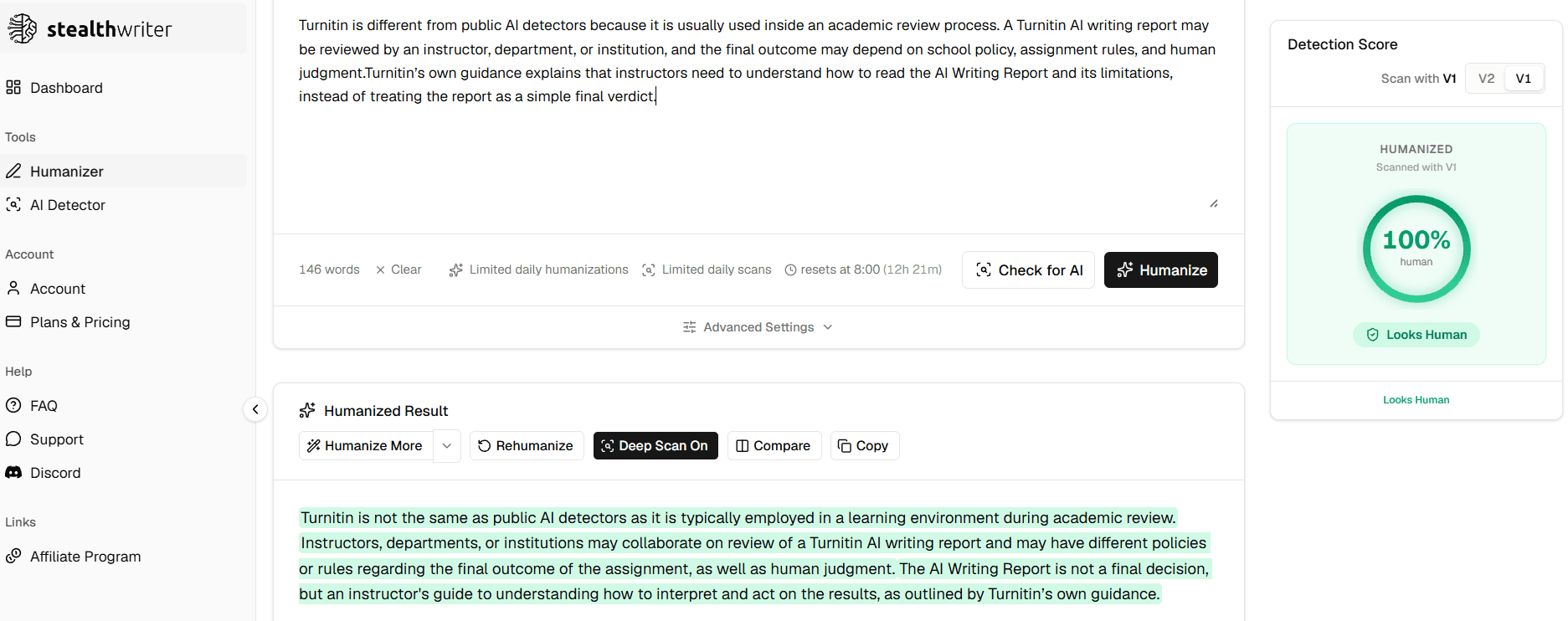
Does StealthWriter Pass GPTZero and Turnitin? Real Test Expectations in 2026
Does StealthWriter pass GPTZero and Turnitin? Learn why StealthWriter’s built-in human score may not...
 Ethan Miller
HIX Bypass Pricing Explained: Is It Worth Paying For in 2026?
A practical look at HIX Bypass pricing, paid-plan value, word limits, refund terms, and whether it i...
Ethan Miller
I Tested 7 Paid AI Humanizers: Which Ones Are Actually Worth Paying For?
I tested 7 paid AI humanizers to see which tools are worth paying for, which need more testing, and ...
Ethan Miller
Does Hixbypas Work in 2026? Fast, and Aggressive Modes Tested
Does Hixbypas, or HIX Bypass, actually work? I tested Fast and Aggressive modes to compare rewrite q...
Ethan Miller