
GPTinf Review 2026: Features, Pricing, and What Our Tests Found

Summary
In this GPTinf review, I tested GPTinf’s humanizer, pricing, free limits, and built-in AI detector to see where it actually works and where users should be cautious. GPTinf has a clean interface, useful workflow controls, and a small free preview, but its free humanizer allowance is very limited at 120 words before sign-up and 120 more after registration.
Pricing also needs context: GPTinf starts at $9.99/month on monthly billing, while yearly billing shows a lower effective monthly price starting at $4.99/month. In my output test, GPTinf was usable but less convincing than GPTHumanizer AI for naturalness and meaning preservation. Its built-in detector is convenient, but detector scores should be treated as a first signal rather than final proof.

The line between AI-assisted writing and human writing is becoming increasingly blurred. As writing tools improve, so do the detectors used to flag machine-generated patterns. That has created demand for tools that rewrite AI-assisted drafts to sound more natural and less mechanically structured. GPTinf is one of the tools that has attracted attention in this category. In this review, we look at its features, pricing, and test results based on the current version of the product and the latest publicly visible information available at the time of writing.
We also compare it with an alternative that is positioned more around deeper structural refinement and long-form readability.
What is GPTinf?
GPTinf is an AI-powered rewriting tool that processes text from AI models such as ChatGPT. It is designed to change structure, vocabulary, and rhythm so AI-assisted writing reads more naturally. The platform presents itself as a way to reduce obvious AI-like patterns, though real-world results can vary depending on the detector, the source text, and the editing context. GPTinf offers several features for content creators, marketers, and SEO users, including compare mode, keyword controls, and API access for more advanced workflows.
Our GPTinf Testing Process
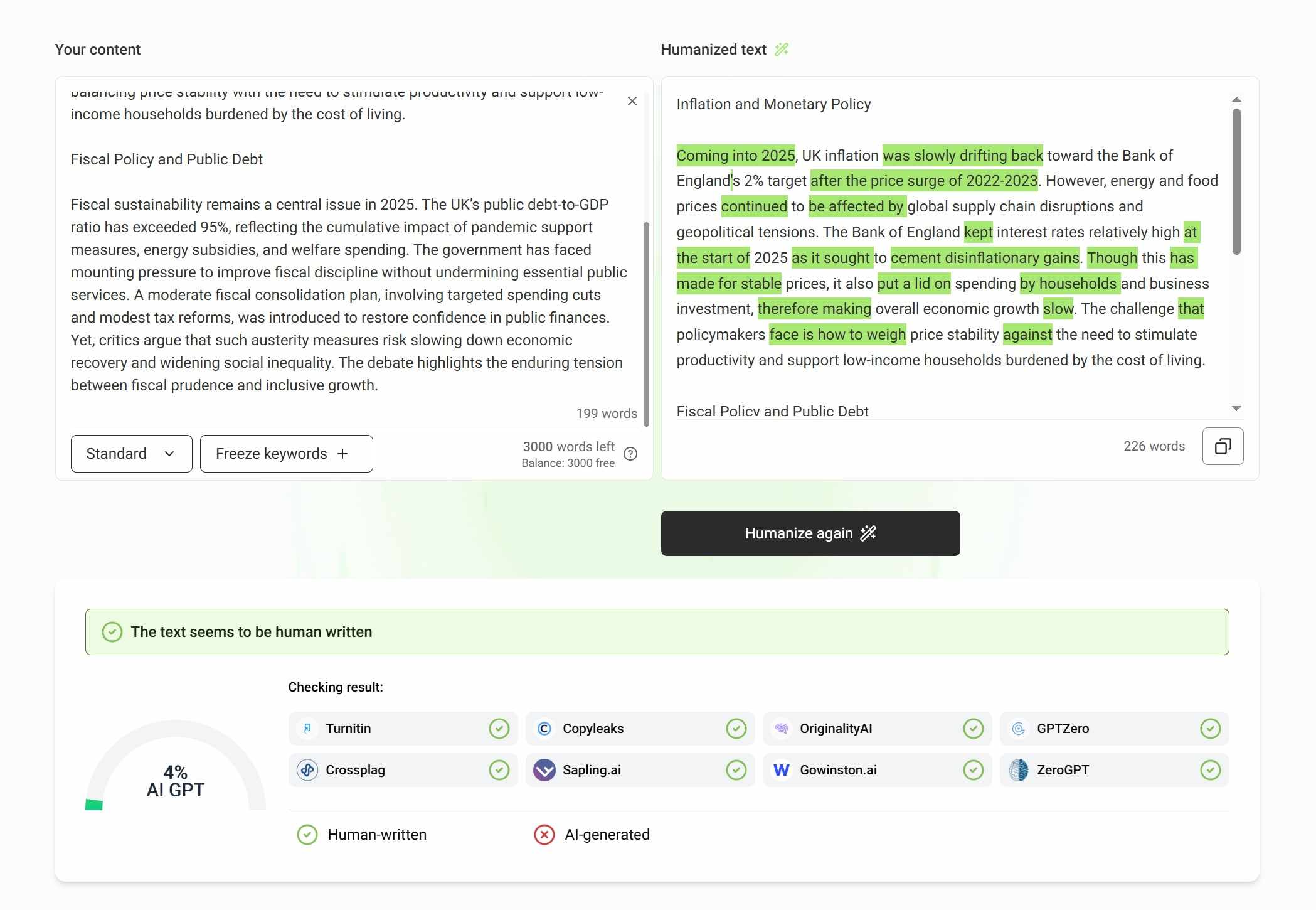
We began by asking ChatGPT to write a 200-word passage. This text was then used as our baseline test. We fed this text to GPTZero and ZeroGPT to establish detection scores. We then reprocessed the same passage through GPTinf, and fed the humanized text through both GPTZero and ZeroGPT again.
GPTinf Test Results
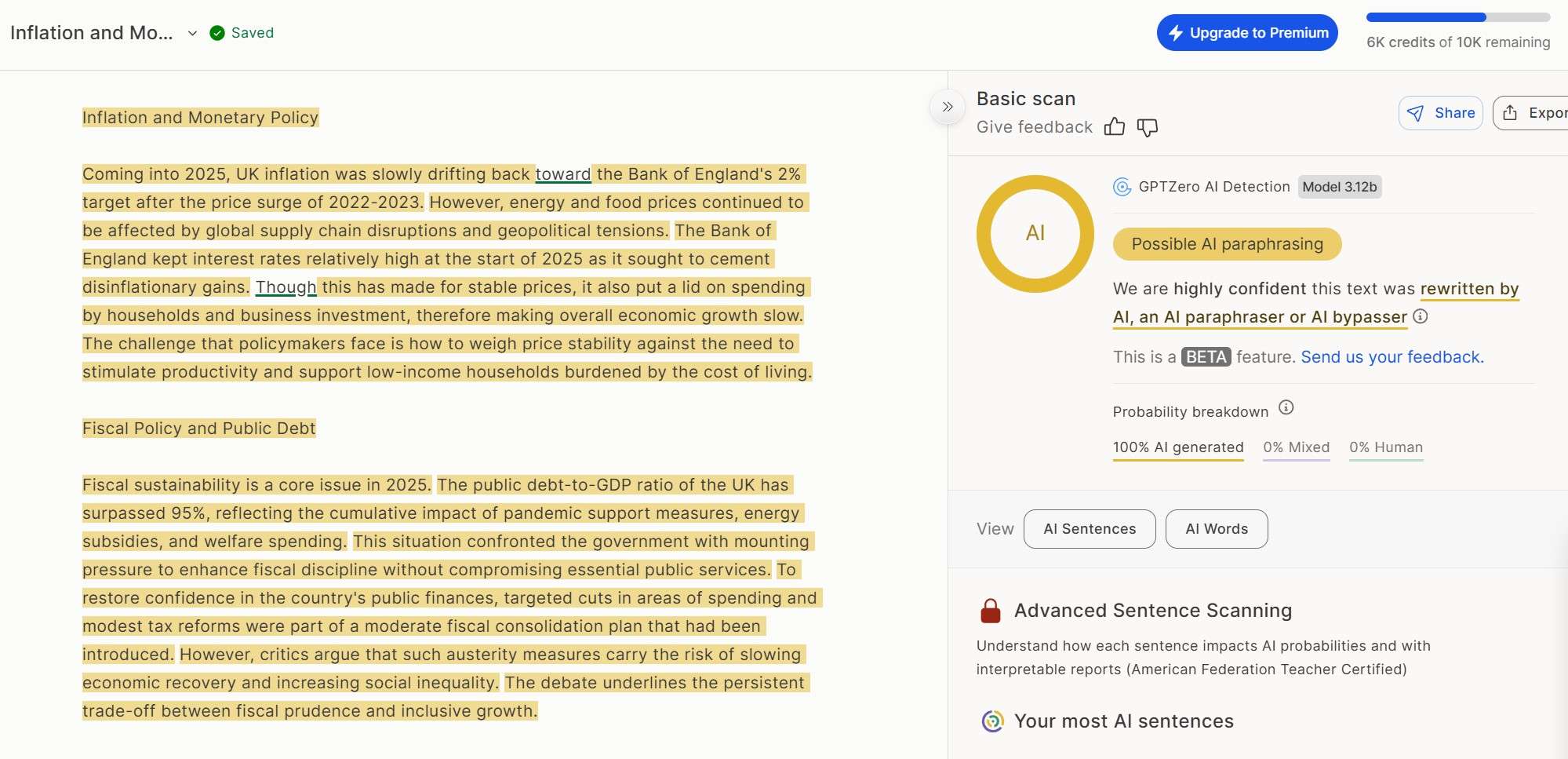
GPTZero Test Result: 100% AI Score
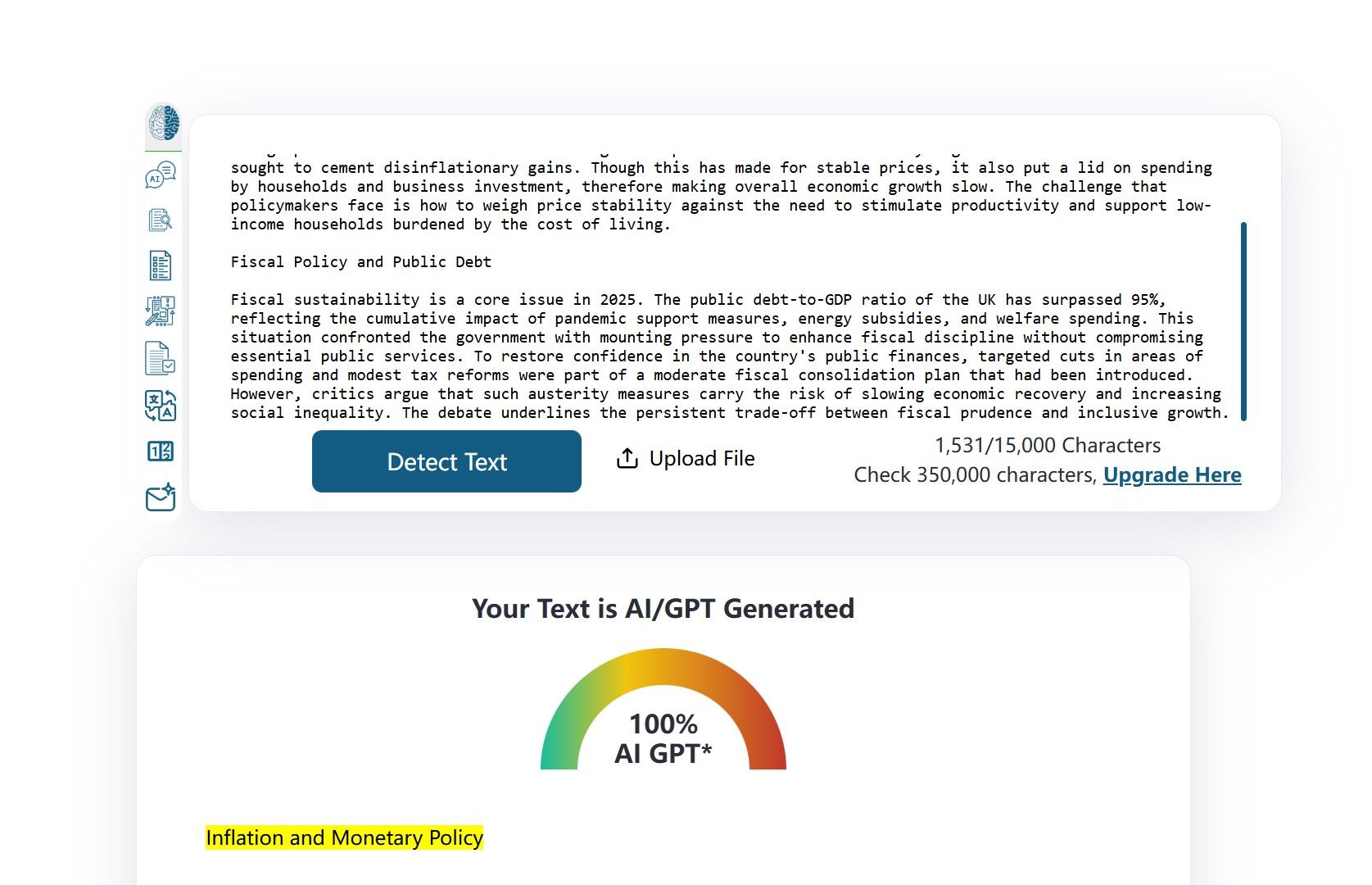
ZeroGPT Test Result: 100% AI Score
AI Detector | AI Detection Score | Outcome |
GPTZero | 100% | Detected as AI |
ZeroGPT | 100% | Detected as AI |
What These Results Tell Us
From the screenshots of the interface we can see that GPTinf differentiates itself from other products by allowing you to freeze content that does not need humanizing and the results page also shows which words have been humanized. GPTinf does humanize phrasing and sentence structure but this was not enough to materially improve the third-party detector results in our sample test.
Interestingly, GPTinf's built-in AI checker showed an AI probability of only 4% and indicated the text would pass most mainstream AI detectors on the market. In our actual testing, however, both GPTZero and ZeroGPT still returned highly AI-leaning results in our sample, which suggests limited improvement under those specific test conditions.
While GPTinf has many distinctive features and has clearly made efforts to optimize user experience, the core function of any humanizer is its effectiveness. Unfortunately, GPTinf delivered disappointing results in this regard. The platform shows promise in terms of usability, but it still needs improvement in its core output quality if the goal is to produce writing that feels more natural while holding up better in external evaluation tools.
For users who want a stronger alternative to surface-level rewriting, GPTHumanizer is positioned around deeper structural editing, more natural sentence variation, and built-in detection feedback that helps identify mechanical passages at the sentence level. Rather than framing the value only around detector scores, it is better understood as a tool for improving readability, flow, and human-likeness while still preserving meaning and intent.
Is GPTinf AI Detector Reliable?
GPTinf also includes a built-in AI detector, which is convenient if you want to check a rewrite inside the same workflow. In my test, however, I would treat the score as a first signal rather than final proof.
The reason is simple: detector results can vary across tools. GPTinf’s own detector may give a very low AI score to GPTinf-humanized text, while external detectors can read the same output differently. That does not make GPTinf’s detector useless, but it does mean users should cross-check important results and still review the text manually for meaning, clarity, and natural flow.
For a deeper look at the detector test, including how GPTinf scored obvious AI text, rough human writing, and GPTinf-humanized output, read the full GPTinf AI Detector review.
Pros and Cons of GPTinf
Based on our research, here is a summary of the main advantages and disadvantages of using GPT inf:
Pros | Cons |
User-friendly interface with a compare mode | Inconsistent results against advanced AI detectors |
Freeze Keywords function | Can be expensive compared to alternatives |
Built-in AI detector | Rewritten text may still require manual editing |
Fast processing speed | Does not create original content, only rewrites |
GPTinf Pricing Plan
GPTinf is free to try, but its free humanizer allowance is very small. The current free access gives users 120 words before sign-up and another 120 words after registration, for 240 free words in total.
After that, GPTinf becomes a paid tool. Its monthly billing starts at $9.99/month for Lite, $24.99/month for Pro, and $59.99/month for Unlimited. If users choose yearly billing, GPTinf shows a 50% saving and displays lower effective monthly prices: $4.99/month, $12.49/month, and $29.99/month.
For this review, the important point is not which GPTinf plan has the best feature list. The real question is whether the output quality justifies paying after such a small free preview. If you want the detailed breakdown of GPTinf’s free trial, login rule, upgrade prompt, and monthly vs yearly pricing, read the full guide to Is GPTinf Free?
GPTinf vs GPTHumanizer AI: A Direct Comparison
At this point we wanted to see how GPTinf compares with another popular tool in the marketplace. We used the same sample that we used for GPTinf and input this into GPTHumanizer AI, then we submitted to the two AI detectors.
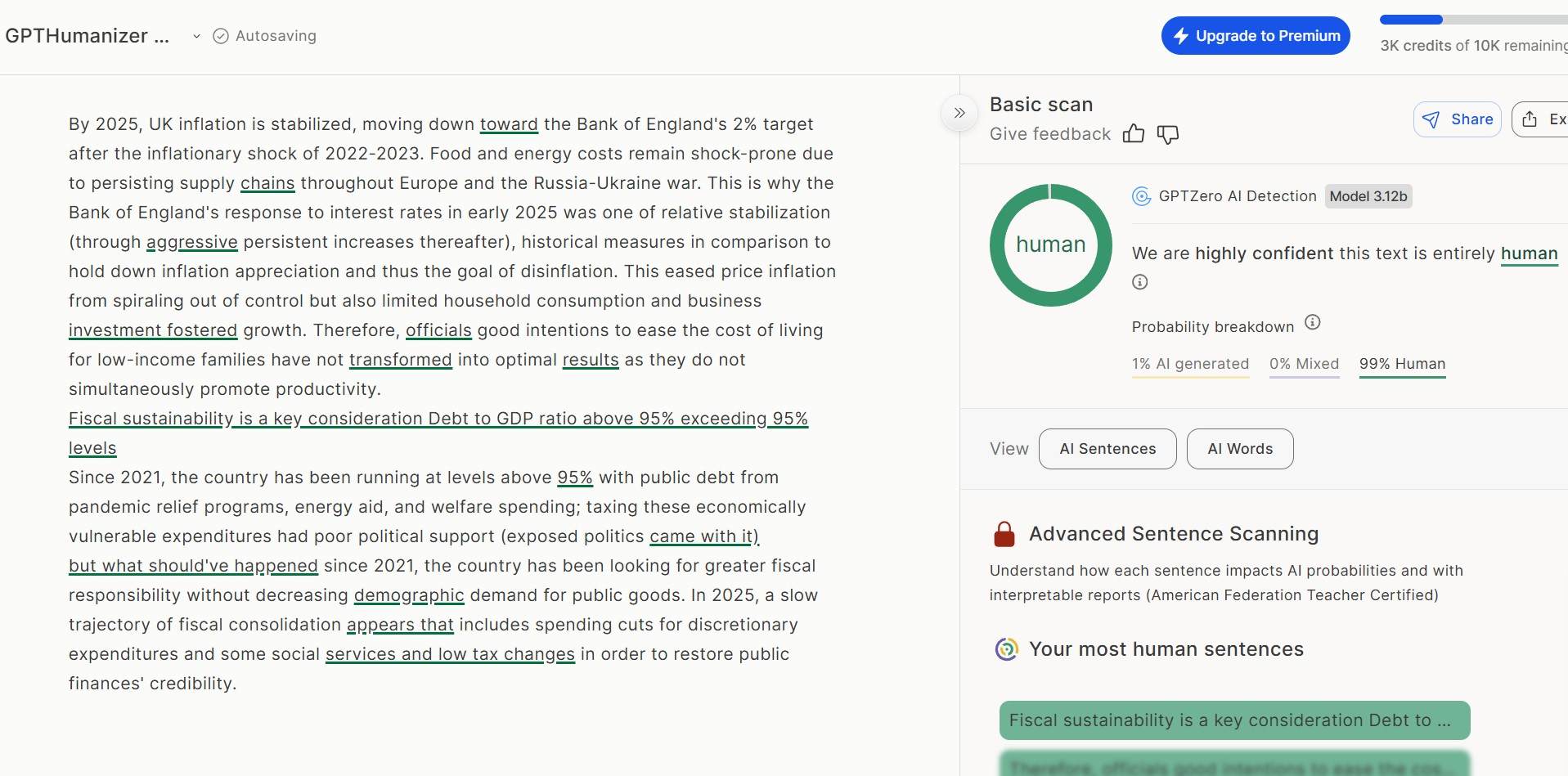
The difference in our test was clear. GPTinf remained heavily flagged by both detectors, while the GPTHumanizer output scored much lower in the same side-by-side check. That does not mean any tool can guarantee the same outcome in every setting, but it does show that GPTHumanizer produced a more convincing rewrite in this specific comparison.
Tool | GPTZero Result | ZeroGPT Result | Overall Outcome |
GPTinf | 100% AI | 100% AI | Failed both detectors |
GPTHumanizer AI | 2% AI | 0% AI | Passed both detectors |
What This Comparison Reveals
The side-by-side test suggests that the real gap is not just interface design, but rewrite depth. GPTinf offers useful workflow controls such as freezing specific content and reviewing visible edits, but the rewritten output in our test still looked too close to AI-generated text when checked by external detectors. GPTHumanizer performed better here because its approach is built around sentence- and paragraph-level refinement rather than lighter paraphrasing.
That said, the stronger takeaway is not that one tool can “guarantee” invisibility. A more accurate conclusion is that GPTHumanizer appears better suited to users who want more natural rhythm, stronger semantic retention, and more revision guidance through sentence-level detector feedback. GPTinf may still appeal to users who prioritize quick edits and keyword control, but GPTHumanizer is the stronger fit for people who care more about rewrite quality and stability across longer or more demanding content.
If your main question is not “how does GPTinf work?” but “what should I try before paying for GPTinf?”, read the dedicated guide to the best free GPTinf humanizer alternative with no sign-up.
GPTinf vs GPTHumanizer AI: Feature Comparison
Before the feature table, it is worth clarifying the difference in positioning. GPTinf feels more like a quick rewriting workflow with keyword control and built-in checking. GPTHumanizer AI is positioned more as an AI humanization tool for improving flow, clarity, and naturalness while preserving meaning across longer drafts.
Category | GPTinf | GPTHumanizer AI |
|---|---|---|
Free Access | Limited free quota | Unlimited Free Lite model |
Humanization Models | Mode-based rewriting, but less clearly tiered | Lite / Pro / Ultra with different rewrite depth |
Rewrite Approach | More surface-level paraphrasing and controlled edits | Structural and stylistic refinement at sentence and paragraph level |
Writing Styles | Limited public detail | 8 writing styles |
Languages | More limited in positioning | 11 languages |
Built-in Detection | Yes | Yes, with sentence-level feedback |
Long-Form Handling | Can become less stable on complex text | Better suited to long-form and structure-aware rewriting |
Pricing Structure | Paid plans focused on usage tiers | Free, Basic, Standard, Pro, and Lifetime options |
Best Fit | Quick edits, keyword freezing, simple workflows | Users who want deeper rewriting, better flow, and a stronger free entry point |
The main difference is clear: GPTinf is more appealing if you want quick edits and workflow controls, while GPTHumanizer AI is stronger if you care about natural flow, meaning preservation, and a more practical free starting point.
If that is the decision you are trying to make, the GPTinf vs GPTHumanizer AI alternative page goes deeper into the trade-off between GPTinf’s workflow controls and GPTHumanizer AI’s more focused rewriting experience.
Conclusion: Is GPTinf the Right Choice for You?
After looking at GPTinf’s features, test results, and overall value, it is clear that the product has some genuinely useful ideas, especially around workflow control. But it still falls short as the stronger all-around choice when output quality matters most. Its results can be uneven, and its detector-facing claims are better treated cautiously than taken at face value.
By contrast, GPTHumanizer AI is easier to recommend as a more complete AI humanization platform. It combines an Unlimited Free Lite model, deeper Lite / Pro / Ultra rewrite paths, broader style and language support, and sentence-level detection feedback that makes revision more transparent. Just as importantly, its positioning is more responsible: the goal is to reduce obvious AI patterns and improve naturalness, not to promise guaranteed invisibility. For users who care most about readability, semantic fidelity, and stronger long-form rewriting, GPTHumanizer AIis the better overall choice.
Frequently Asked Questions
Is GPTinf free?
GPTinf is free to try, but not fully free to use. The free humanizer allowance is 120 words before sign-up and another 120 words after sign-up.
How much does GPTinf cost?
GPTinf starts at $9.99/month on monthly billing. If billed yearly, Lite is shown as $4.99/month as an effective monthly price.
Why does GPTinf show two different prices?
Because GPTinf has monthly and yearly billing. Monthly Lite costs $9.99/month, while yearly billing shows a 50% saving and displays $4.99/month.
Is GPTinf good for long content?
GPTinf can handle longer content on paid plans, but the free trial is too limited for serious long-form testing. You need a paid plan to judge it properly.
Is GPTinf AI Detector reliable?
GPTinf AI Detector is useful for a quick check, but one detector score should not be treated as final proof. Results can vary across different AI detectors.
Does GPTinf pass AI detection tools?
GPTinf says it helps reduce AI-detection signals, but no tool can guarantee a pass across all detectors. You should still review the output manually.
Is GPTinf worth paying for?
GPTinf may be worth paying for if you like its workflow and need regular rewriting. In my test, it was usable, but GPTHumanizer AI produced a more natural rewrite.
What is the best free GPTinf alternative?
GPTHumanizer AI is a better free GPTinf alternative if you want no-sign-up access and more practical testing room before paying.
Should I use GPTinf or GPTHumanizer AI?
Use GPTinf if you prefer its paid workflow controls. Try GPTHumanizer AI first if you want a free, no-sign-up AI humanizer with stronger naturalness in testing.

Related Articles
HIX Bypass Pricing Explained: Is It Worth Paying For in 2026?
A practical look at HIX Bypass pricing, paid-plan value, word limits, refund terms, and whether it i...
 Ethan Miller
Does Hixbypas Work in 2026? Fast, and Aggressive Modes Tested
Does Hixbypas, or HIX Bypass, actually work? I tested Fast and Aggressive modes to compare rewrite q...
Ethan Miller
Best HIX Bypass Alternative: Free, No-Sign-Up AI Humanizer Compared
Looking for a HIX Bypass alternative? Compare HIX Bypass with GPTHumanizer for free access, no-sign-...
Ethan Miller
StealthGPT AI Review 2026: Features, Pricing, Output Quality, and Alternatives
I reviewed StealthGPT AI across pricing, features, rewrite quality, and real writing use cases. See ...
Ethan Miller