
Do College Admissions Check for AI? What 2026 Applicants Should Know

Summary:
Introduction
College applicants and admissions offices have both quietly added AI into their story at the desk.
College applicants wonder if AI-wrote essays will be caught and penalized. Admissions offices wonder if they can still consider essays to be the informal window into an applicant’s voice and experience that they’ve always imagined.
The question that almost every applicant eventually asks is straightforward: are colleges actually looking for AI in admissions essays? The honest answer is: yes, many of them are, in one way or another — not always with the policies or tools applicants imagine, and not all in the same way.
To see what that means for you, it’s worth zooming in on particular universities, what they say about AI, and what kinds of tools and processes they’re actually using.
How Colleges Are Using AI and AI Detectors Right Now
One of the clearest indicators that AI has found a home in admissions is public reporting. A handful of schools in the United States have started using AI tools to read and score portions of applications, including essays. Virginia Tech, Caltech, and other schools have introduced AI tools that aid in reading and assessing written materials and determining if a piece of work is authentic. The University of North Carolina has also faced backlash after reports of using AI to read applicants’ writing, and Georgia Tech and Stony Brook University have tested AI in related ways such as reading transcripts and shortlisting scholarship candidates.
These may not be “AI detectors” that simply tell whether a piece of text was written by a human or a computer. They could also be more general AI reading tools that support scoring of essays, identify style changes, or highlight anomalies. In either case, it tells us that an increasing number of schools have AI in their application review ecosystems.
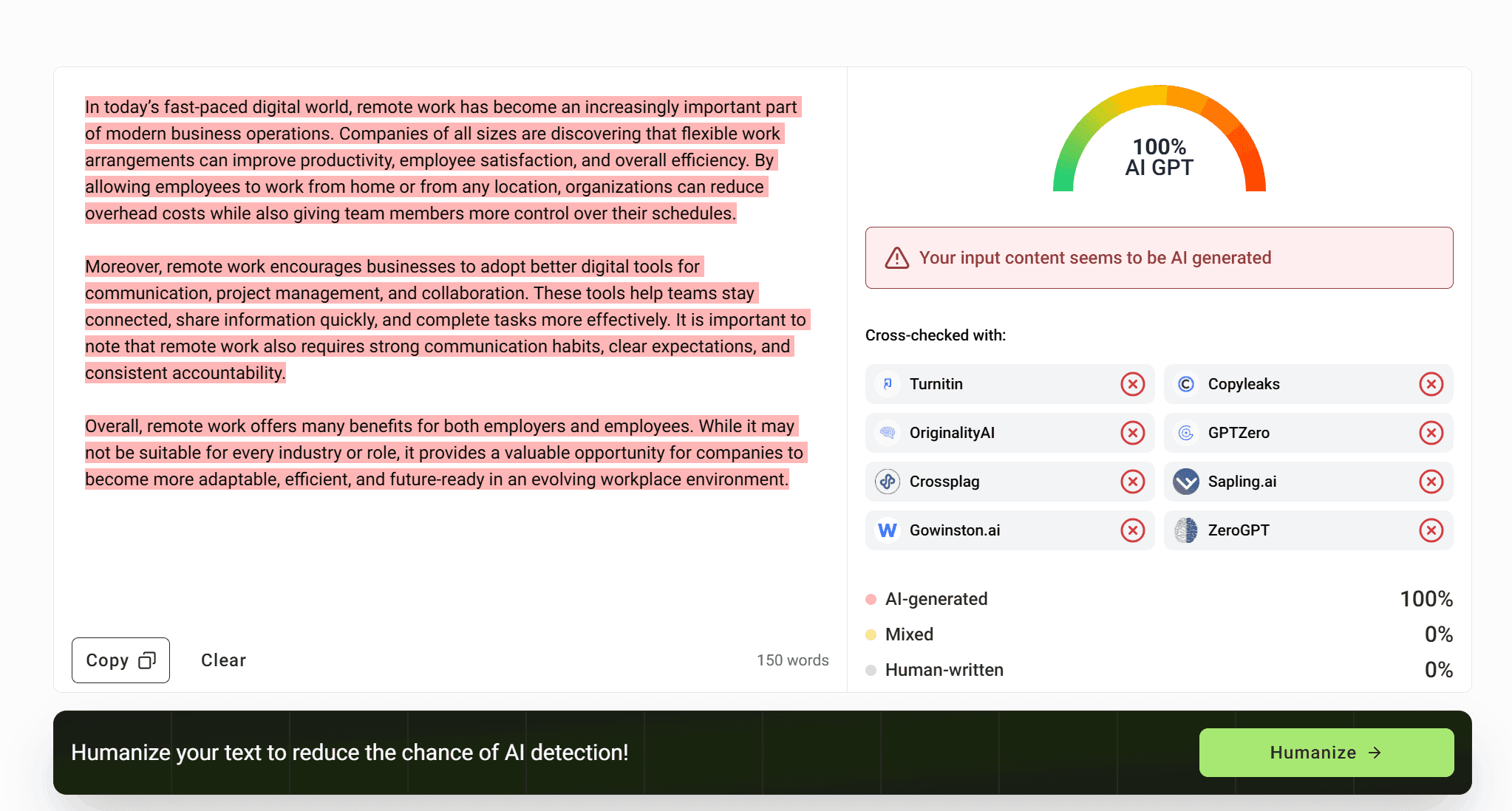
More generally, enrollment-management and ed-tech voices report some admissions offices are using AI-writing detectors like Turnitin’s AI checker, GPTZero, and Originality.ai to read essays and flag machine-generated content. These detectors are often integrated into their existing plagiarism-detection platforms or admissions workflows.
But there is also strong pushback in higher education. After months testing Turnitin’s AI detector, Vanderbilt University publicly announced that it was turning off the tool because of concerns about accuracy, transparency, and the potential unintended negative impact on students (See Vanderbilt’s official explanation for disabling Turnitin’s AI detector) . Other schools—including Yale, the University of Maryland, West Chester University, and the University of Pittsburgh—have similarly opted not to use automated AI writing detection, citing concerns about fairness and accuracy.
Taken together, these examples suggest a nuanced reality. Some schools are embracing AI detection and AI-assisted review; others are actively withdrawing. Most fall somewhere in between and are testing cautiously.
Real Policy Examples: Brown, Caltech, and the “Top 30” Landscape
A handful of colleges are starting to publish explicit AI policies.
In a notable analysis of AI policies in college applications, I reviewed dozens of institutional policies and found only a handful of universities that explicitly prohibit the use of AI in application essays. Brown University is one of them. According to Brown University’s application integrity policy, applicants may use AI only for basic spelling and grammar review, while the substantive content of essays, short-answer responses, and other submitted materials must be their own work. Brown also notes that it verifies a small randomly selected sample of admitted students’ credentials each year as part of its broader effort to deter application fraud.
Another notable example is Caltech. For Fall 2025 and Fall 2026 applicants, Caltech requires everyone to read its “Ethical Use of AI” before submitting supplemental essays. The school prohibits the generation of essay text via AI and says it may even deny or rescind admission because of that. At the same time, Caltech allows limited AI use for clarity or grammatical edits as long as applicants disclose the tools they used and how they used them .
The picture emerging at other highly selective institutions is that many top-30 schools fit into a “limited use allowed” category: applicants are allowed to use AI tools for minor proofreading, structural suggestions or idea generation but not for drafting, rewriting or shaping the core narrative. Others have no publicly stated policy but require a student to certify that the work is their own and warn that misrepresentation can have serious consequences.
This is the emerging consensus among selective institutions: while AI can work at the margins, it shouldn’t be authoring your story.
How AI Detectors Work, and Why They’re Imperfect
Most AI-text detectors work by looking for statistical regularities suggestive of machine-generated text. Statistically, for example, they expect a certain degree of predictability in the following of words and sentences, little variation, and phrasing common to large language models. Certain detectors even examine "burstiness," the natural rhythm of human writing that leans toward variation.
Yet detectors are still imperfect in three major ways.
First, they work by probability, not proof. A "likely AI-generated" label doesn't mean a machine actually wrote the essay. Strong writers who are concise and have a very structured style are frequently flagged (and some aren't even flagged until they're on the verge of being penalized). Similarly, second language students are prone to being flagged because their writing has much more predictability.
Second, machine-generated text is easy to tweak. A student can take a ChatGPT essay, change it to include personal details, edit sentence structure, and make it super hard to detect. Detectors fail when the text is heavily edited because the statistical regularities are no longer as visible.
Third, detectors are bad at short essays. Supplemental answers of less than 250 words are too short to allow for reliable judgments.
Because of these shortcomings, most colleges see detector output as an indicator of potential word problems, not as final proof.
What Happens When an Essay Is Flagged
No, an essay being flagged does not mean there will be a dismissal.
Normally, the flagged essay is re-read by one or more members of admissions. They look for elements of an authentic voice: personal memories, reflective insight, sensory detail, emotional nuance. They compare it to supplemental responses, short answers and other writing on the application.
If everything feels consistent, then the worry fades. If there’s an iteration—a polished, sophisticated essay alongside a more abrupt, simplistic one—the admissions team looks around a little more.
In rare cases a college will request an additional writing sample or short interview to confirm authorship. But these situations are rare, and generally only occur when multiple red flags—other than a detector score—suggest misrepresentation.
The point is, being flagged invites a human reader, not an automatic penalty.
When Students Can Reasonably Use AI: A Practical Table
Here is a clarified version of the earlier table, now reintroduced and aligned with actual institutional policies:
How AI Is Used | How Schools Typically View It | Risk Level | Notes |
Checking spelling, grammar, punctuation | Generally acceptable | Low | Caltech and several top universities explicitly allow this as long as the ideas and words remain your own. |
Brainstorming topics or generating questions to think about | Usually acceptable | Low–Medium | Many advisors recommend AI for early ideation, provided the student writes the final content independently. |
Rewriting sentences, smoothing style, or paraphrasing large sections | Often discouraged | Medium–High | Over-polishing can erase personal voice and make writing sound machine-like. |
Using AI to draft paragraphs or entire essays | Prohibited at most selective schools | High | Brown and Caltech explicitly forbid this; considered misrepresentation. |
Submitting mostly or fully AI-generated text | Considered serious misconduct | Very High | Can lead to rejection or rescission if discovered. |
This table reflects emerging norms. The more AI shapes the substance of your essay, the greater the risk.
How to Stay Safe and Still Write a Strong Essay
Treat AI as a minion, not a coauthor. Write the core of your story yourself. Your own memories, real experiences, real emotions, and real reflections. Not only will this keep AI from suspecting you—they’ll make your essay way more interesting.
If you do use AI, use it very infrequently. The usual exception being for grammar correction or brainstorming prompts. Anything that is removing your own voice is not okay. Instead, focus on effective AI writing humanization strategies that amplify your unique personality throughout the essay.
Also try to keep all of your materials consistent. It’s better if your main essay feels dramatically different from your supplemental essays than if it feels like the same essay with a different score.
The Future of AI in Admissions
AI won’t stop being involved in how apps are scored. Some institutions are using stylometrics, comparing writing samples throughout the application and ensuring they have a consistent voice. Others are using timed writing assignments to gauge whether applications make sense under duress.
At the same time, a growing number of schools are publishing more explicit guidelines about acceptable and unacceptable AI use. A few law schools have even introduced optional essays asking applicants to reflect on how they use AI, so the conversation is evolving, not evaporating.
The signal is clear: the admissions process is changing, and it's centered around the same thing: authenticity.
What This Means for Applicants
In future admissions cycles, universities will keep evolving their AI policies. Some, like Brown, will prohibit all AI-generated content. Some, like Caltech, will allow a certain degree of editing assistance but will bar AI authorship. Some, like Dartmouth, will use AI tools against the grain, as either a fraud detection tool or a mass application processing aid.
But one thing will never change: Your story is yours. AI can help you write it. AI will never take your place. In an environment where each new group of applicants is tougher than the last, the essays that shine are the most human rather than the most polished.

 Ethan Miller