
ChatGPT Watermark for Text: A Practical 2026 Guide

Summary
Introduction
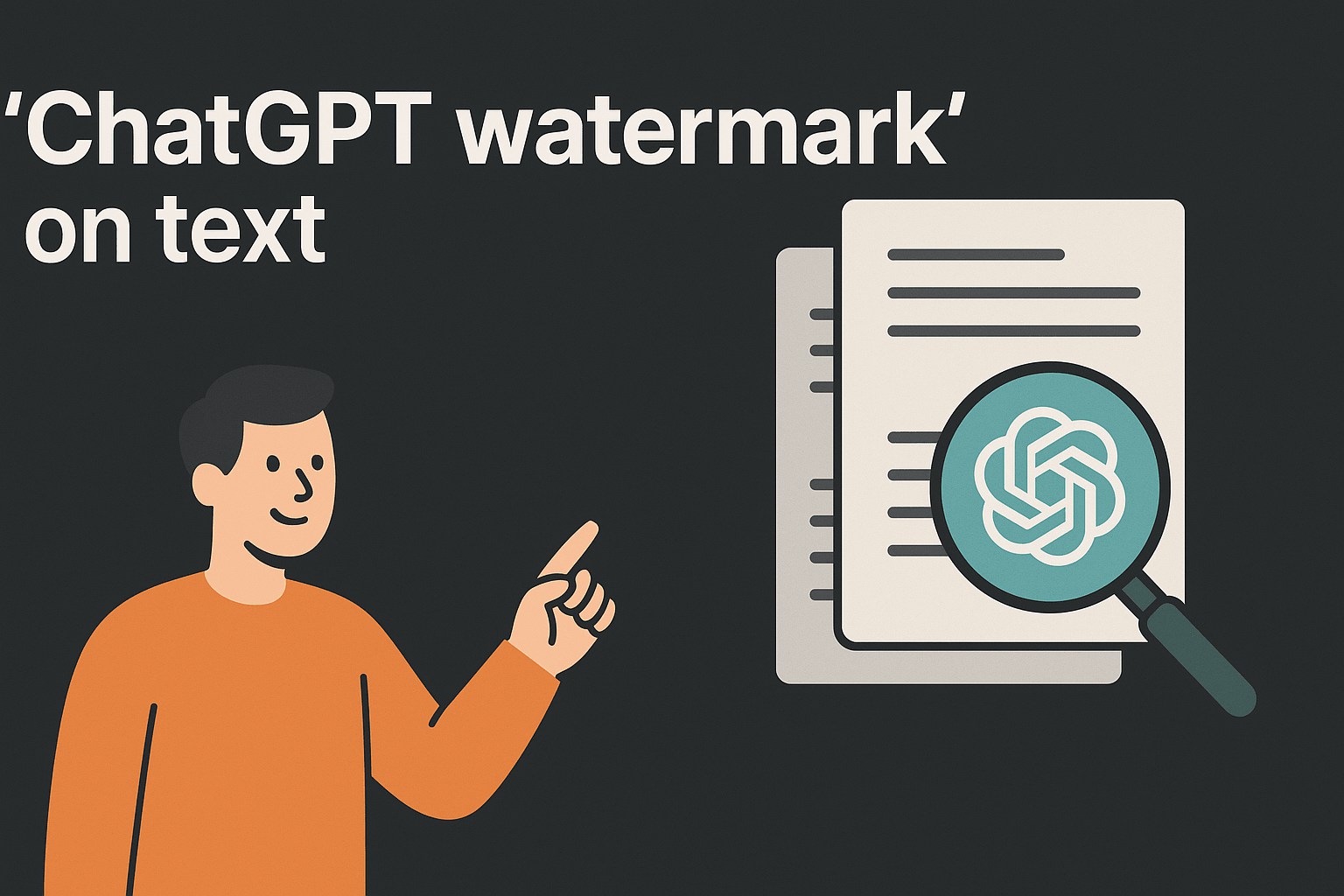
"ChatGPT watermark" (on text) is a generic name that people give to any sign that a passage may have been produced or heavily aided by a text generation model. There is no standard watermark on text that is tamper-proof and official, unlike images (e.g. C2PA). We in fact just have probabilistic traces on a document - some statistical properties, some "style fingerprints" or some traces on a character level that may be indicative that the document has been produced with the aid of an AI model.
This guide explains what a text side "chatgpt watermark" really means, how it could impact your work and workflows, and how to detect and safely remove any watermark artefacts while still being transparent and compliant. If you want the deeper reason these signals show up in the first place, see how deep learning models mimic human syntax. Many of these traces come from the same probability-driven patterns that make raw AI text look predictable in the first place.
For non-technical teams, tools like gpthumanizer.ai provide a solution that bundles detection and normalization for you. You copy your text, get an overview of how "risky" it might be, and perform a safe "cleaning" before human rework.
What is ChatGPT Watermark?
Definition: When people say chatgpt watermark for text, they typically refer to one or more of the following signals:
1) Statistical watermarking
During generation a model may bias token sampling in a way that an output distribution shows a detectable pattern - if you know what to look for. These are probabilistic approaches, model specific and can be very fragile to paraphrasing, truncation, translation or even a strong edit.
2) Character / format artefacts
Invisible characters, unusual line breaks, odd punctuation styles, etc.; or artefacts from copy and paste. These are not “official” watermarks, but they are easily searchable and easy to delete.
3) Stylometric fingerprints
Statistical style cues such as perplexity, burstiness, variance in sentence length, functional word frequency, templated phrasing, etc. Useful as signals, but not definitive evidence. In other words, what people call a "watermark" is often not a hidden stamp but a pattern: text that stays too statistically safe, too even, or too template-like across a passage.
What’s the Influence of ChatGPT Watermark?
In an academic setting, a draft that is flagged for a “chatgpt watermark” can influence the judgment of academic integrity. Such signals are probabilistic and sensitive to genre, length or language background. If present, a watermark flag should be seen as evidence that should be documented and investigated, rather than evidence that an offence has been committed. Good practice is to examine the content of the work itself for elements such as the argumentation, the use of sources and the reproducibility of results, as well as the process, e.g. early dated outlines and drafts, notes, lists of citations and information on which sources were consulted. A clear statement of any use of these models should also be to the author’s credit if it is shown that they have made claims and arguments for which they are responsible and have verified facts.
How to detect and remove ChatGPT Watermark?
However, gpthumanizer.ai is a simple, non-destructive way to check for and remove the 'text-side' 'chatgpt watermark' that can cause a first pass detection. Just paste or upload your draft and you will get a report on what watermark signals could be detected - zero-width characters, 'unusual' whitespace, 'unusual' quotes and dashes, etc. - and a stylometrics test to identify the use of a template or other repetitive elements, or unusually high variance.
The goal is not to fake human authorship. It is to remove non-semantic noise such as zero-width spaces, broken punctuation, unusual Unicode carryover, and then review overly repetitive or overly predictable phrasing that may trigger unnecessary false positives. If AI played a material role in the draft, you should still disclose that use under the relevant policy.
Conclusion
There is no single "chatgpt watermark" for text - only signals. Use multi-signal detection with human judgement, keep clean editorial hygiene (normalization, consistent use of punctuation, version history etc) and disclose if the use of an AI is material. If you would like an end-to-end lane for non-technical users then gpthumanizer.ai combines detection and safe removal of artefacts so you can produce polished, human transparent copy.
FAQ
Does ChatGPT add an official watermark to text?
No. There’s no universal, tamper-proof, official text watermark. What we see are probabilistic patterns and occasional character artifacts.
Are zero-width characters an “official watermark”?
No. They’re just artifacts that can be inserted (intentionally or accidentally) and are trivial to remove.
Why do detectors disagree?
Different metrics, thresholds, and training data. Results are probabilistic and can vary by passage length and genre.
Can paraphrasing or translation defeat text watermarks?
Paraphrasing and translation reduce many statistical signals, but there’s no guarantee across all methods/models. Focus on truthful, well-sourced writing and disclose meaningful AI assistance.
How can I quickly check and clean a draft?
Run a character scan, do Unicode normalization, and review style metrics. If you want a streamlined workflow, tools like gpthumanizer.ai can detect and remove common artifacts in one place—then you finish with human editing.
Is it ethical to remove “watermarks”?
Removing accidental artifacts (e.g., zero-width spaces) is routine editing. Misrepresenting authorship is not. If AI contributed substantially, disclose it per your policy.

Related Articles
HIX Bypass Pricing Explained: Is It Worth Paying For in 2026?
A practical look at HIX Bypass pricing, paid-plan value, word limits, refund terms, and whether it i...
 Ethan Miller
Does Hixbypas Work in 2026? Fast, and Aggressive Modes Tested
Does Hixbypas, or HIX Bypass, actually work? I tested Fast and Aggressive modes to compare rewrite q...
Ethan Miller
Best HIX Bypass Alternative: Free, No-Sign-Up AI Humanizer Compared
Looking for a HIX Bypass alternative? Compare HIX Bypass with GPTHumanizer for free access, no-sign-...
Ethan Miller
StealthGPT AI Review 2026: Features, Pricing, Output Quality, and Alternatives
I reviewed StealthGPT AI across pricing, features, rewrite quality, and real writing use cases. See ...
Ethan Miller