
WriteHuman AI Review 2026: Free Plan, Pricing, Output Quality, and Alternatives

Summary
WriteHuman AI is a simple AI humanizer that works best for short, light cleanup. It can make stiff AI-generated text read more smoothly, but in my test it performed more like a light polish tool than a deep rewriting system.
The free plan is useful for testing, but it is very limited. Based on my test, users can use WriteHuman once without signing up, with a maximum input of 250 words. After that, login is required. The official pricing page also shows 3 free humanizer requests per month, with a 250-word limit per request.
In my output test, WriteHuman was inconsistent. One short sample came back almost unchanged. A review-style sample was rewritten more noticeably, but the tone became heavier than intended. A longer sample showed more rewriting, but still included awkward phrasing such as “surface level focused issues,” “applied editing price,” and “point focused and casually clear.”
External feedback is generally positive but not one-sided. Trustpilot currently shows a 4.1 TrustScore from 226 reviews, but 22% of reviews are 1-star. Third-party tests also suggest that WriteHuman’s output and detector performance can vary depending on the content and tool used.
My verdict: WriteHuman is worth trying if you need quick cleanup for short drafts. It is less convincing if you need deeper humanization, stronger meaning retention, or a more flexible long-form editing workflow.
WriteHuman is one of those tools that looks appealing at first because the workflow is simple and the promise is clear: paste AI text, get something that reads more naturally, and move on. After testing the tool on short and slightly longer samples, my take is that WriteHuman is decent for quick cleanup, but it is not the strongest option if you care about deeper rewriting, stronger meaning retention, or long-form consistency.
If you are comparing tools at a broader level before choosing one, this guide to the top AI humanizers of 2026 gives the bigger picture. In this review, I’m focusing specifically on WriteHuman: what it does well, where it feels limited, how the free plan works, and whether it is actually worth paying for in 2026.
What WriteHuman Actually Promises
WriteHuman is positioned as a tool that rewrites AI-generated text so it reads more naturally and feels less mechanical. The appeal is straightforward: a simple rewriting workflow, a clean interface, and a built-in scoring layer that tries to show whether the output feels more human-like.
In practice, that makes WriteHuman more of a cleanup tool than a deep rewriting system. It is built for users who want a faster polish pass on short or mid-length text, not for users who need heavy restructuring, strong tone control, or highly nuanced long-form rewriting.
How WriteHuman Performs in Practice
1. Readability and Flow
WriteHuman usually improves raw AI text at the sentence level. It can smooth out awkward phrasing, reduce some repetitive wording, and make drafts feel a little easier to read. For quick cleanup, that is the main reason someone would use it.
The issue is that smoother does not always mean more natural. In many cases, the output still feels a bit too even, a bit too safe, or slightly detached from the original voice. That matters more when the source text already has nuance, opinion, or a stronger point of view.
2. Meaning Retention and Rewrite Depth
This is where WriteHuman feels more limited. The rewriting often stays fairly shallow, so the output may read cleaner without feeling meaningfully more human. On more detailed or higher-context passages, some nuance can get simplified along the way.
That does not make it useless. It just means WriteHuman is better treated as a light refinement tool than a high-control rewriting solution. If you mainly want quick readability gains, it can help. If you want deeper restructuring while keeping the original meaning intact, its ceiling feels lower.
3. Real Output Quality Test
For this review, I tested WriteHuman on three short samples: a general blog-style paragraph, a review-style paragraph with a clear judgment, and a slightly longer passage about what a good AI humanizer should do. I focused on practical writing quality rather than detector scores.
Test Sample | What Happened | My Take |
|---|---|---|
Short blog-style paragraph | WriteHuman returned a version that was almost identical to the original text. | This suggests WriteHuman may do very light cleanup when the input is already clear. That is not necessarily bad, but it does not show deep rewriting. |
Review-style paragraph | The tool rewrote the text more noticeably, but some phrasing became awkward or too strong, such as “simple processes lack depth” and “would not be worth a subscription for me.” | WriteHuman can rewrite opinion-based content, but it may shift the tone or make the judgment sound heavier than intended. |
Longer humanizer explanation | The output changed the structure and wording, but some phrases felt unnatural, such as “surface level focused issues,” “applied editing price,” and “point focused and casually clear.” | On longer or more nuanced content, WriteHuman still needs manual editing for sentence quality, rhythm, and natural phrasing. |
The test did not make WriteHuman look useless. It can rewrite and clean up AI-generated text. But the results also did not convince me that it is a strong deep-humanizing tool. In one sample, it barely changed the draft. In another, it changed the wording but introduced phrases that I would still edit before publishing.
My practical conclusion is that WriteHuman works best as a light cleanup tool for short drafts. If you need deeper rewriting, stronger meaning control, or a more natural long-form editing workflow, I would test the output carefully before paying for a plan.
4. Detector Feedback
Detector feedback can be useful, but I would not use it as the only way to judge WriteHuman. A lower AI score does not automatically mean the text is clearer, more natural, or ready to publish.
External tests also show mixed results. Some reviews report that WriteHuman performs better on tools like GPTZero or Originality.ai, while other tests show weaker performance on Copyleaks or more advanced detection systems.
That is why I treat detector feedback as a secondary signal. The better review question is whether the rewritten text sounds natural, keeps the original meaning, and reduces the amount of manual editing needed.
Is WriteHuman Free? Pricing and Plan Limits
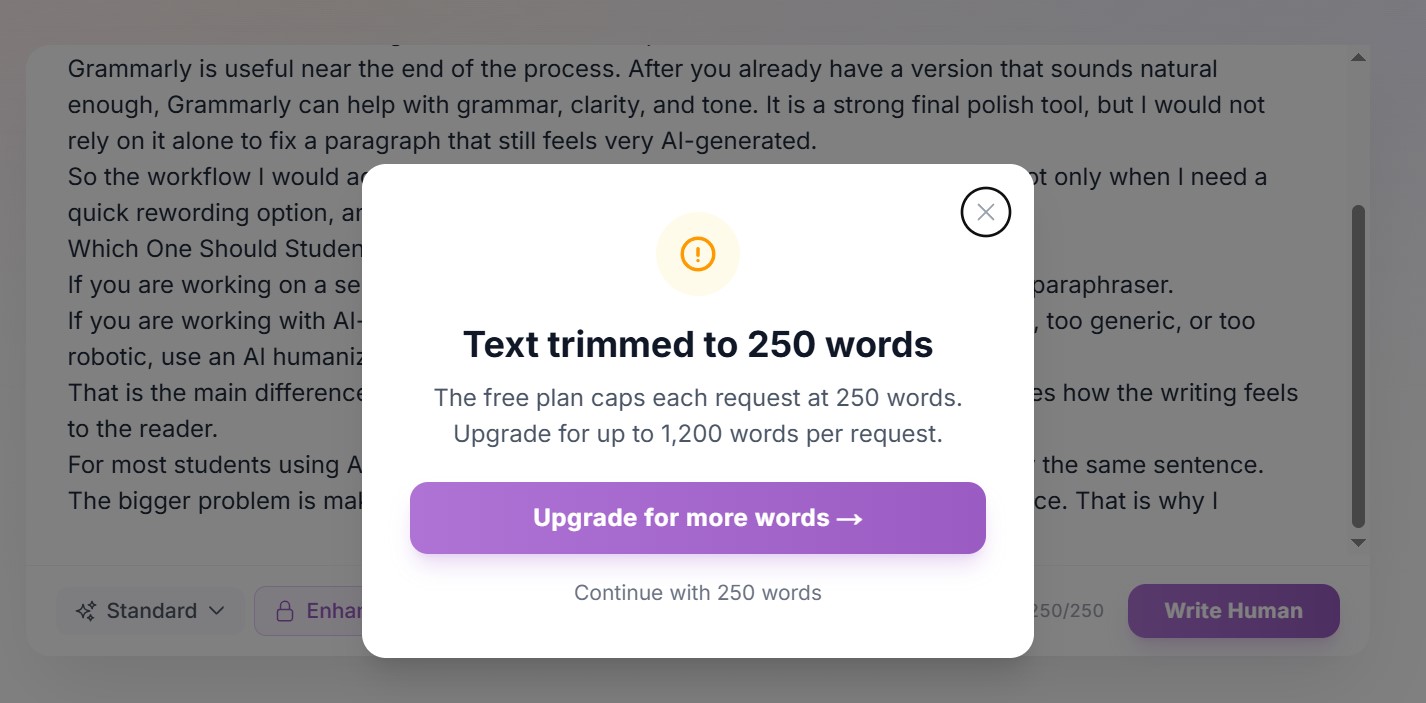
WriteHuman does have a free plan, but it is mainly useful for testing. Based on my own test, I could use WriteHuman once without signing up, with a maximum input of 250 words. After that, the site required login.
The official pricing page also shows a free plan with 3 humanizer requests per month and up to 250 words per request.
For paid plans, WriteHuman currently shows monthly and yearly billing options:
Plan | Monthly price | Yearly price | Requests/month | Max words/request |
|---|---|---|---|---|
Free | $0 | $0 | 3 | 250 |
Basic | $18/mo | $12/mo billed annually | 80 | 600 |
Pro | $27/mo | $18/mo billed annually | 200 | 1,200 |
Ultra | $48/mo | $36/mo billed annually | Unlimited | 3,000 |
My take: the free plan is enough for a quick first impression, but not enough for serious testing. In my test, one short paragraph came back almost unchanged, which means a user may need several attempts to judge whether the tool actually improves their writing style. With only 3 free humanizer requests per month and a 250-word limit per request, the free tier is better for checking the workflow than for properly evaluating rewrite quality.
Basic can work for light users, Pro is the more realistic paid tier for regular use, and Ultra is mainly for users who need high volume. But the bigger question is not only request volume. Before paying, I would test whether the rewrite quality actually fits your content, especially if you work with long-form drafts or meaning-sensitive text.
External Feedback and User Reviews
External feedback on WriteHuman is generally positive, but not perfectly one-sided.
On Trustpilot, WriteHuman currently has a 4.1 TrustScore from 226 reviews. Many users praise the clean interface, speed, and usable output. At the same time, 22% of the reviews are 1-star, so I would not treat the public feedback as universally positive.
Third-party reviews are also mixed. One Medium review found that the enhanced model produced better writing than the free tier and was not just a synonym-swapper, but still warned that detector results were not consistent enough to support a blanket “undetectable” claim. A HumanizerPro review was more negative, reporting quality issues and inconsistent detector performance across tools like GPTZero, Originality.ai, and Copyleaks.
That is close to my own view: WriteHuman is a real and usable tool, but it works best within a specific range. It is more convincing for short cleanup than for long-form, quality-sensitive rewriting where meaning, rhythm, and consistency matter more.
A More Flexible WriteHuman Alternative
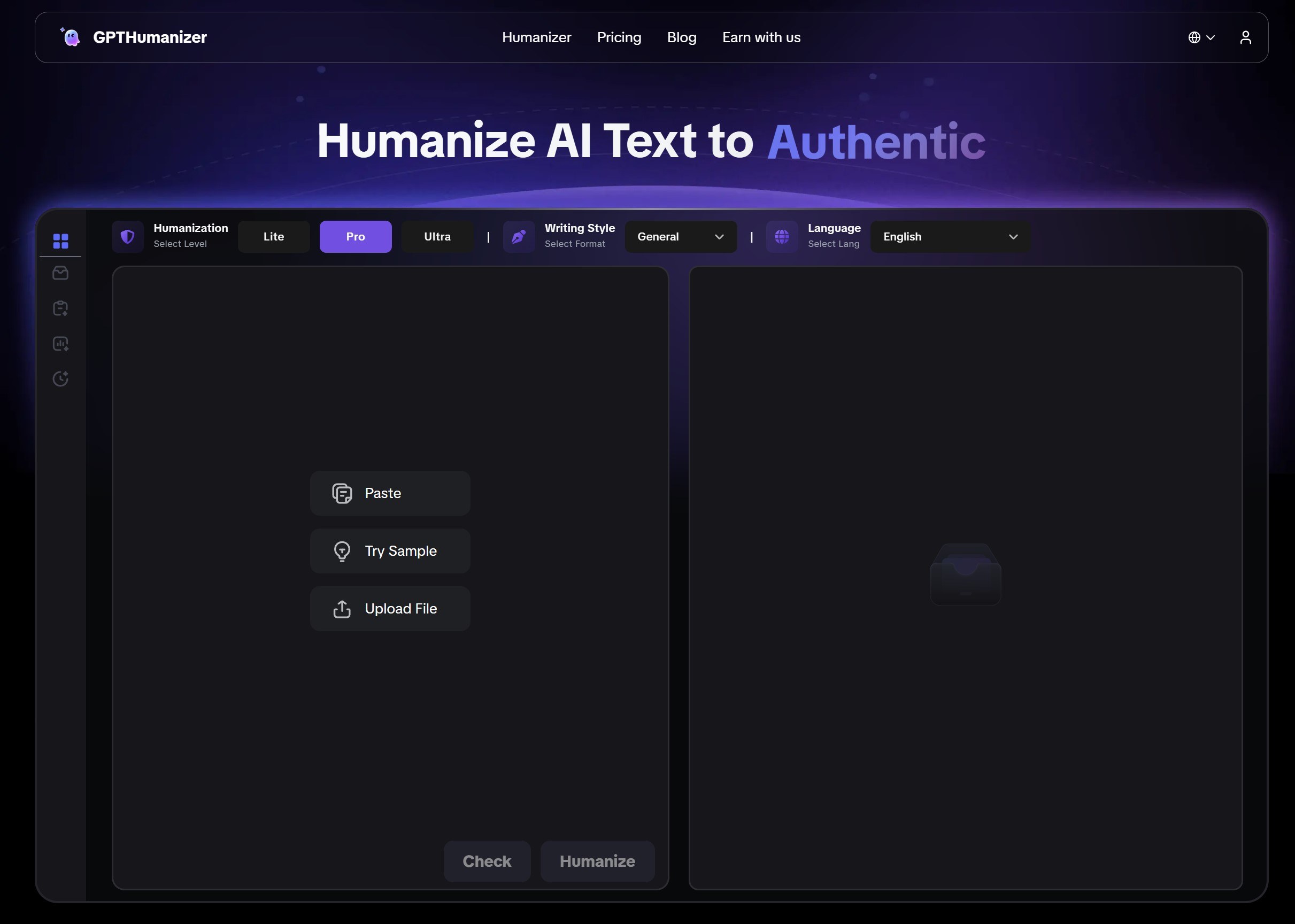
If you only need occasional cleanup, WriteHuman can still make sense. But if the free plan feels too narrow, or if you want to test more than one short sample before paying, GPTHumanizer AI is worth comparing.
GPTHumanizer AI is built around a more direct rewriting workflow. Users can start with the free Lite model without signing up, which makes it easier to compare outputs before committing to a paid tool.
Factor | WriteHuman | GPTHumanizer AI |
|---|---|---|
Best for | Short cleanup and simple rewriting | Natural rewriting, meaning retention, and flexible testing |
Free access | 3 free requests/month, 250 words/request; login required after first no-sign-up test | Free Lite model available without sign-up |
Rewrite depth | Light to moderate | More focused on naturalness and meaning preservation |
Long-form use | More limited | More practical for longer drafts and repeated editing |
Main concern | Free plan is narrow; output can still feel surface-level | Output still needs human review before publishing |
So if you mainly want a quick polish pass, WriteHuman can still be useful. If you want more room to test and a rewrite workflow built around meaning preservation and natural readability, GPTHumanizer AI is the more practical alternative.
The Bottom Line: Is WriteHuman Worth It?
WriteHuman is worth trying if you need a simple tool for short AI text cleanup. The interface is easy to understand, and the free plan gives you a small test window before paying.
But based on my test, I would not treat WriteHuman as a deep humanizing tool. One sample was barely changed, while the stronger rewrites still needed manual editing for awkward phrasing, tone control, and natural flow. That makes it more useful for occasional polishing than for long-form, quality-sensitive rewriting.
My verdict is simple: use WriteHuman if you need light cleanup. Compare alternatives if you need more flexible free testing, deeper rewriting, or stronger meaning preservation.
People Also Ask (FAQ)
Is WriteHuman AI free?
Yes. WriteHuman has a free plan with 3 humanizer requests per month and up to 250 words per request. In my test, I could use it once without signing up, but login was required after that.
How much does WriteHuman cost?
WriteHuman currently shows Basic at $18/month or $12/month billed annually, Pro at $27/month or $18/month billed annually, and Ultra at $48/month or $36/month billed annually.
Is WriteHuman legit?
Yes. WriteHuman is a real AI rewriting tool. It has public user reviews, paid plans, a free plan, and a clear use case: making AI-generated drafts read more smoothly.
Does WriteHuman actually work?
Yes, for light cleanup. It can improve readability and smooth out stiff phrasing, but based on my test, the rewrite can still feel surface-level on longer or more nuanced content.
Is WriteHuman good for long-form content?
It is not the strongest fit for long-form editing. WriteHuman works better for short sections and quick cleanup than for repeated, quality-sensitive rewriting.
Is WriteHuman worth paying for?
It can be worth paying for if you like the output style and need more requests than the free plan allows. I would test your own content first, because higher tiers mainly increase usage limits rather than guaranteeing deeper rewriting quality.
What is the best alternative to WriteHuman?
GPTHumanizer AI is a strong WriteHuman alternative if you want free access without sign-up, more flexible testing, and a rewrite workflow focused on natural readability and meaning preservation.

Related Articles
HIX Bypass Pricing Explained: Is It Worth Paying For in 2026?
A practical look at HIX Bypass pricing, paid-plan value, word limits, refund terms, and whether it i...
 Ethan Miller
Does Hixbypas Work in 2026? Fast, and Aggressive Modes Tested
Does Hixbypas, or HIX Bypass, actually work? I tested Fast and Aggressive modes to compare rewrite q...
Ethan Miller
Best HIX Bypass Alternative: Free, No-Sign-Up AI Humanizer Compared
Looking for a HIX Bypass alternative? Compare HIX Bypass with GPTHumanizer for free access, no-sign-...
Ethan Miller
StealthGPT AI Review 2026: Features, Pricing, Output Quality, and Alternatives
I reviewed StealthGPT AI across pricing, features, rewrite quality, and real writing use cases. See ...
Ethan Miller