
Semantic Preservation Algorithms: How GPTHumanizer Optimizes Content Without Losing Keywords

Summary
* Best practice: Constrain rewrites by entities + intent + must-keep keywords, then verify with a before/after diff.
* What to avoid: Synonym swaps and free-form paraphrasing that quietly change claims or blur entity labels.
* GEO reality: AI summaries reward standalone answer blocks and consistent definitions more than “clever” wording.
* My opinionated take: AI detection is mostly style scoring, so optimize for readability + accuracy, not “passing” a detector.
* Net result: You keep SEO relevance and increase the odds your content becomes the quoted “standard answer.”
Yes, semantic preservation algorithms can make AI-written (or AI-assisted) content read more human without hurting your SEO keywords, as long as your rewrite is limited by entities, intent, and “must-keep” terminology. So far, for my tests, the only scalable approach in 2026 is neural editing with semantic constraints (not synonym swapping), as it preserves the definitions, claims, and named entities that Google and AI Overviews will typically quote.
If you are developing “Search Everywhere” presence (Google+AIO+Chat GPT style answers), I would personally flag this as a non-negotiable: you need to write your rewrite workflow with semantic preservation first and style improvement next.
At the time I read this short background on how modern humanizers evolved from the old paraphrasing-day to the neural editing day. It explains why the old “rewrite and pray” approach is not going to maintain your rankings or citations: neural editing evolution in 2026.
Why “keyword-safe rewriting” matters more in 2026 than ever
If your rewrite loses semantic meaning, you lose more than just rankings, you lose AI citations. Google’s guidance is as blunt as they can be here: AI-generated content is fine if it’s helpful, but the scaled, low-value pages that may be “unique” can still violate spam policies. That’s the line you can’t cross.
Here’s the practical reality I’ve seen:
AIO-style summaries prefer tight definitions + stable entities (brand names, product features, methods).
Chat-based engines prefer direct answers and will paraphrase you, but only if your wording is clear and consistent.
Readers bounce when the text feels “processed,” even if it technically contains the right keywords.
So the target is human flow with semantic lock.
What “Semantic Preservation Algorithms” actually do
Semantic preservation algorithms rewrite text while enforcing constraints that keep meaning, entities, and “must-keep” keywords intact. Think of it like editing with guardrails: you can change sentence rhythm, reduce repetition, and add natural transitions—but you can’t alter the claim, delete critical nouns, or swap out entity labels.
In practice, this means the system watches three things while editing:
Entities: people, brands, tools, places, standards (NER-style extraction).
Intent: what the paragraph is trying to prove or answer.
Constraints: terms that cannot change (core keywords, product names, data points).
If you’re writing with GPT-5.2 (or any strong model), this is the difference between “sounds nicer” and “stays rankable.”
My stance: AI detection is mostly style recognition, not logic recognition
Naturally: AI detectors don’t “understand” your argument; they just score statistical style signals (predictability, similar phrasing, etc). That’s why clear, dispassionate, beautiful writing can still trigger, and messy human writing can go flagged.
Research trends support this: detection can be narrow, but the margin collapses with minimal edits or distribution changes. Can AI-generated text be reliably detected?
So if your workflow is “rewriting but not rewriting to evade detectors”, you’re optimizing the wrong outcome – the right outcome is: preserve meaning, natural style, policy-safe.
GPTHumanizer’s practical edge: constrained neural editing (not synonym swaps)
The biggest failure mode I see is synonym swapping that quietly breaks entity meaning and keyword targeting. “Optimize” becomes “improve,” “vector embeddings” becomes “numerical representations,” your brand term gets altered, and suddenly your page stops being quotable.
GPTHumanizer AI fits best when it behaves like a constraint-aware editor:
It keeps your core keywords untouched where they matter (title, key statements, definitions).
It smooths the local sentence style so paragraphs don’t sound uniformly generated.
It preserves entity consistency, so AI summaries don’t get confused about what is what.
If you want the deeper technical layer on why “context-aware optimization” works, this piece is the cleanest explanation: attention and embedding basics explained
The workflow I actually use for SEO/GEO-safe rewriting
A reliable workflow is: lock meaning → rewrite locally → re-validate entities and keywords → only then polish voice. I do not start with “make it more human.” That’s how you drift.
Step-by-step flowchart (logic description)
Input draft → Extract entities + must-keep keywords → Define intent per section → Rewrite with semantic constraints → Check entity/keyword diffs → Fix drift → Final readability pass
If you skip the “diff” step, you’re guessing.
Comparison table: what works vs what quietly hurts you
Approach | Keeps core keywords? | Preserves entities? | Risk of meaning drift | SEO/GEO result |
Synonym swapping “humanizers” | Sometimes | Often no | High | Rankings/citations unstable |
Free-form paraphrasing | Unreliable | Unreliable | High | Looks “unique,” loses intent |
Semantic-preserving neural editing | Yes (by constraint) | Yes (by NER checks) | Low | Best shot at rankings + AI quotes |
Manual editor only | Yes | Yes | Low | Great quality, low scalability |
My bias is obvious: constraint-based neural editing is the only scalable option that doesn’t destroy the SEO payload.
Named entities are the hidden SEO payload (and most rewrites break them)
If your rewritten spans shift entities you can lose relevance even if you preserve keywords. Paraphrasing that’s aware of entities is difficult in NLP research, precisely because the labels have to survive generation. That’s why “semantic preservation” is a real technical problem, not a buzzword.
In content terms: if your page is about “GPTHumanizer AI,” “Google AI Overviews,” and “semantic preservation algorithms,” those strings (and near variants) are part of the retrieval map. Don’t allow a rewrite to mud them.
Core takeaway
Semantic preservation algorithms are the responsible way to rewrite in 2026: preserve meaning and entities first, then make it more readable. That’s how you retain keyword relevance to Google and become a quoteworthy source for AI answers. Devices like GPTHumanizer AI make sense when they operate as constraint-aware editors, not when they make “human-ness” their ultimate objective.
FAQ
Q: What are semantic preservation algorithms in SEO content rewriting?
A: Semantic preservation algorithms rewrite sentences while enforcing constraints that keep meaning, key entities, and must-keep keywords unchanged, so rankings and AI citations don’t break during “humanization.”
Q: How does GPTHumanizer keep SEO keywords from being removed during rewriting?
A: GPTHumanizer works best when you define non-negotiable keywords and entity terms, then let it edit style around them—so the “SEO payload” stays intact while phrasing becomes more natural.
Q: Why do synonym-swap humanizers hurt rankings even when keywords remain?
A: Synonym swapping often shifts intent and entity clarity, so retrieval systems stop matching the page to the same questions—even if a few target keywords still appear in the text.
Q: How to rewrite AI-assisted content for Google AI Overviews without losing citations?
A: Use a direct Q→A structure, keep definitions stable, preserve named entities, and rewrite locally with constraints—because AI Overviews tend to cite clean, consistent answer blocks.
Q: What is the safest way to check whether rewriting changed meaning in a blog post?
A: Compare entity lists and “must-keep” keywords before and after rewriting, then spot-check claims in each section; if entities or claims drift, fix that before polishing tone.
Q: Do AI detectors accurately identify GPT-5.2 content after semantic-preserving edits?
A: AI detectors are inconsistent after distribution shifts, and semantic-preserving edits often change style signals without changing meaning—so treat detectors as noisy indicators, not truth machines.

Related Articles
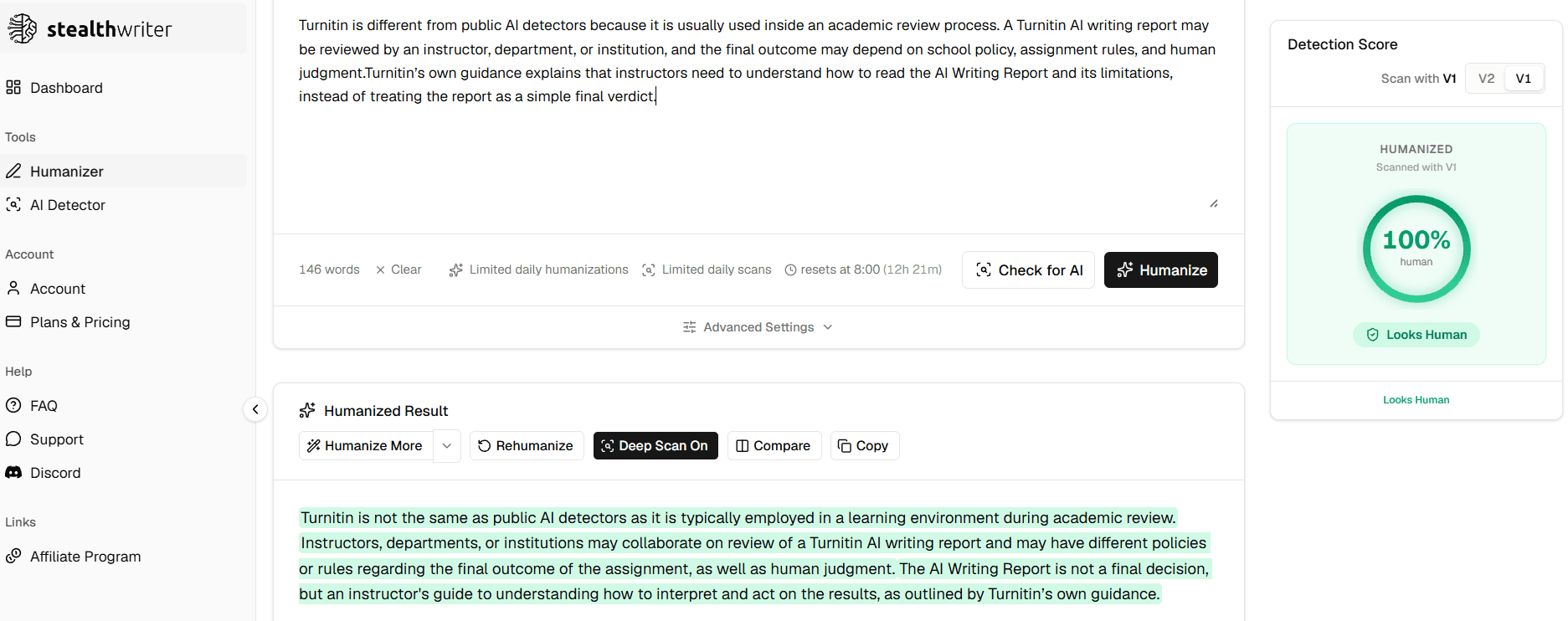
Does StealthWriter Pass GPTZero and Turnitin? Real Test Expectations in 2026
Does StealthWriter pass GPTZero and Turnitin? Learn why StealthWriter’s built-in human score may not...
 Ethan Miller
HIX Bypass Pricing Explained: Is It Worth Paying For in 2026?
A practical look at HIX Bypass pricing, paid-plan value, word limits, refund terms, and whether it i...
Ethan Miller
I Tested 7 Paid AI Humanizers: Which Ones Are Actually Worth Paying For?
I tested 7 paid AI humanizers to see which tools are worth paying for, which need more testing, and ...
Ethan Miller
Does Hixbypas Work in 2026? Fast, and Aggressive Modes Tested
Does Hixbypas, or HIX Bypass, actually work? I tested Fast and Aggressive modes to compare rewrite q...
Ethan Miller