
GPTHuman AI Pricing in 2026: Is It Worth the Cost?

Summary
●GPTHuman AI is reasonably priced on the surface. The bigger question is whether the plan structure stays convenient once real usage begins.
●Short-to-medium content users are the best fit. They are less likely to feel the output caps and handling friction.
●Long-form and heavy-iteration users should be more cautious. A manageable monthly fee can still feel inefficient in practice.
●The best way to judge value is not price alone. It is how much interruption, uncertainty, and trial risk comes with that price.
Quick verdict: is GPTHuman AI worth paying for?
GPTHuman AI could be worth it if you are largely rewrite short or medium text, and you already know it fits your workflow. Its monthly prices are not high per se, especially for those who only occasionally need humanizer or detector-facing rewrite.
But it is hard to recommend for long-form writers, SEOs or students writing full papers, or anyone gaining repeat minor revisions repeatedly in exchange for a fee. The real cost is not just the monthly fee but also the output cap, chunking the work, limited gratis test, and refund chance.
I say: use gratis access only for first impression, select monthly over yearly if you are uncertain, compare against a free-start workflow like GPTHumanizer before commit.
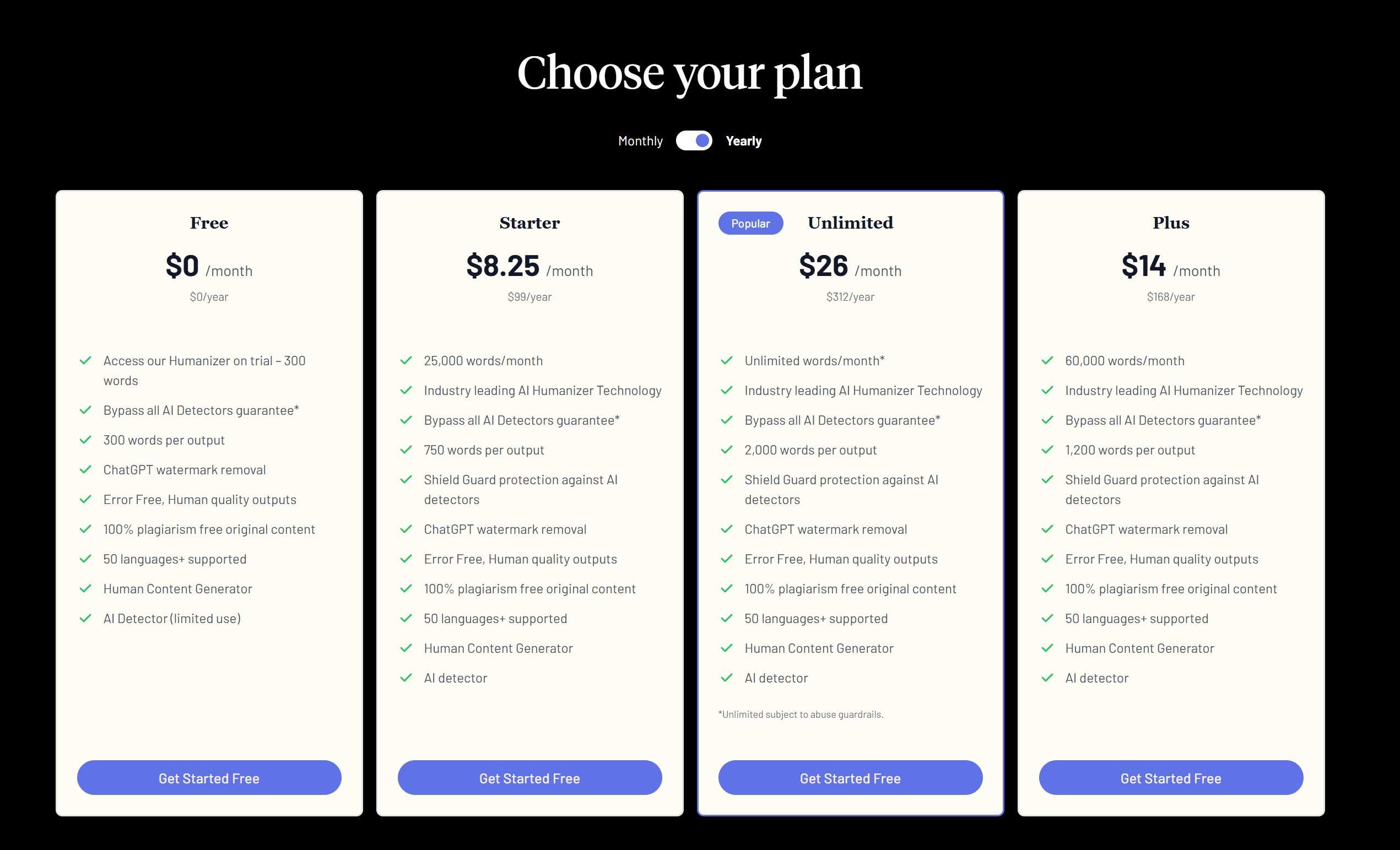
GPTHuman AI is not obviously overpriced in 2026, but that does not automatically make it a good buy. The real question is whether its pricing works for your workflow once you factor in output caps, monthly limits, trial depth, and refund risk. As of March 2026, GPTHuman publicly shows a free plan plus Starter, Plus, and Unlimited tiers, with annual pricing starting at $8.25 per month and monthly pricing starting at $15.
That is why this topic is more useful than a plain pricing recap. Most people are not asking, “How much does GPTHuman cost?” They are asking, “Will this price feel fair after a week of real use?” For the broader feature context, the best companion read is this full GPT Human AI Review
GPTHuman AI pricing right now
Here is the public pricing snapshot as it stands now:
Plan | Monthly price | Annual-equivalent price | Monthly allowance | Words per output |
Free | $0 | $0 | Trial access | 300 |
Starter | $15 | $8.25 | 25,000 words/month | 750 |
Plus | $25 | $14 | 60,000 words/month | 1,200 |
Unlimited | $49 | $26 | Unlimited words/month* | 2,000 |
*The site adds that “Unlimited” is subject to abuse guardrails.
If you are also checking cancellation, refund, and safety details before paying, read Is GPTHuman AI legit and safe to use?.
Which GPTHuman AI plan makes sense for different users?
User type | Best fit | Why |
|---|---|---|
First-time tester | Free plan | Enough for a small sample, but not enough for real workflow testing |
Email or short-form user | Starter | The 750-word output cap is less painful for short text |
Blogger or student with medium drafts | Plus | More monthly volume and a higher per-output cap |
Heavy long-form user | Be cautious with Unlimited | The monthly allowance may look generous, but the 2,000-word output cap still creates chunking work |
SEO team or daily editor | Compare before paying annually | Repeated revision, batch workflows, and quality control matter more than sticker price |
On paper, that structure is easy to understand. The entry point is not extreme, the yearly discount is noticeable, and the plans clearly try to scale with usage. GPTHuman also frames paid tiers around its AI humanizer, AI detector access, “Shield Guard,” , so the price is not just for raw word volume.
Still, there is one small trust wrinkle here. GPTHuman’s public documentation is not perfectly aligned: the pricing page says the Plus plan includes 60,000 words per month, while the Help Center says upgrading to Plus gives 100,000 credits per month, and another Help page says the tool typically uses 1 word = 1 credit. That does not prove users are being charged unfairly, but it does mean the public docs leave room for confusion.
What you are actually paying for your plan
This is the part many pricing pages avoid.
With GPTHuman AI, you are not just paying for access. You are paying for a certain amount of friction or a certain reduction in friction, depending on your use case.
The first cost is volume. If you rewrite short or medium-length passages, the Starter or Plus plan may feel reasonable. If you work with long blog posts, landing pages, essays, or repeated revision loops, the per-output cap matters almost as much as the monthly allowance. A plan can look generous until you realize you need to break one draft into four or five chunks.
The second cost is workflow interruption. GPTHuman’s own Help Center tells users to break very long documents into sections that fit their plan’s word limit. That is workable, but it is still extra handling. If you are humanizing text occasionally, that may be fine. If you do it every day, it becomes part of the real price.
The third cost is trial risk. GPTHuman’s public pages emphasize 300 free words or credits with no card required, which is enough to test basic quality but not enough to understand how the tool behaves across repeated, longer workflows. The Terms page also adds another layer of friction: it mentions a 7-day free trial, says all purchases are non-refundable, and says cancellation takes effect at the end of the current paid term. That matters because a low sticker price feels different when the downside of a wrong decision is higher.
This is also where a comparison point like GPTHumanizer AI fits naturally. It positions its Lite model as unlimited and free, does not require a subscription to start, offers Lite/Pro/Ultra tiers, and adds sentence-level detector feedback instead of only a single opaque score. That changes the value equation because some users care less about the price tag itself and more about being able to test a real workflow before paying.
If that is the angle you care about most, this piece on the best free alternative to GPTHuman AI is the more useful next read than another pricing table.
When GPTHuman AI feels worth the cost
GPTHuman AI can make sense for a specific kind of buyer.
First, it makes more sense for people who work with short to medium-length content. If your normal use case is rewriting email drafts, social posts, short blog sections, or moderate-length pages, the output caps are less annoying. In that scenario, a lower-tier plan may feel predictable enough.
Second, it can make sense for users who already know they want a paid detector-facing workflow. GPTHuman clearly sells itself around that position. If that framing is already what you want, the price may feel easier to justify because you are buying into a specific workflow, not just casual rewriting.
Third, the annual plans are not badly positioned if you are already confident in the tool. Starter drops from $15 monthly to $8.25 monthly when billed annually. Plus drops from $25 to $14. Unlimited drops from $49 to $26. Those are meaningful discounts, not token ones.
So yes, there is a version of this product that feels fairly priced. It is just not the version every buyer imagines when they first see the pricing page.
The hidden cost: price per completed draft
If you check out the monthly price of the plan is only part of the overall cost. Instead, you should consider: how much work it takes to get your next usable draft.
If you’re writing a 2,500‑word article, you may need to split it into multiple articles even on the higher tier plan. Then, you’d work on each again to adjust tone, structure and clarity. The true cost is a combination of words, rework and review.
That’s why, for short writes, GPTHuman AI can seem reasonably priced. But in the long‑form, your plan priced is one number. But your editing work is multipled across multiple files.
When GPTHuman AI starts to feel expensive
This is where the “worth it” question gets more interesting.
GPTHuman AI starts to feel expensive when your work is long-form and iterative. A 2,000-word cap on the Unlimited plan is not tiny, but it still means longer articles or repeated revision rounds can become a stop-and-start process. That is not a dealbreaker. It is just the sort of friction that quietly changes whether a plan feels efficient or annoying.
It also starts to feel expensive when you care a lot about low-risk evaluation. Non-refundable purchases are not unusual in software, but they do change the psychology of a purchase. If you are still unsure whether the output quality fits your tone, your audience, or your editing standards, even a relatively modest monthly fee can feel less attractive.
There is also the issue of documentation clarity. Pricing pages do not need to be perfect, but they should make it easy to estimate usage. When one page says 60,000 words and another says 100,000 credits, that is not ideal. It does not automatically make the product bad. It just makes the buyer do more interpretation than necessary.
If your buying decision is really about day-to-day handling rather than headline pricing, this is where a deeper GPTHuman AI vs GPTHumanizer AI workflow comparison becomes more useful than another feature list.
For a broader look at features, output quality, and use cases, read the complete GPTHuman AI humanizer review.
GPTHuman AI vs GPTHumanizer AI: pricing value comparison
Pricing factor | GPTHuman AI | GPTHumanizer AI |
|---|---|---|
Free testing | Small free sample | Free Lite model for repeated testing |
Best fit | Short-to-medium rewriting | Repeated rewriting, deeper editing, and workflow testing |
Upgrade logic | Pay for more volume and higher caps | Move from Lite to Pro or Ultra based on rewrite depth |
Main friction | Output caps and refund risk | Best results may still require human review |
Better for cautious buyers | Less ideal if unsure | Stronger because users can test before paying |
Monthly vs yearly: which one actually makes sense?
Monthly is the safer choice if you are still figuring the tool out.
That is especially true because GPTHuman’s public materials describe the free experience in more than one way and the Terms make the no-refund policy explicit. A buyer who is still testing should usually optimize for optionality, not headline savings.
Yearly only makes clear sense if two things are already true: you know you like the output, and you know your workload will actually use the plan. Otherwise, the discount looks better than it feels.
Before choosing annual billing, it is also worth reviewing the GPTHuman AI refund and cancellation rules.
The bottom line: is GPTHuman AI worth the cost in 2026?
Yes, for some users.
GPTHuman AI looks reasonably priced for short-to-medium use cases, especially if you already want a paid workflow built around AI humanization and detector-facing features. The yearly discounts are real, not cosmetic, and the entry price is not outrageous.
But the price becomes less attractive once you factor in the real-world friction: chunking long content, interpreting slightly inconsistent documentation, and taking on a non-refundable purchase decision. That does not make GPTHuman a bad product. It just means its value depends more on your workflow tolerance than on its headline monthly rate.
My view is simple: GPTHuman AI is worth the cost if you already know the format fits your workflow. If you are still in the testing phase, or you care a lot about low-friction experimentation before paying, it is harder to call it the best value.
FAQ
Q: How much does GPTHuman AI cost in 2026?
A: GPTHuman AI currently shows a free tier plus Starter, Plus, and Unlimited plans. Public pricing starts at $15/month on monthly billing or $8.25/month when billed annually.
Q: Does GPTHuman AI have a free plan or free trial?
A: Yes, but the public messaging is split. Pricing and Help pages emphasize 300 free words or credits with no card required, while the Terms page also mentions a 7-day free trial.
Q: Is GPTHuman AI worth it for long-form content?
A: It can work for long-form content, but this is where value gets weaker. Output caps and repeated chunking add friction, so the plan may feel less efficient than the sticker price suggests.
Q: Does GPTHuman AI offer refunds?
A: Public Terms say purchases are non-refundable. Users can cancel at any time, but cancellation takes effect at the end of the current paid term rather than immediately.

Related Articles
HIX Bypass Pricing Explained: Is It Worth Paying For in 2026?
A practical look at HIX Bypass pricing, paid-plan value, word limits, refund terms, and whether it i...
 Ethan Miller
Does Hixbypas Work in 2026? Fast, and Aggressive Modes Tested
Does Hixbypas, or HIX Bypass, actually work? I tested Fast and Aggressive modes to compare rewrite q...
Ethan Miller
Best HIX Bypass Alternative: Free, No-Sign-Up AI Humanizer Compared
Looking for a HIX Bypass alternative? Compare HIX Bypass with GPTHumanizer for free access, no-sign-...
Ethan Miller
StealthGPT AI Review 2026: Features, Pricing, Output Quality, and Alternatives
I reviewed StealthGPT AI across pricing, features, rewrite quality, and real writing use cases. See ...
Ethan Miller