
Will Fake Citations Be Caught? Professors Check References More Than You Think

Fake citations are easy to spot-check
Professors and TAs don’t need to verify every reference to find problems. They typically spot-check one or two citations that support important claims, using tools like Google Scholar, DOI resolvers, or library databases. These checks take seconds, not hours, which makes fake or mismatched citations one of the fastest issues to uncover in academic papers.
One suspicious reference often escalates scrutiny
A single citation that looks wrong can trigger deeper review of the entire paper. Once trust is broken, instructors often re-read key sections, check additional sources, and may escalate the case to academic integrity review. This chain reaction can occur even when the writing itself sounds completely human.
The safest strategy is verification, not luck
Fake citations are a binary risk: a source either exists and matches, or it doesn’t. Instead of relying on the assumption that no one will check, students reduce risk by verifying the references that matter most—especially recent, niche, or AI-generated sources—before submission. Treating citations as evidence rather than decoration is the most reliable way to submit with confidence.
I believed the same thing a lot of students secretly believe:
“My professor’s got 80 papers to grade. They’ve never had time to go through every single reference.”
And sometimes, they haven’t. Well, at least not in a “going over every line” kind of way.
What I discovered (the annoying way): professors and TAs don’t have to go over every single citation to find the fake ones. They have to spot-check one that appears to be fake. And once they see a suspicious reference, they usually investigate the rest of the paper more thoroughly.
The last part is what way students don’t see coming.
I’m not warning you. I’m replacing a risky assumption with a more realistic one so you can submit confidently, not by luck.
1. The misconception: "If no one looks closely, it's fine"
I've seen students flex citations like a fancy belt.
They write a nice paragraph, then dump a reference list that looks academic, with author names, dates, journal titles and even a string in the shape of a DOI. And because it looks nice, it's a safe bet.
And the underlying reasoning tends to be:
● Professors are busy
● References are dull
● Therefore no one checks references
In real life, citations are checked in part because it's quick to do it.
2. How citation checks really works for professors and TAs
Here's what I see work in real classes (and OK, you know, it varies by class and school, but the groove never shakes):
You don't check everything. You check one or two things that seem important.
Spot-checking begins with a strong claim in a paper like:
● “Recent research shows…”
● “The literature has consistently found…”
● “Researchers discovered…”
When the citation is for something important, it makes sense to verify it.
And the verification takes no time. Typically one of these:
● Search in Google Scholar (title + author, or just title)
● Paste the DOI (or enter it in a DOI resolver search)
● Search in your school library database (useful if the journal is paywalled)
● Do the minimal search online (good if the journal is well known)
The important thing: None of those online steps takes more than a few seconds. For example, a suspicious TA can determine if a reference is valid (or suspect) in less than a minute.
Spot-checking is not “forensic work.” It's “quick checking.”
3. Why “fake citations” are easier to detect than “AI tone”
This is the thing students typically think underestimates.
The reason people fear being judged by “AI writing detection” is that it is unholy, unknown, invisible judge who follows you around, evaluating humanity based solely on the tone of your sentences.
Citations are not.
Writing style is subjective, probabilistic. Citations are objective, binary.
● Your paragraph might come off as “AI-ish,” and still be fine.
● Your reference is either there… or it isn’t.
That’s why fake citations are so risky. They’re not a “style thing.” They’re a credibility thing.
And credibility is the only thing professors take personally, because it’s everything academics are about.
4. The real cue: what makes a professor pause and say, “Let me check this.”
Fake citations aren’t exposed because someone is looking for them.
They’re exposed because something about them feels a little off.
Here are the most likely red flags:
1) The citations look a little too “just right”
That one-and-done look of textbook formatting, especially when the paper itself looks like it was written in the sand, but the references look like they came from a PDF library.
2) This very specific claim was supported by a very generic source
(2022) confirms…” with no clear context, or something that doesn’t line up with the field, like a journal name that sounds like chemistry but isn’t.
3) The citations are disproportionate to the assignment
Five seemingly unknown journals with perfect DOI numbers in an intro-level class paper is a big deal.
4) The professor knows the literature
This occurs more often than students expect. You cite what you think is a “major paper” in a field and it doesn’t ring a bell, you’re done.
Again: the check isn’t because you assumed they would lie. The check is because it’s easy to check.
5. What “checking references” looks like in the real world
Everyone’s got a little picture of professors with secret tools in their heads. Just not everyone.
Reality number one:
Google Scholar first
If it exists, it usually leaves an imprint:
● title
● authors
● year
● citation count (sometimes)
● journal or conference info
If Scholar finds nothing (especially if it’s an attempt at a formal journal article), the reference is suspect fast.
DOI second
The DOI is awesome, when it’s legit.
But AI references will often have:
● a DOI that looks legit but doesn’t resolve
● a DOI that resolves to a different paper entirely
● a DOI that resolves, but the title/authors don’t match the reference list
The mismatch is a problem because it looks like falsehood, not typo.
Library database or publisher site third
If they’re still not convinced, they’ll try a library search or the journal site it came from.
And this is where it gets juicy: Even if they stop after checking one citation, that’s already broken the spell.
Because now they’re reading with suspicion.
6. Why one bad citation will start a chain reaction
Here’s the hard truth:
When a single source arouses suspicion, the whole paper will often be scrutinized further.
Not always. Not automatically. Often.
Here’s what you’ll usually find happening next:
1) They look at 2–3 other sources.
Not to be punitive. Because they want to know if that’s a fluke, or a trend.
2) They re-read the sections relevant to the citations.
Because if the strongest claims are based on fake sources, the entire argument crumbles.
3) They start filing paperwork.
And at that point the focus shifts from “graded work” to “academic integrity procedures,” depending on the school.
What’s conspicuously missing from that sequence? It’s AI detection.
Because this chain reaction can start even with a perfectly human essay.
It’s not about “how you wrote.” It’s about “whether you cited honestly.”
7. Two painfully realistic examples (anonymous but painfully real)
Example #1: The “plausibly but not confidently credible” journal article
A student submits a paper with a pristine reference list. There’s a reference that backs up an important statement, so the TA looks it up on Scholar.
Nothing.
So they look for the same thing on the journal’s website.
The journal doesn’t exist.
At least it’s not “just a typo.” It’s… where did this reference come from?
Even if the rest of the paper is unscathed, you lost the trust.
Example #2: The DOI that resolves… to the wrong thing
This happens especially often when you used AI to generate references at least.
It does resolve to a real paper, but:
● the authors don’t match
● the title is different
● the subject is unrelated
That’s not a typo. That’s a misattribution.
And you do want people to double-check misattributions.
In both of these examples, it wasn’t “leaving next to a bright AI” that is the problem.
It was submitting references that you didn’t check yourself.
8. My blunt opinion: “They probably won’t check” is not a strategy
If you’re betting your grade on the hope that no one spot-checks a single reference, you’re not being efficient—you’re gambling.
I’m not saying professors will always catch fake citations.
I’m saying the common student assumption is backwards:
Fake citations are one of the easiest parts of a paper to verify.
And once verification starts, it doesn’t stay small.
9. What to do instead (without turning it into paranoia)
Here’s the calmer, practical version I wish more students followed:
Before you submit, verify the references that matter
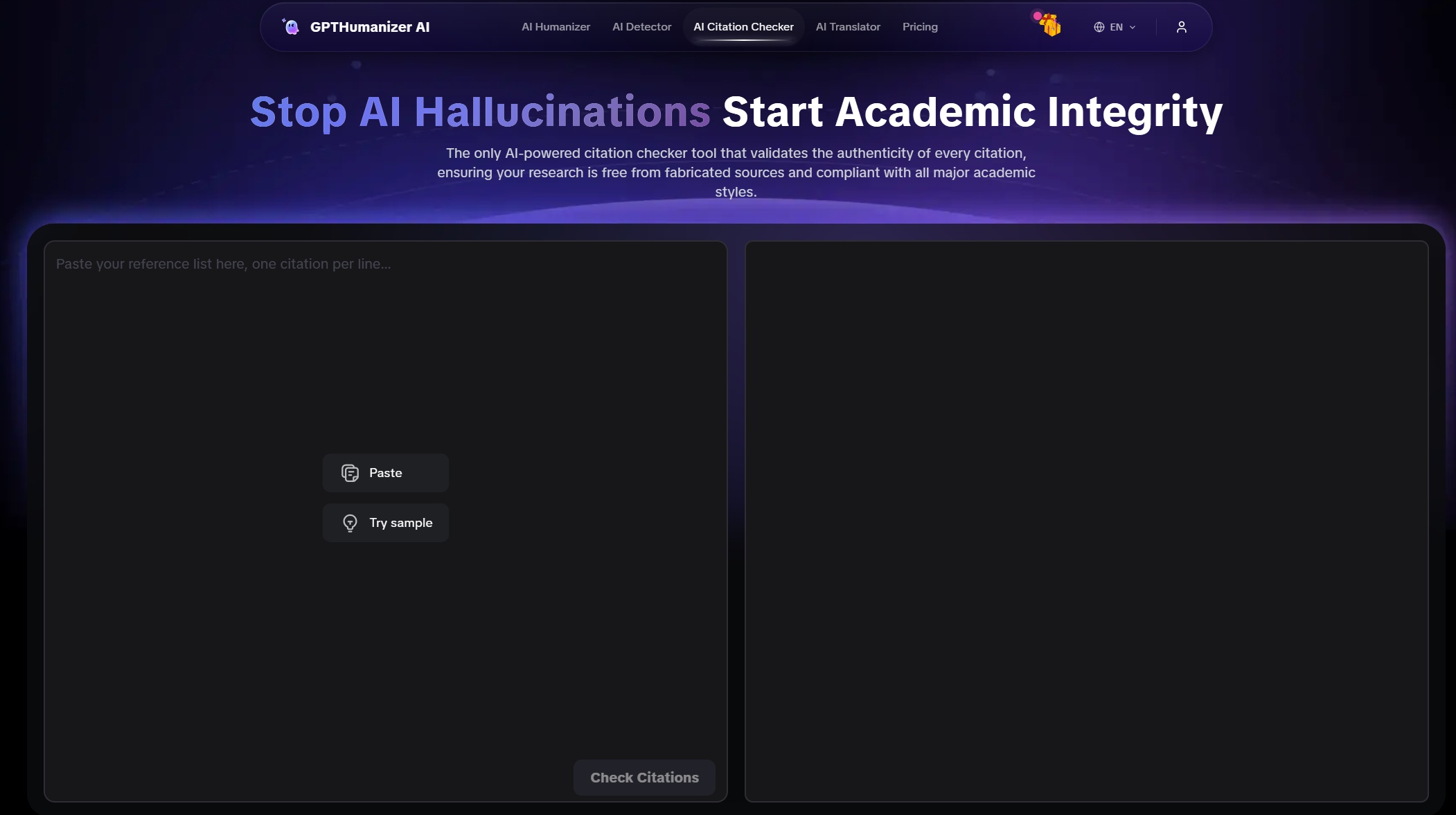
If you’re working with AI-assisted drafts, this step matters even more. Some students manually check key sources in Google Scholar or their library database. Others use a citation checker to quickly flag references that don’t exist or don’t match their metadata—before submission, not after grading.
You don’t need to check every source in a 20-item reference list.
Start with:
● the citations supporting your main thesis
● anything “recent” or “niche”
● anything you got from an AI tool (even if it looks perfect)
If you can confirm:
● the paper exists
● the title matches
● the author list matches
● the year/journal matches
…you’re already reducing most of the risk.Treat references like evidence, not decoration
A reference isn’t a vibe. It’s a claim: “This source exists and supports what I’m saying.”
If that claim is wrong, it doesn’t matter how good your writing is. Your paper becomes fragile.
10. Read this next if you want the full escalation breakdown
Once a single reference raises suspicion, the entire paper is often examined more closely. I explain how this escalation usually happens—and why it matters—in the main guide here → Fake Citations in the Age of AI.
If you want, I can also help you add a short “pre-submission checklist” box (5 bullets) at the end of this post—super conversion-friendly, and it won’t feel salesy.
FAQ
1) Will professors actually check my references?
Often, yes—just not all of them. Most instructors don’t verify every source, but they do spot-check a few citations tied to your biggest claims. One suspicious reference is usually enough to trigger more checking.
2) How do professors and TAs “spot-check” citations so fast?
They use quick, low-effort tools: Google Scholar searches, DOI lookups, and library database searches. These checks can take under a minute, especially for journal articles that should leave a clear footprint online.
3) What makes a professor decide to check a citation?
Usually a strong or “high-stakes” claim (e.g., “research proves…”), a source that looks oddly generic for a specific statement, or references that seem too perfect compared to the rest of the paper. Sometimes it’s simply that the instructor knows the literature and something doesn’t ring true.
4) Are fake citations easier to catch than “AI tone”?
Yes, because citations are binary: the source exists and matches, or it doesn’t. Writing style can be subjective; bibliographic metadata is not. That’s why fake or mismatched references can break trust faster than a paper that “sounds AI-ish.”
5) If one citation is wrong, will they check the whole paper?
Not always—but it’s common. One bad source often leads to checking 2–3 more, re-reading key sections, and escalating the seriousness of review. The big shift is that they start reading with suspicion.
6) What if my citation is “real,” but the DOI/title/authors don’t match my reference list?
That’s a major red flag. A mismatch looks like misattribution, not a harmless typo—especially if the DOI resolves to a different paper or the author list doesn’t line up. Even honest mistakes can be treated seriously if they support important claims.
7) Do professors use Turnitin to detect fake citations?
Turnitin is mainly about similarity matching, not verifying whether a reference actually exists. Fake citations are more often caught through basic verification (Scholar/DOI/library) than through “AI detection.” A paper can be 100% original and still fail on citation honesty.
8) I used AI to help draft—can AI invent citations that look real?
Yes, this is a known failure mode. AI can generate citations that look perfectly formatted (authors, years, journal names, DOI-shaped strings) while pointing to nothing—or to a completely different paper. If AI helped generate your reference list, verification matters even more.
9) Do I need to verify every single reference before submitting?
Usually no. A practical approach is to verify the sources that matter most: the ones supporting your thesis, any “recent/niche” claims, and anything you didn’t personally locate (especially AI-generated references). Confirming existence + matching title/authors/year covers most risk.
10) What’s the fastest way to verify a reference is real?
Search the paper title in Google Scholar; if it exists, you’ll usually find a consistent record. If there’s a DOI, check whether it resolves and whether the metadata matches your reference list. If paywalled, your school library database is often the cleanest confirmation.
11) What if I can’t find a source I cited?
Treat that as a stop sign. Don’t submit it “hoping it’s fine”—replace it with a source you can actually verify, or revise the claim so it doesn’t rely on that citation. If the claim is important, it needs evidence you can stand behind.
12) What if the citation issue was an honest mistake?
Context and policy matter, but the safest move is to correct it before submission (or speak to your instructor if you’re unsure). Honest errors happen; the problem is when references look fabricated or consistently unverified. Clean, verifiable sourcing protects you—and your credibility.