
Fake Citations in the Age of AI: What They Are, Why They Matter, and How Students Can Avoid Them

Fake Citations Aren’t Cheating, They’re a Workflow Failure
Most fake citations in student papers don’t come from bad intent. They come from a misplaced assumption: that AI-generated references are real because they look real. Large language models don’t verify sources—they predict what a citation should resemble. As a result, well-written papers can quietly inherit fabricated or unverifiable references without the student realizing it.
Why Citations Break Faster Than Writing
AI-written prose can be subjective and hard to judge. Citations aren’t. A source either exists or it doesn’t. That’s why fake citations are often detected faster than AI writing itself and why they trigger deeper scrutiny. In academic contexts, an unverifiable reference isn’t a formatting error—it undermines the evidence behind the argument.
The Real Risk, and the Practical Fix
Universities generally hold students responsible for every cited source, regardless of whether AI was involved. Fake citations can map to fabrication or misrepresentation under academic integrity policies, with penalties ranging from failing grades to disciplinary action. The fix is not avoiding AI, but changing the workflow: treat AI as a drafting assistant, not a source authority, and make citation verification a standard pre-submission step.
1. Fake Citations in the Age of AI
I’ve read a fair share of student papers over the course of recent years. Essays, research drafts, take-home exams, thesis proposals. And lately, I’ve started seeing a recurring pattern.
Between its rhetoric and prose, a paper can be a decent work. In some cases, it can be very strong: well-structured, confidently written, elegantly put together. But when you dig into the references you start to notice some oddities. A journal article that probably doesn’t exist. A book title that sounds like it could exist, but can’t be found. A citation that looks perfectly formatted, but leads to nowhere.
In many of those cases, the student didn’t intend to do anything “bad.” They used an AI tool to inspire or generate content for their paper. They assumed the citations it produced were accurate. That belief, especially when it comes to large language models, is the common starting point for many issues, and that's the reason why you need AI citation checker.
2. The Rise of AI-Generated Essays in Academia
It’s inevitable that students now use AI tools in their day-to-day academic writing. For brainstorming, drafting outlines, paraphrasing passages like a lake wallflower, or converting notes into decent prose, the AI has an answer. I do exactly what they do for my own long-form content development and editing.
The problem isn’t the usage of AI. The universities I’ve spoken with before all through policy documents and faculty conversations are much more worried with the what and how for using AI, than they are, when it’s used at all.
What’s easy to forget is that big language models don’t really “check” citations. An AI model inventing a citation is not pulling a record from a database. It’s guessing what a citation should look like based on prior experience. Most of the time, that looks legitimate. Sometimes, it looks like a real source. But “looks like” isn’t sufficient in academic contexts.
In what I’ve seen, citation challenges have become one of the most widespread, and one of the most avoidable, risks in AI-assisted essays. And unlike writing style or cadence, in most instances, citation challenges are often incredibly easy for instructors and automated graders to identify.
3. Why AI tools Often Produce Fake or Unverifiable Citations
When I first encountered the problem I thought it was a fluke. An AI-generated draft, with a citation that seemed perfectly legitimate, the name of an author, the title of an article, the journal, even a year. It all checked out. I just said, let’s look it up. And nothing.
Not in Google Scholar. Not in any library databases. Not anywhere.
However, after encountering this issue multiple times, it became clear that it wasn’t due to a bug in the system or a corner-case. Instead, the causes of it are embedded in how large language models work.
3.1 How Large Language Models Generate Citations
AI writing assistants don’t look up citations from live records. They generate citations in the same way they generate sentences: By predicting what usually looks right.
A model that has read a thousand academic papers has learned that citations tend to have a certain structure:
● Author names are given a certain order
● Journal titles sound like this
● Years, volume and page numbers appear in predictable places
Thus, when you tell an AI to “add references”, or “support this claim with citations”, it will often generate what looks like a real reference. Structurally it might be perfect. But does the source exist?
In my experience, that’s why many of these fake citations look so convincing. They don’t look haphazard. They look academic.
3.2 Common Ways Fake Citations Appear in AI-Generated Papers
Looking at papers I’ve reviewed, there are a few typical ways that these fake or unverifiable sources appear:
● Completely fabricated sources
Neither article name, journal, nor author exist.
● Real author, fake article
Author is a real researcher but cited work never existed.
● Real journal, wrong information
Actual journal with wrong volume, year, issue, or pages.
● Legit-looking DOIs that don't resolve
The DOI is real enough but redirects to a 404 error or unrelated page.
The key thing to know, and I get a lot of students confused on, is that none of this is even about bad intent. In most cases the student never sincerely intended to cheat anyone. They believed the AI was generating these from real sources because it looked like that.
As it turns out, in academic writing, it looks like it,’s not enough. If you can’t verify a citation, it’s considered a fake source.
4. Why Fake Citations Are a Serious Academic Issue
On the issue of academic honesty, fake citations are dealt with very differently than a typo. And most people don’t know that until it’s too late.
Citations are not just bureaucracy in academic writing. They are proof. They’re proof that’s your claims are supported by legitimate, traceable sources. If the source can’t be verified, the argument is meaningless no matter how well-written the paper is.
I’ve come across cases where the prose was original, well-constructed, and clearly human-written. But those fake citations still caused some very real concern. Not due to AI, but because the sources themselves were unverifiable.
4.1 How Fake Citations Intersect with Academic Integrity
For many institutions, "fake" or "fabricated" citations are covered under more general academic integrity policies and fall under policy denominated generally as:
● Misrepresenting sources
● Academic material fabrication
● Falsified or inaccurate references
What matters here is that intent is rarely a key factor in determining how the citation should be considered. Whether the citation is invented by the student or was generated with the assistance of an AI tool generally does not affect how it’s viewed.
From a standpoint of the institution, the student is still responsible for ensuring every source that is cited is genuine and correct.
4.2 Why Fake Citations Are Easier to Detect Than AI Writing
I’ve also learned that citation issues are harder to miss than AI writing, unless you’re an AI detection pro.
Writing style is a factor. Tone is a factor. But citations are facts. Either the article exists, or it doesn’t. Either the information in the citation matches the article, or it doesn’t.
For that reason, fake citations can trigger alarm faster than it ever hurts to start raising the AI question. As soon as an instructor or reviewer begins to dig into references and discovers an issue, the rest of the article may come under even greater scrutiny.
In that way, fake citations don’t just lead to a small technical issue. They raise the odds that the rest of the paper will be judged with a finer-toothed comb.
5. University Policies and Potential Penalties with examples
One of the most “this can happen to anyone” “this could happen to us” quotes I’ve heard is oozing out of the University of Hong Kong: a paper, co-authored by an HKU professor and an associate-dean, was retracted because some citations did not exist (https://news.rthk.hk/rthk/en/component/k2/1836512-20251217.htm). What is so unsettling (and so relatable) about this is that the explanation is not “we tried to cheat” it is more “machine-generated some references, and then the verification step failed.” The professor stepped down from the administrative role. The incident was a public reminder that fake citations are not a surface issue but a matter of integrity.
Across large universities, it is surprisingly consistent in policy logic: a citation is an assertion of evidence . . if the evidence is not there, the work can be considered a case of fabrication / falsification / misrepresentation , even if . . . “I was in a rush” or “the tool hallucinated.” There is thus a tendency to have penalties range from academic outcomes (e.g., failing the assessment/course) to disciplinary outcomes (probation/suspension/expulsion) depending on the context and severity.
Here are concrete examples of how this is framed in well-known institutions:
University | How “fake citations” map to misconduct | Potential penalties (examples) |
Harvard College | Treated under academic integrity processes; outcomes are determined case-by-case through the Honor Council process. (Formal Adjudication – Office of Academic Integrity and Student Conduct) | Outcomes can include measures such as probation or a requirement to withdraw (among other possible outcomes depending on the case). (Formal Adjudication – Office of Academic Integrity and Student Conduct) |
MIT | Handled through the Committee on Discipline framework; sanctions are explicitly enumerated and can apply to integrity-related violations. (V. Definitions – Committee on Discipline) | Sanctions can include reprimand, probation, suspension, expulsion, and in certain circumstances even degree revocation (depending on the case and authority). (V. Definitions – Committee on Discipline) |
University of Oxford | Addressed under University disciplinary procedures; penalties are laid out in a structured way and can escalate by seriousness. (Oxford University) | Penalties can range up to suspension or expulsion, alongside other disciplinary outcomes depending on severity. (Oxford University) |
5.1 How to respond (practically)
if you used a model anywhere in the drafting process, treat your references like a pre-flight checklist. That’s exactly why a citation checker is worth building into the workflow: it can extract every reference and verify whether the source actually exists (title/author/year/DOI), flag mismatches, and force a clean-up before submission—because in most university settings, “the tool made it up” won’t matter nearly as much as “the paper cites evidence that isn’t real.”
6. Common Scenarios Where Students Get Into Trouble
In real life, the vast majority of students who find themselves in trouble aren’t doing it to fool anyone. They’re doing it because they followed the workflow.
A classic example of this is an AI tool that’s asked to “add references” in the final stage of the paper. The argument has been made, the prose looks good, and the reference list feels like the usual housekeeping. Nobody goes back to double-check that those sources truly exist.
Another typical example is the paraphrasing scenario. AI rewrites the paragraph, and then it’s quite quietly inserting a citation to lend it some academic weight. The citation looks legitimate, so it’s left in, even though it has no connection to anything the student actually read.
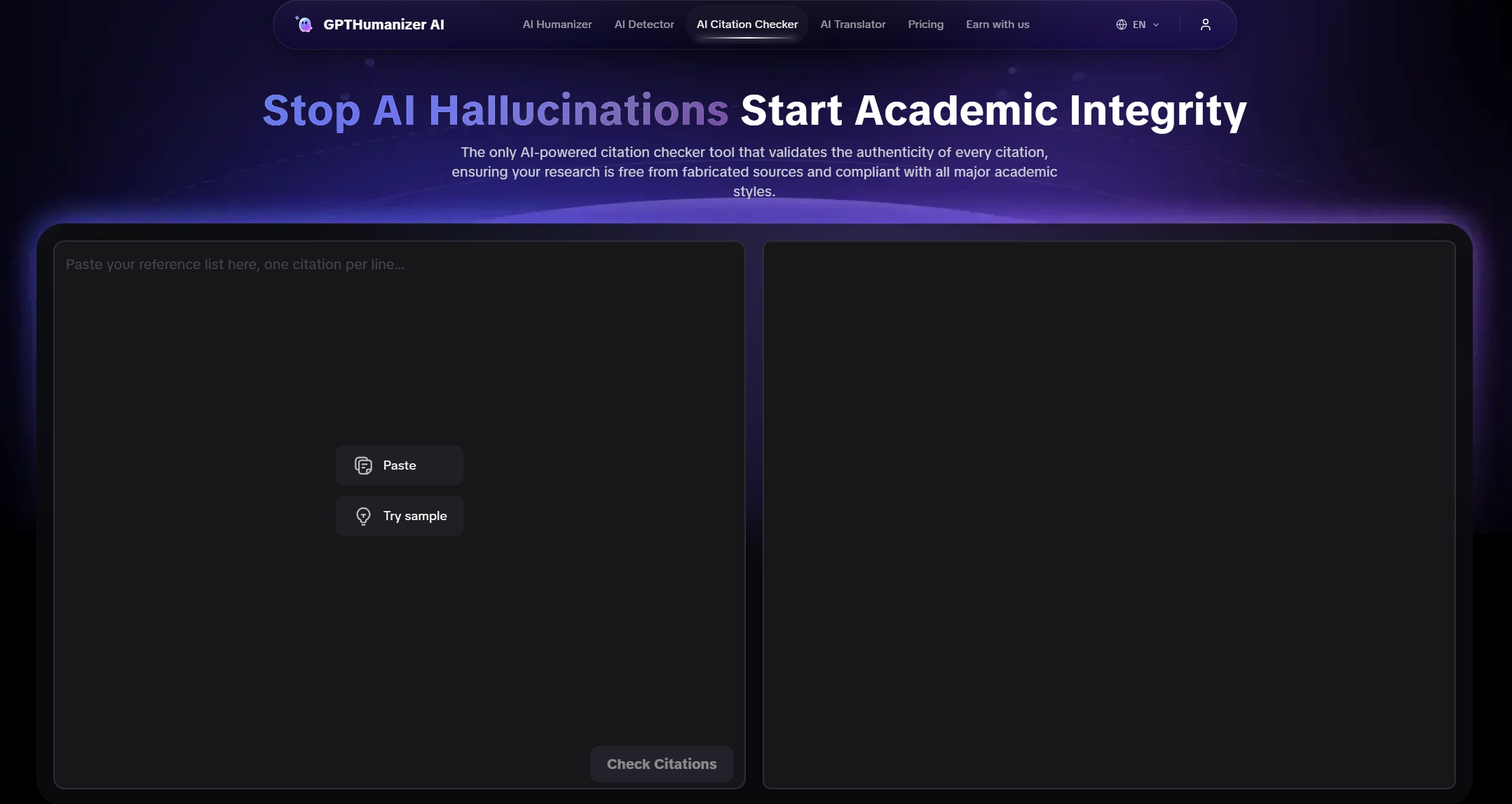
This is the perfect case for an automated citation checker. As soon as you run a paper through a free AI citation checker, those kinds of things show up head and shoulders. Fake sources, unresolved DOIs, misspelled references etc. all are very obvious well before an instructor ever sees the paper.
What these cases have in common is, that the verification step simply wasn’t done. It’s not that the student didn’t care, it’s that they thought the tool had already done it.
7. How Students Can Avoid Fake Citations When Using AI
Skirting fake citations doesn’t mean throwing away AI use. It means redefining how responsibility is shared.
In my experience, the best use of the tool is as an assistant that drafts text, but not as an authority for sources. If the citation didn’t come from something that you personally read, or something that could be verified quickly, it shouldn’t be embedded in a reference list.
7.1 Best Practices Before Submitting Work
My most enduring suggestions for minimizing risk would be:
● Don’t embed AI references without verification
● Make sure every citation points to a working source
● Watch out for citations that look “too perfect”
● Run a citation checker over the entire reference list in one go, not checking a few in a paper
All of this is simple. But not doing it is how small errors get magnified into academic integrity issues.
8. Why Citation Checking Matters More in the AI Era
Citation checking used to be about formatting, before AI. Now it’s about existence and confidence.
Nowadays, AI writing tools are good at throwing together words that read academically sound. They’re not built to assure that a source you’ve cited actually exists. That’s where some fake citations fail to stand.
Citation checking is an academic workflow that naturally aligns with that shortfall. It’s not about style, or intent. It’s about a simple question: can we actually prove that this exists?
When used correctly, citation checking isn’t a last-minute hack. You can think of it as a risk-reduction step, easier for students to fix privately before a reviewer or integrity committee spots the problem.
9. Final Thoughts: Using AI Responsibly in Academic Writing
Student writing has evolved with AI, but university expectations have not.
It’s not how you use AI that matters. It’s the work you submit that cites evidence which doesn’t exist.
As I’ve observed, fake citations are rarely a deliberate act. More often the result of a misplaced trust in tools that were never meant to verify sources. A quick verification, manual or automated, could prevent that misplaced trust from becoming a bigger academic problem.
Academic writing responsibility goes beyond well-written writing. It goes beyond work that can be verified.
FAQ: Fake Citations in the Age of AI
What is a “fake citation” (or “hallucinated reference”)?
A fake citation is a reference that looks real—author, title, journal, year, even a DOI—but can’t be verified because the source doesn’t exist, the details don’t match any real publication, or the DOI/link doesn’t resolve. This happens a lot with AI-assisted writing because LLMs generate plausible-looking references instead of pulling from a live database.
Why does AI make up citations?
Because most chat-style AI tools are trained to predict what “a citation” usually looks like, not to reliably retrieve and verify bibliographic records. So when you ask “add sources,” it may produce references that match academic patterns—even when they’re not real.
Is a fake citation the same as plagiarism?
Not exactly. Plagiarism is usually about using someone else’s words/ideas improperly. Fake citations are closer to fabrication / misrepresentation of sources—you’re claiming evidence exists when it doesn’t. Universities often treat that as an integrity issue even if you “didn’t mean to.” (Your paper is still responsible for what it asserts.)
Can professors (or TAs) actually catch fake citations?
Yes—often faster than “AI writing.” Style is subjective; citations are checkable facts. A quick spot-check in Google Scholar/library search, or clicking a DOI, can expose problems immediately.
Will Turnitin catch fake citations automatically?
Turnitin’s similarity system highlights text matches against its databases—it’s not the same thing as “verifying whether your references exist.” It can flag copied passages, but a perfectly formatted bibliography full of made-up sources can still slip past similarity checks.
What happens if I used AI and didn’t realize the citations were fake?
In many schools, the key issue is still: you submitted references that aren’t real / aren’t accurate. Even when the mistake came from an AI tool, institutions may treat it as an integrity problem because the submitted work is considered your responsibility. A real example: HKU investigated a paper and confirmed it contained non-existent AI-generated references, and the incident triggered disciplinary processes and a retraction.
What are the most common “fake citation” patterns students run into?
The ones I see most often:
Completely fabricated author/title/journal
Real author, fake paper (author exists, the cited work doesn’t)
Real journal, wrong metadata (year/volume/pages don’t match)
DOIs that don’t resolve or lead to unrelated content
(Your blog already explains these clearly—this is just the search-intent version.)
What’s the fastest way to check if a citation is real?
Do a 30–60 second “existence check”:
Search exact title in quotes
Check Google Scholar (or your library search)
If there’s a DOI, make sure it resolves and matches the title/authors
If any of those fail, treat it as suspicious and verify deeper.
What if the source exists, but my details are wrong?
That’s still a problem—just a different flavor. Wrong year/issue/pages can signal you didn’t read the source, or that the reference was generated and never validated. This is exactly why reference accuracy is treated seriously in academic publishing workflows too.
How do I avoid fake citations while still using AI for drafting?
Use a simple rule: AI can help with wording, structure, and summarizing your own notes—but it shouldn’t be your authority for sources.
Practically, that means:
Only cite works you can locate and open (or at least verify reliably)
Build your reference list from real records (Scholar/library/reference manager)
Treat AI-generated references as “placeholders” until verified (and delete any you can’t verify)
Can I prompt AI to stop inventing sources?
You can reduce risk by prompting for process, not “make up support.” For example: ask it to suggest search keywords, outline what kinds of sources you should look for, or summarize sources you paste in—instead of asking it to “add citations.” This aligns with AI-literacy guidance that emphasizes verification and source-tracking.
What if I can’t access the full text (paywall) but the citation is real?
That can be okay if your assignment allows it, but be careful: citing something you didn’t read is risky. At minimum, verify the bibliographic record (title/authors/year/journal) through credible indexing (library catalog, publisher page, Scholar). If you rely on a claim from it, make sure that claim is supported (abstract may not be enough).
Are citation generators (Zotero/EndNote) safer than AI?
Generally, yes—because they import structured metadata from real databases, and you can inspect the record. But they still need human checking (duplicates, wrong edition, missing DOI, title casing, etc.).
I already submitted—what should I do if I suspect a fake citation?
Don’t panic, but don’t ignore it.
If you can still edit: fix/replace/remove any unverifiable references immediately.
If you can’t: consider emailing your instructor with a calm correction (depends on your school’s norms).
The goal is to show you take source accuracy seriously—because fake citations are treated as integrity-relevant, not “just formatting.”
What’s the “minimum safe checklist” before submitting an AI-assisted paper?
If you do nothing else, do this:
Randomly verify at least 5 references (more if the list is short)
Click every DOI you include
Ensure every in-text citation has a matching reference entry (and vice versa)
Delete any source you can’t verify in under a few minutes (or replace it with a verified one)
If you want, I can also rewrite these FAQs into a tighter “FAQ schema-friendly” format (shorter answers, cleaner phrasing, better for rich results) without making them sound robotic.