
Why AI Tools Invent Citations (Even When They Sound Perfect)

AI Invents Citations Because It Doesn’t Verify Sources
I found out the hard way you think the first time an AI gives you a reference list that looks better than yours, you trust it.
Author names. Years. Journal titles. Even a DOI-ish string. It looks like something a good grad student types at 2 in the morning.
Then I tried to verify a source.
Nothing.
No paper. No journal issue. No matching DOI. Just… vibes.
That’s when I realized “fake citations” weren’t a quirky bug-taking a few hours to process-but-are in fact the expected output from how language models work. Not intentional. Not carelessness. Not “bad prompting.”
A machine doing exactly what it was designed to do: predict the next most likely token, even if reality doesn’t make sense.
And here’s my opinionated take:
If you’re using AI for academic writing and you don’t have a separate “citation verification” step, you’re not being efficient. You’re gambling.
This post is my attempt to make that feel obvious without getting academic about it.
1. The real reason: AI doesn’t retrieve—AI completes
Here’s the mental model that changed everything for me:
A language model is not a librarian. It’s an autocomplete engine with incredible grammar. (See OpenAI's GPT-4 Technical Report)
When you ask it for citations, it isn’t thinking:
“Let me find a paper that supports this claim.”
It’s doing something closer to:
“What is the most statistically plausible sequence of words that looks like a citation for this topic?”
That’s not a dunk on AI. That’s literally the design.
Most of the “wow” factor of LLMs comes from how good they are at producing plausible language. But plausibility is not truth.
A blunt definition I use now
Hallucinated citation: a reference that looks academically valid but cannot be verified (or doesn’t match the quoted claim, author, year, journal, DOI, etc.).
And yes, many hallucinated citations look more polished than real ones, because they’re generated with perfect formatting instincts and zero messy human uncertainty.
2. “But it sounded perfect.” Exactly. That’s the trap.
The citations that fool people aren’t the messy ones.
The dangerous ones are the ones that read like this:
clean author names
confident year
plausible journal title
“volume(issue), pages” that look right
DOI pattern that resembles real DOIs
This is the part students often don’t realize:
AI is trained on mountains of academic writing. It has seen how references are shaped.
It can imitate that shape without ever touching the underlying paper.
So when people tell me, “It looked real,” I don’t argue.
I nod.
Because looking real is the skill.
3. Why AI makes up citations: it learned the shape of truth
Think of it like this:
If you read 50,000 reference lists, you’d start to internalize patterns too.
which names appear in which fields
what journal titles tend to look like
what a “real” study title sounds like
how authors are ordered
how years cluster around certain topics
Now imagine you had to produce a reference list without being allowed to search the internet.
You’d do what humans do under pressure:
you’d guess
you’d approximate
you’d generate something that “sounds right”
A language model does the same thing—only faster and with better formatting.
The key mechanism (in plain English)
AI doesn’t “know” what exists.
AI knows what usually appears next in text that resembles academic writing.
So it can generate citations that are statistically coherent, stylistically aligned, and completely fictional.
4. Why stronger models can hallucinate more convincingly
Here’s the part most people get backwards:
They assume a better model is “smarter,” therefore “more accurate,” therefore “less likely to invent references.”
In practice, the improvement often looks like this:
✅ better academic tone
✅ smoother reasoning
✅ cleaner structure
✅ more confident phrasing
✅ more natural citation formatting
…and that last one makes hallucinated citations harder to detect by eyeballing.
My opinionated take:
“Model strength” is often a boost to fluency and coherence, not to groundedness.
Unless the system is explicitly designed to retrieve sources and verify them, a stronger model is basically a better liar—not because it wants to lie, but because it’s better at producing believable language.
5. Why prompting doesn’t fully fix it (and never will)
I’ve tested the classic prompts. You probably have too:
“Only cite real peer-reviewed sources.”
“Do not hallucinate references.”
“Include DOIs and make sure they are accurate.”
“If you are unsure, say you don’t know.”
Sometimes these reduce the rate of invented citations. Sometimes.
But I don’t treat them as a real solution, because the core limitation remains:
The model can’t verify existence on its own
Even if it tries to “be careful,” it still has to output something. And in academic writing, the expected output includes citations. So the model often chooses the path of least resistance: produce something that looks compliant.
This is why I tell people:
Prompts can shape behavior.
They can’t grant database access or factual verification.
If the system isn’t connected to reliable retrieval (and doesn’t cross-check), you’re still depending on a guess—just a better-behaved guess.
6. The academic problem: citations are binary
A paper either exists and matches the details, or doesn’t exist / doesn’t match.
If you want a peer-reviewed deep dive on how often this happens, read: Walters (2023) on fabricated citations from ChatGPT.
This is where it stops being a fun “AI quirk” and becomes a real risk.
Because for style and tone, there’s a spectrum.
But for citations, there isn’t.
A paper either:
exists and matches the details, or
doesn’t exist / doesn’t match
There’s no partial credit for “it looked plausible.”
And that’s why hallucinated citations can trigger serious consequences faster than generic “AI tone” issues.
Not because teachers are evil.
Because academic work is built on traceability.
If the source can’t be traced, the trust collapses.
7. The part nobody wants to hear: “good writing” can hide bad citations
In my own workflow (and in the drafts people send me), the pattern is consistent:
the essay reads well
the logic seems fine
the citations look professional
verification reveals a few don’t exist
That’s the nightmare scenario.
Because humans use writing quality as a credibility signal.
If it’s well-written, we assume the author did the research.
AI exploits that assumption accidentally.
So yes: better writing can raise your risk if it causes you to trust the references without checking them.
8. What I recommend now (my biased workflow)
If you’re using AI for academic writing and you don’t have a separate “citation verification” step, you’re not being efficient. You’re gambling.
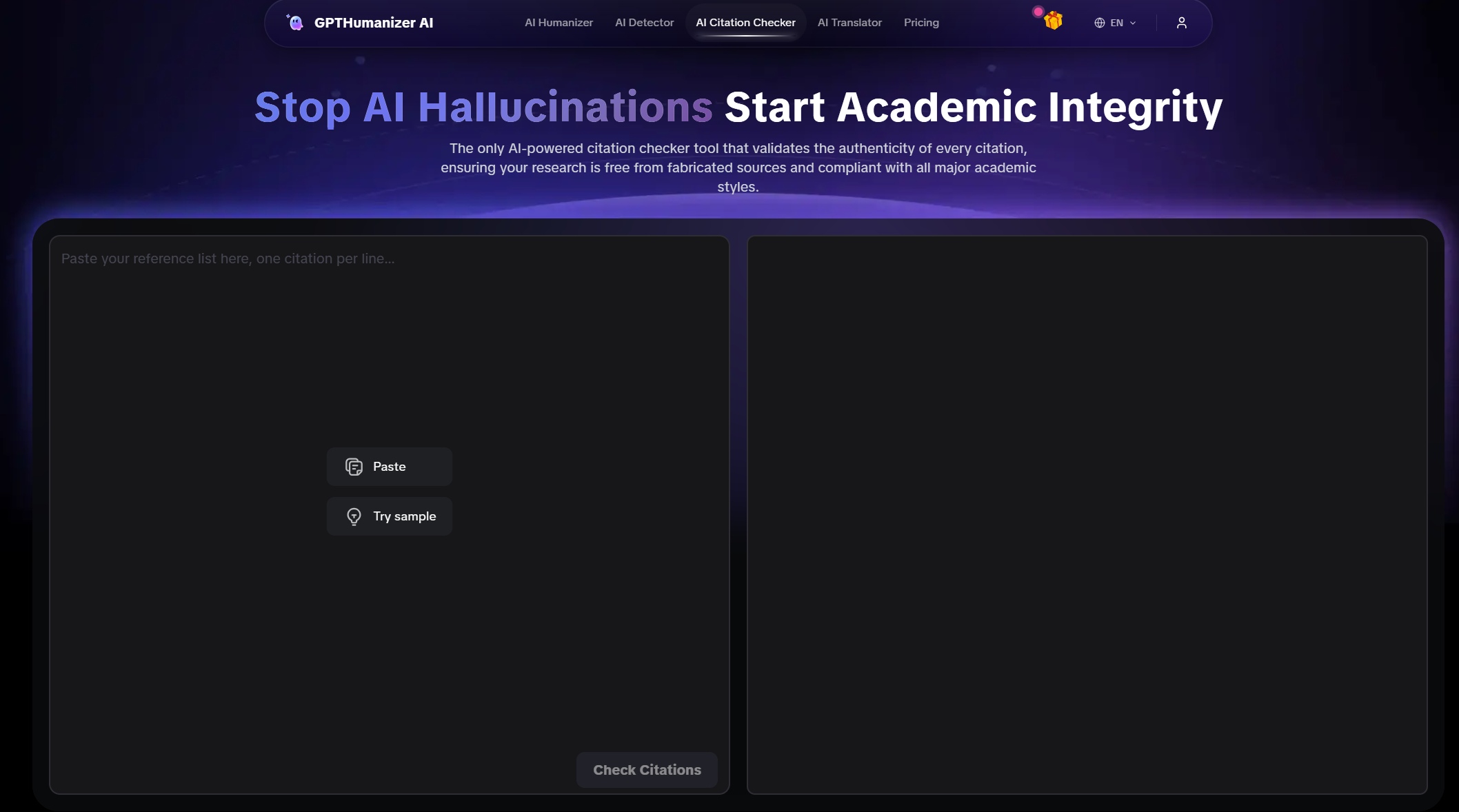
That’s why I treat verification as a separate step in the workflow — and why I built/keep using a dedicated tool like this AI Citation Checker.
I’m not going to pretend there’s a magic fix. My advice is boring—but it works.
1) Treat AI citations as “draft placeholders,” not sources
When AI gives me references, I treat them like:
hints
topic markers
“this might exist” candidates
Never as submission-ready citations.
2) Verify every reference you didn’t personally find
If I didn’t locate it through a library database, Google Scholar, a publisher site, or DOI lookup, it’s not real to me yet.
3) Separate “writing” from “verification”
This is the biggest mindset shift:
Use AI to draft
Use independent tools to verify sources
Only then finalize citations
If you merge these steps, you’ll eventually submit a “perfect-looking” reference list that’s partly fictional.
9. Why this matters in AI search, not just school
A quick GEO (Generative Engine Optimization) reality check:
AI-powered search and answer engines are increasingly picky about grounding. If your content repeatedly includes unverifiable sources—even accidentally—you’re training downstream systems (and human readers) to distrust your site.
From a GEO perspective, hallucinated citations are toxic because they:
reduce perceived authority (E-E-A-T vibes tank)
create “verification friction” (readers bounce)
increase the chance your content gets filtered out or ignored as unreliable
My view: the future reward will go to writers and sites that treat citations as a product feature, not an afterthought.
That’s why I like the idea of having a dedicated verification step (or tool) in the workflow—especially for students and academic creators.
Understanding how AI generates citations explains why fake references have become such a widespread academic risk. I connect this technical behavior to real academic consequences in this longer piece → Fake Citations in the Age of AI.
10. Key takeaways (what I want you to remember)
AI invents citations because it predicts patterns; it doesn’t inherently verify existence.
Stronger models can hallucinate more convincingly because they’re better at academic style.
Prompts help, but they don’t solve verification without retrieval + cross-checking.
Citation truth is binary—“looks real” doesn’t count.
For academic integrity and GEO credibility, citation verification should be its own step.
11. FAQ
Why does AI hallucinate citations even when I ask it not to?
Because “don’t hallucinate” is a behavioral instruction, not a capability upgrade. If the model can’t verify sources, it may still generate plausible citations to satisfy the expected format of an academic answer.
Are hallucinated citations more common with certain topics?
In my experience, yes—especially in niche, emerging, or interdisciplinary areas where the model has weaker anchors. The model still knows what citations should look like, so it fills gaps with plausible-sounding fabrications.
Does adding DOIs fix the problem?
Not reliably. AI can generate DOI-like strings that follow real patterns. A DOI must be verifiable against real registries/publisher pages to count.
What’s the safest way to use AI for academic writing?
Use AI for drafting and clarity, then verify sources independently (library databases, scholar tools, publisher sites, DOI verification) before you finalize your reference list.


 Lucas Grant