
What Is a Fake Citation? (With Real Examples Students Miss)

Fake Citations Aren’t About Intent, They’re About Verifiability
A fake citation isn’t defined by whether a student meant to deceive. It’s defined by whether the source can actually be found, checked, and verified. If a reference leaves no trace—no abstract, record, DOI resolution, or citation trail—it doesn’t belong in academic work, no matter how polished it looks.
Why Students Miss Fake Citations (and Why They Look Legit)
Most fake citations follow academic patterns perfectly: real-sounding titles, plausible authors, proper formatting. This creates a trust gap, not a knowledge gap. Students assume that if a citation looks academic, it must be real—especially when it’s generated or inserted by AI during drafting or paraphrasing.
How to Spot Risky References Before They Become a Problem
The article breaks down common fake-citation patterns students often miss, including invented articles by real authors, incorrect journal details, non-resolving DOIs, and sources quietly added during AI paraphrasing. The core takeaway is simple: appearance never replaces verification. In academic writing, citations are claims about evidence, and that responsibility can’t be outsourced to tools.
1. What Is a Fake Citation? (With Real Examples Students Miss)
I’ve read plenty of student writing over the years - essays, drafts of research papers, take-home exams, first bits of a thesis, and there’s a question that appears far more often than you think.
Not “Did I commit a plagiarism offence?”
But: “Is this really a fake citation?”
And that is often where problems begin.
Most of the students I know haven’t deliberately created sources. They’re not trying to deceive anyone. They’re walking that fine line between what looks academic, what sounds plausible, and what won’t raise eyebrows. And before anyone notices, it’s part of the received writing.
It’s not about assigning blame here. It’s about acknowledgement, how you can recognize a fake citation before it creates a scholarly problem, visit here to check fake AI citations.
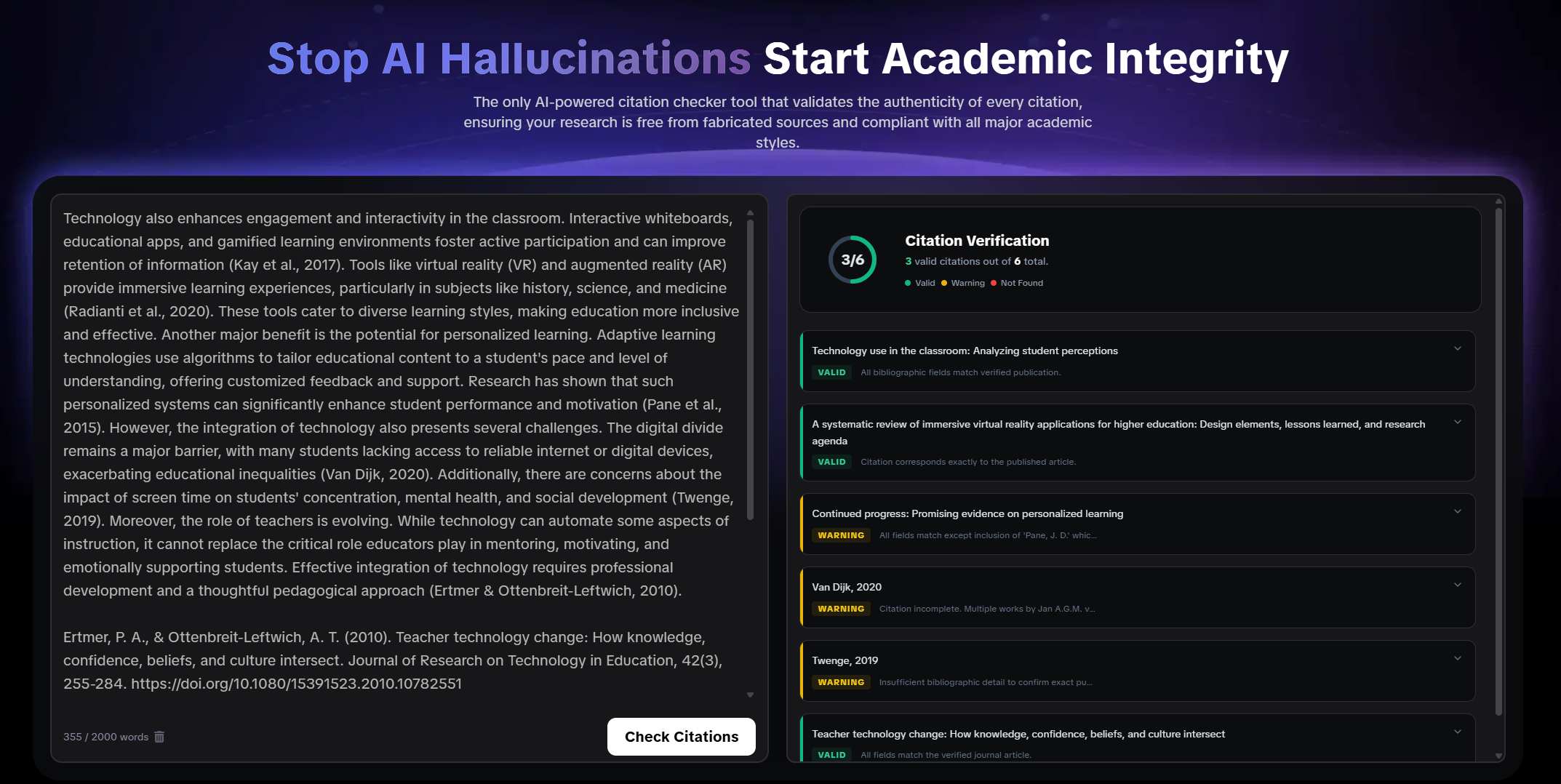
2. So What Exactly is a Fake Citation?
Simply put, it would be any citation that’s impossible to verify as a real, searchable source.
And that’s important, because it doesn’t depend on intent. Does it matter whether the source was invented on purpose, created by a paper generator from AI, or just slipped in at the end of a draft without much thought? No, it matters whether the source actually exists and what it is that it is, as far as what you’re claiming it is.
Citation means claim of evidence, not decorative flourish. That’s what it means when you cite something. You tell your reader, “This source exists, and it supports what I’m saying.” And if that claim can’t be checked, the citation is invalid, no matter how slick it looks.
I’ve discovered over the years a simple test that’s been handy most of the time:
If I can’t find it, check it, or track it with reasonable effort, it doesn’t belong on an academic reference list.
3. Why Students Get Suck in the Grey Area
The challenge is that fake citations don’t look fake.
Almost always the references that look odd are formatted properly. They follow traditional academic patterns. They contain author names, article titles, journal names, dates, DOIs. In short, they look legitimate.
And that’s why students are hesitant. It doesn’t look suspicious. It is there.
In most cases the assumption is simple: “If it came so cleanly from the tool, it must be drawing from something legit.” That seems like a fair assumption, especially when you’re scrambling to get a paper to deadline and the rest of it looks solid.
What I’ve discovered is that this is not a knowledge gap. It’s a trust gap.
4. Real Examples of Fake Citations That Most Students Miss
These are the kinds of patterns I’ve seen when reviewing drafts. None of them are obvious nonsense or casual careless errors.
Example 1: The Article That Feels Real, but Isn’t
This is the most common one.
I hit meta with this one. The journal name is very academic. The article title is spot on for the topic. The author names seem valid. All of it feels very familiar.
And yet, you Google Scholar, library databases, or just hit up Google and look up your term and there's nothing. No mention. No abstract. Nothing.
These references are not. They are reasonable. That makes them dangerous.
Example 2: Real author named for a paper they never wrote
In this instance, the guy is legit. He's publishing in the field. He's name appears in legit journals.
But the exact article that was cited isn't there.
This is easy work for AI tools. They know how a particularly kind of researchers “tend to write,” and they can generate a paper title that sounds like a natural extension of that author’s work, even when that paper itself never existed.
Because the name matches, students usually cease searching.
Example 3, a true journal with all false details
At times the journal is available, but not the citation information.
The year is wrong. The volume or issue number is incorrect. The page numbers are incorrect or missing. When you try to find the article in the journal’s archive, you can’t find it.
They get brushed off as a “slight formatting mistake.” However, when details are wrong they suggest that the source was never checked. And in academic institutions that differentiation is more important to students than they realize.
Example 4: A DOI That Looks Legit (Until You Click It)
You can think of a DOI as a safety net. It looks legit. It has a standard format.
But I’ve come across enough DOIs that result in 404s, give you unrelated articles or titles that don’t match the cite at all. Plenty of students never actually click them, just assume that the DOI is proof.
It doesn’t.
Example 5: Citations discreetly inserted upon paraphrasing
This one is more subtle.
A paragraph of text is rewritten with an AI. The original thing never had a citation, but the new thing has one. It's a pretty good citation, so we'll keep it.
There's no one that just read that source, not to mention no one that actually knows where it came from. It was auto-added and not a conscious decision to add it. It's still a fake reference if it's not verifiable.
5. Why “looking academic” isn’t the same as being real
Academic writing teaches us to look for form. We learn what a journal title should look like, how a reference is supposed to look, what scholarly language sounds like.
AI is great at mimicking those forms.
But, by default, it doesn’t check for existence.
A reference that looks academic can still be empty if it just doesn’t link to a real source that can be accessed. In academic writing, appearance doesn’t replace verification.
6. Why AI Tools Are Good at Generating Fake Citations
This is not a bug. It is a feature.
AI writing tools don’t actually search live databases for references. They instead make guesses about how a citation should look based on patterns they’ve seen. So if you ask for sources, the model will output something that looks like a source, because it doesn’t know anything else.
A better model will produce something that looks just as convincing. That’s why a lot of these slip through the cracks.
Knowing this, it becomes obvious: AI can be useful for word choice and structure, but it can’t be your source of authority.
7. How I Personally Decide Whether a Citation Is “Safe”
When I review my own work, I use a simple rule.
If I wouldn’t feel comfortable opening the source in front of a reviewer, instructor, or editor, I don’t keep it.
That usually means checking:
● Can I actually find the source?
● Do the title, author, and year match what’s being cited?
● Does the DOI (if included) resolve to the correct record?
If any of those feel uncertain, I remove or replace the citation. It’s not worth the risk.
8. Why This Is Important More Than Students Know
False citations aren’t treated as a typo in an academic context. They’re treated as an evidence issue, an unproven claim.
I explain in much more detail why colleges will get serious if you produce a false citation, and and what can happen when they slip through, I break that down in much more detail here:
Fake Citations in the Age of AI
That’s a useful context to have, but it begins with recognition. You can’t solve a problem you can’t identify.
9. Final Thoughts: Recognition Comes Before Responsibility
Most students who run into fake citation issues weren’t trying to cut corners. They trusted tools that were never designed to verify sources.
Learning to recognize fake citations isn’t about guilt. It’s about responsibility. AI can assist with drafting, but the moment you attach a citation, you’re making a claim about evidence. That responsibility doesn’t transfer.
The safest habit I’ve learned isn’t avoiding AI—it’s never outsourcing trust.
FAQ: Questions Students Ask When They’re Unsure About a Citation
How do I know if a citation is fake or just hard to find?
This is one of the most common grey-area cases.
Some real sources are genuinely difficult to access—behind paywalls, hosted on niche journals, or poorly indexed. The difference is this: a real source usually leaves some trace. You’ll find an abstract, a publisher page, a library record, or a citation trail pointing back to it.
When there’s no footprint at all, that’s when a citation becomes suspicious.
What if I can only find part of the citation information?
Partial matches are a warning sign.
If you can find the journal but not the article, or the author but not the title, it usually means the reference details were never verified. In academic work, incomplete traceability is still a problem—even if the source sounds plausible.
Is it okay to leave a citation in if it “supports the idea,” even if I didn’t read the source?
That’s risky.
A citation isn’t just about supporting an idea in theory. It signals that you can stand behind that source. If you haven’t checked what the source actually says—or whether it exists—you’re attaching evidence you can’t defend if questioned.
What should I do if I discover a fake citation after finishing my paper?
If you catch it before submission, the safest move is to remove or replace it immediately.
If you’ve already submitted, don’t panic—but don’t ignore it either. Many instructors prefer early correction over silence, depending on your institution’s norms.The key is demonstrating responsibility, not perfection.
Are fake citations more common in certain subjects or fields?
From what I’ve seen, yes.
They appear more often in fields where:
● sources are highly specialized,
● article titles are formulaic,
● or students rely heavily on summarization and paraphrasing tools.
The more “pattern-based” a discipline’s literature is, the easier it is for AI to generate something that looks right but isn’t.
Can a citation be considered fake even if the formatting is perfect?
Absolutely.
Formatting only shows that a reference follows a style guide. It says nothing about whether the source exists or is accurate. A perfectly formatted citation can still point to a non-existent or incorrect source.
Why do fake citations often appear at the end of a paper?
Because that’s where verification is most likely to be skipped.
By the time the writing is done, references feel like cleanup work. Students assume the hard part is over. That’s also when AI tools are often asked to “add sources,” which increases the risk of unverified references slipping in.
If I remove a fake citation, does it weaken my argument?
Only if the argument depended on evidence that was never real to begin with.
In many cases, removing an unverifiable citation actually strengthens the paper, because it eliminates claims that can’t be supported. A smaller reference list with real sources is always safer than a longer one built on guesswork.
Why don’t fake citations always get caught immediately?
Because no one checks every reference every time.
Instructors often spot-check, not audit. That’s why fake citations can go unnoticed—until one reference raises a red flag. At that point, the entire paper may be reviewed more closely.
Is there a “safe number” of citations to verify if I’m short on time?
There’s no official rule, but as a habit, I always verify:
● any citation added by AI,
● any source I didn’t personally read,
● and at least a handful of references chosen at random.
If problems show up early, that’s a sign the whole list needs attention.
Why are fake citations treated more seriously than writing mistakes?
Because citations are claims about evidence, not style.
Grammar errors affect readability. Fake citations affect credibility. Once credibility is questioned, the rest of the work is judged more strictly—no matter how well-written it is.