
Fake Citations vs Plagiarism: What’s the Difference (and Why It Matters)?

Fake Citations vs Plagiarism: What’s the Difference and Why It Matters
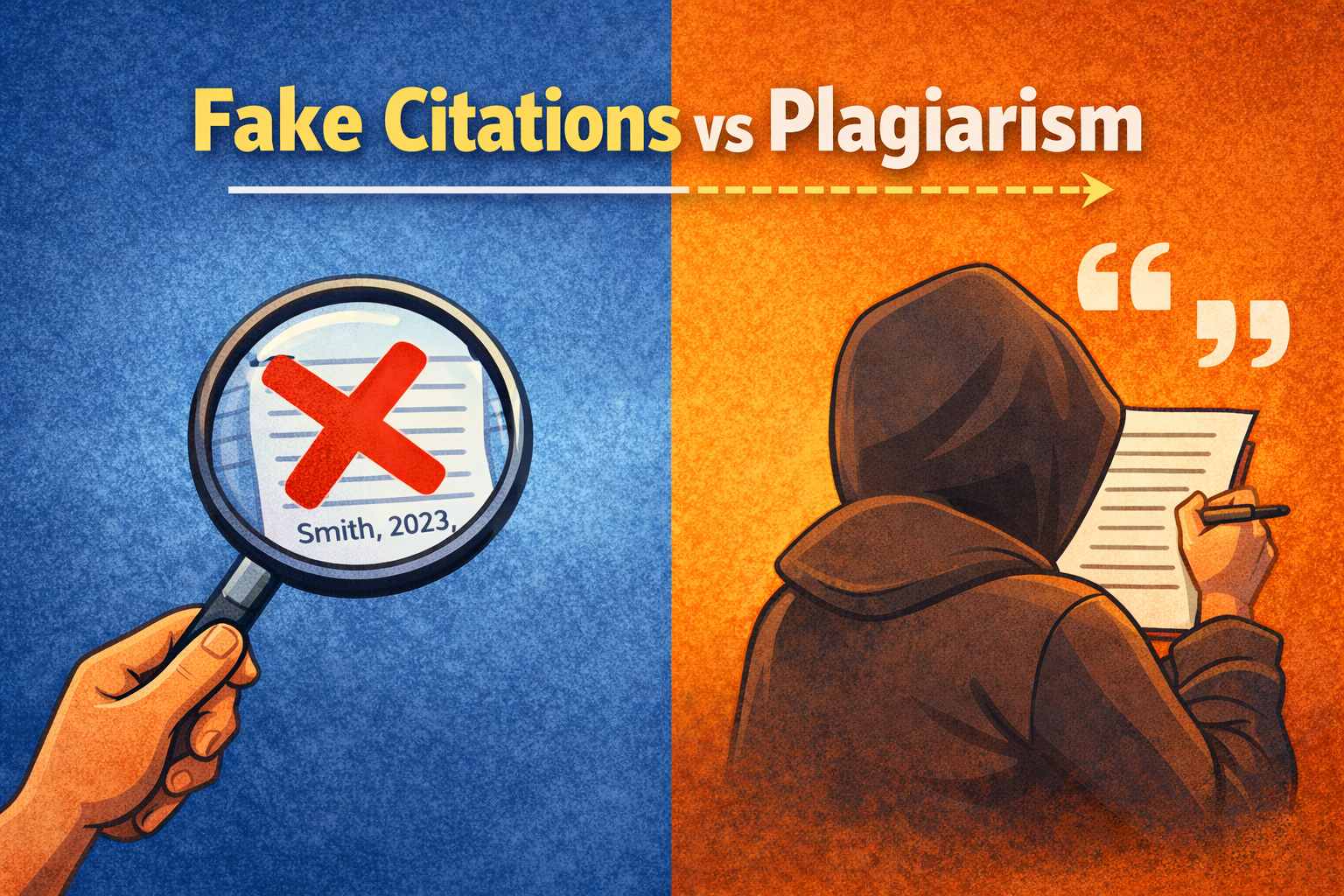
Fake citations and plagiarism are different academic issues. Plagiarism involves using real work without proper attribution, while fake citations involve referencing sources that do not exist or do not support the claim. Universities typically classify fake citations as fabrication or misrepresentation rather than plagiarism. This distinction matters because academic review prioritizes verifiability over intent, especially in AI-assisted writing.
I’ve come across dozens of students’ papers that were fine overall, good structure, good arguments, good language, good writing, but the references were garbage. When I mentioned that, I almost always got the same reply:
“But is that real, you know, plagiarism?”
A perfectly reasonable question. And it is one of the most common misconceptions I encounter. We talk about fake citations and plagiarism as if they’re the same issue. They’re not. And swapping them around leads to the wrong assumptions about the risk and intent, and what universities actually do when they grade academic submissions.
This article is my attempt to straighten that out, based on actual experience, not just policy discussions.
What Plagiarism Is in Practice (Not Just in Policy Documents)
What comes to mind when you think about plagiarism? Plagarism means copying. That’s not entirely wrong, it just isn’t the whole story.
Plagiarism is in practice: using a real idea, real words, real structure from someone else without giving credit,as defined in university academic integrity guidelines such as those published by the University of Oxford. That can include things like:
● Copying text directly without citation
● Paraphrasing too closely to the original source
● Presenting another author’s idea as though it were your own
The point here is every instance of plagiarism is based on real sources and real work. The fact is the work exists, but it is not given proper credit or credit is misdirected.
What I Mean by “Fake Citation”
Fake citations are a separate issue.
Fake citation is no plagiarism. It’s citing a source that doesn’t exist, or that would never support the claim you’re making.
In many of the papers I’ve seen, fake citations come in a few flavours:
● A journal article that could exist, but isn’t recorded anywhere
● An author–year combination that never existed together in the paper you think it’s from
● A reference that exists, but says something entirely different from the text
Often students don’t put them on purpose: they’re the product of lack of research, over-dependence on secondary summaries, or now, AI-generated reference lists that weren’t checked.
But it doesn’t change the core problem: the academic record is wrong.
Is a Fake Citation Considered Plagiarism?
Plagiarism is about misattributing authorship. Fake citations are about fabrication or misrepresentation—providing references that don’t correspond to real, verifiable sources. Many universities explicitly classify fake or invented references under categories like fabrication rather than plagiarism, as reflected in academic integrity policies such as Northeastern University’s definition of fabrication.
That doesn’t make fake citations harmless. It just means they’re a different type of academic misconduct.
One explanation I often give students is this:
Plagiarism asks, “Did you take credit for someone else’s real work?”
Fake citations ask, “Can this work be trusted at all?”
Why Universities Care Less About Intent Than Students Expect
One of the most frequent defenses I encounter is, “I didn’t intend to do that.” I accept it, but in academic review, they rarely give much mind to the idea of intent.
Universities make sure that a paper’s claims can be checked and verified. If a reference can’t be located, the reviewer can’t verify and test the assumption made on top of that reference. That is reliability issue from the institutional side.
In other words, the issue isn’t how the error came to be, it’s whether the piece of work passes the test. That’s why bogus references are considered seriously, even unintentionally.
Fake Citation vs Plagiarism, How I Usually Explain It
Here’s the comparison I’ve found most helpful when explaining the difference:
Aspect | Plagiarism | Fake Citation |
Core issue | Using real work without proper credit | Referencing non-existent or incorrect sources |
Involves copying | Often | Not necessarily |
Typical cause | Poor citation or paraphrasing | Fabrication, rushed research, AI hallucination |
How it’s reviewed | Attribution and similarity | Verifiability and accuracy |
Student intent | Can be deliberate or accidental | Often unintentional |
Both can undermine academic integrity, but they do so in different ways—and they’re evaluated differently.
Why This Is So Important in the Age of AI
This distinction just matters way more now because AI tools can generate references that look convincingly real. They don't search databases, they predict what a citation looks like.
I have seen papers where the text passes a casual review, but the reference list falls apart under even inexpensive checking. That’s why this is no longer a hypothetical issue.
I cover in more depth how universities handle fabricated citations in AI-assisted work here in my main guide → Fake Citations in the Age of AI.
What I Recommend Before Submitting Any Paper
Based on what I’ve seen, a few habits make a real difference:
● Only cite sources you’ve personally opened and checked
● Treat AI-generated reference lists as drafts, not facts
● Do a final pass focused solely on reference accuracy
Some students choose to run a dedicated citation check at this stage, especially if AI was involved. Regardless of the method, the goal is the same: make sure every reference actually exists and supports the claim it’s attached to.
Final Thought
Fake citations and plagiarism aren’t the same thing. But both affect how trustworthy a piece of academic work appears. Understanding the difference, and why it matters—is part of developing real academic judgment, not just following rules.
FAQ: Fake Citations vs Plagiarism
Is a fake citation the same as plagiarism?
No. Plagiarism involves using someone else’s real work without proper credit. Fake citations involve referencing sources that don’t exist or don’t match the claim. Universities typically classify fake citations as fabrication or misrepresentation rather than plagiarism.
Is a fake citation considered academic misconduct?
Yes. Even when unintentional, fake citations are usually treated as academic misconduct because they make the work unverifiable and unreliable.
Can fake citations happen without intent to cheat?
Absolutely. Many fake citations come from rushed research or unverified AI-generated references. Lack of intent doesn’t eliminate the problem, but it may affect how a case is handled.
Why do universities care so much about fake references?
Because academic work depends on verifiability. If references can’t be checked, the argument built on them can’t be trusted—regardless of how well written the paper is.
How can students avoid fake citations when using AI?
The safest approach is to verify every reference manually before submission. AI can assist with drafting, but responsibility for accuracy still rests with the author.


 Lucas Grant