
Why US Professors Prefer Humanized AI Writing Over Raw AI Output

TL; DR
In your US college class, if you submit a chunk of raw AI output, you rarely “get caught”, you just pay the price where the curriculum rubric lives: analysis, specificity, and ownership. Humanized AI writing isn’t “less toxic”, it’s more defensible student work: claims backed up with evidence and interpretation, voice, and course specificity. When professors want you to humanize your AI writing, they’re not rewarding vibes, they’re rewarding anything they can grade.
1. How I read papers (and what raw AI makes me see more clearly)
I’m reviewing a draft—TA-style writer, writing tutor, whoever packs their bags to help students before they submit—so I’m not asking “Is this AI?” I’m asking the same questions instructors ask in grading:
1. What’s the thesis—really?
2. What evidence is being used, and what does the writer do with it?
3. Does the voice sound like a person making choices, or a system producing a report?
It usually takes me of the few minutes to spot whether I’m reading something that emerged from a student or something that arrived fully-formed. Raw AI reads as a clean “explainer.” Humanized reads differently. It reads like someone thought about a position, wrestled with it, and made trade-offs in presenting it.
That’s why professors want humanized work, even when AI was used to draft.
2. What I mean by “raw AI” vs “humanized AI writing”
I’m not talking about grammar. Raw AI can be grammatically perfect.
Raw AI output usually means:
● generic, interchangeable language
● smooth, templated paragraph structure
● confident claims with thin support
● little to no “thinking trail”
Humanized AI writing means the opposite:
● your voice shows up in phrasing and emphasis
● claims are narrower and more defensible
● evidence is followed by your interpretation
● the paper contains course-specific anchors (prompt constraints, readings, lecture ideas)
Here’s the difference in a way a professor would recognize:
Dimension | Raw AI output | Humanized AI writing |
Overall feel | polished summary | student reasoning |
Claims | broad + confident | specific + bounded |
Evidence | listed or quoted | explained + interpreted |
Voice | generic, interchangeable | consistent, personal |
Typical grade impact | “clear but shallow” | “clear and thoughtful” |
3. Why raw AI output often earns lower trust and grades
This isn’t an ethics thing. It’s about what instructors see on the page.
1) Raw AI sounds “generic confidence”
A typical professor comment is: “This sounds confident, but the paper doesn’t do the arguing.”
Raw AI often chimes in with sentences like:
● “Clearly this shows that…”
● “It is clear that…”
● “This illustrates…”
But then it fails to do the college writing thing: show how you got there.
Professors aren’t grading confidence. They’re grading justification.
2) Raw AI has no “thinking chain”
Good student writing usually shows what was happening in the writer’s mind:
● a limitation
● a tradeoff
● a counterexample
● a moment of doubt (“This seems true in X context, but not Y.”)
Those aren’t “weaknesses.” They are evidence that there is a mind involved.
Raw AI often simply delivers a conclusion. It sound like the system is answering a final (standalone) question.
3) Raw AI has “too smooth” flow (template writing)
A lot of AI writing follows a generic rhythm:
● topic sentence
● explanation
● example
● mini conclusion
● transition
This isn’t a bad thing. But if you hear that rhythm in every paragraph, it is one step from “Yours” to “system.”
4) Raw AI often mismatches the student’s prior voice
Instructors and TAs pay attention when a student’s writing seems to change:
● vocabulary suddenly becomes more formal
● sentence length becomes unusually uniform
● the tone becomes “essay machine”
That does nothing. But it triggers a practical question: “Can you explain this argument in your own words?”
5) Raw AI uses evidence without interpretation
This is the biggest reason for getting lower scores.
Many AI drafts can quote or reference sources. But they don’t reliably do the most important part of academic writing:
Explain why the evidence matters and why it supports your specific claim.
That “so what” work is where analysis sits and where points are.
A quick classroom example illustrates this difference.
In a writing workshop I helped with last semester, three students submitted essays about the same reading on technology and labor. All three papers were grammatically clean and well structured, but the instructor gave them almost identical feedback: “Clear summary, but where is your argument?”
The essays described the author’s ideas accurately, yet they rarely interpreted the evidence. Paragraphs often quoted a source and then moved on without explaining why that example mattered for the thesis.
One student later revised the paper by adding only a few sentences of interpretation after each citation, explaining how the evidence supported the specific claim in the paragraph. Nothing else changed dramatically, but the revised draft immediately read more like student reasoning rather than a generated explanation.
That small shift, from listing evidence to interpreting it is often what separates raw AI output from humanized academic writing in the eyes of a grader.
4. Why professors prefer humanized AI writing (it maps to the rubric)
Professors aren’t rewarding “human vibe.” They’re rewarding indicators of real learning and real authorship.
1) Clear reasoning is easier to grade
If a student makes a claim, supports it, interprets it, and ties it back to the thesis, the grader can feel comfortable awarding analysis points.
I summarize this as:
“Give me something I can grade.”
Humanized text typically includes some of those reasoning links that AIs don’t.
This emphasis on reasoning and interpretation is also reflected in standard academic writing guidance. Purdue University's widely used OWL writing resource explains that strong academic arguments require not only evidence, but also clear explanation of how that evidence supports the writer’s claim.
In other words, the goal of a college essay is not simply to present information, but to demonstrate the student’s reasoning about that information. When instructors see interpretation connected to evidence, they can evaluate the student’s analytical thinking, which is exactly what grading rubrics are designed to measure.
2) Natural tone reduces misinterpretations
A natural academic voice isn’t casual. It should be readable and specific.
Raw AI is over-neutral: sometimes it refuses to commit to a perspective, and sometimes it commits to an argument without backing. Humanized text tends to sound like a student addressing an actual reader (probably your instructor). That helps the argument be more readily understood and judged.
3) Variation in structure indicates real cognition
People don’t write with perfect consistency. Real writing includes:
● sentence variety
● occasional emphasis
● different paragraph pacing
Variation is no trick. It’s a natural consequence of human focus and decision-making.
4) Specificity is the quickest path to authenticity
If a paper includes course-specific anchors (something derived from the prompt, lecture, reading, or discussion), it’s so much more authentic as student work.
Even a couple anchors per page can shift how the entire paper feels.
Here’s a rubric-aligned view:
What rubrics reward | What raw AI often lacks | What humanized writing adds |
Analysis | interpretation | interpretation + stance |
Evidence | relevance | relevance + explanation |
Organization | logical flow | flow + intentional emphasis |
Voice | consistency | consistent + personal nuance |
Engagement | course connection | course-specific anchors |
5. What I see in high-scoring AI-assisted assignments
Good AI-assisted paper doesn’t try to look “less AI.” They try to look more like student writing where it matters.
Common patterns I see:
● The thesis is focused and defensible (not “technology is changing society”).
● The paragraph answer a mini-question that supports the thesis.
● The paragraph includes evidence and interpretation (not just citation).
● The writer acknowledges at least one counterpoint or limitation.
● The paper has a few course anchors (prompt phrasing, lecture concept, assigned reading).
The conclusion is not rehash (not “To sum up…”), but it makes the implications clear (“If this is true, then…”).
You probably notice what's not included: gimmicks. Trickery. Detector-bait. The writing looks good because the thinking looks good.
6. What instructors typically do when a paper reads like raw AI
This varies by institution and syllabus policy, but the most common outcomes are not dramatic.
1) Scenario A: It just earns a lower grade
The instructor marks it as:
● vague
● surface-level
● under-argued
It doesn’t fail because it’s “AI.” It fails because it’s not strong academic writing.
2) Scenario B: The instructor requests revision or a conversation
Especially when the style shift is sharp, instructors may ask:
● for an outline
● for drafts
● for an explanation of the argument
3) Scenario C: In high-stakes or policy-strict classes, it escalates
This is less common, but real, for when AI use is disallowed or must be disclosed.
If you work in a Turnitin environment, knowing how Turnitin (itself!) talks about interpretation matters too. Turnitin has spoken openly about false positives in AI writing detection and how educators should interpret them, which is why instructors (ideally) don’t consider an AI score as an automatic judgment.
Understanding false positives in Turnitin AI detection
And Turnitin’s own guide to its new Advanced Similarity Report also explains its AI writing detection capabilities as a tool to help teachers spot text that could be produced by generative AI tools, that is, a signal to check, not a verdict.AI writing detection in the new, enhanced Similarity Report – Turnitin Guides

7. The “minimum edits” that professors respond to (instead of rewriting your whole paper)
I’m intentionally short here, since your pillar has the whole workflow ready. This is the minimum that most reliably changes “raw AI” into “defensible student writing”.
1. Rewrite your thesis + topic sentences in your own voice
These lines determine how the grader is going to read everything else.
2. Add two course anchors per page
A prompt constraint, a lecture idea, a detail from a reading, an insight from a discussion.
3. Replace three generic arguments with evidence + your analysis
Don’t just say it, show it, with evidence.
4. Add one limitation/counterpoint
One sentence like: “This argument works in X context, but it might not in Y.”
That’s it. If you just do these four things, most professors will see your paper different.
See the entire step-by-step "how I humanize AI writing for US college assignment" workflow.
8. Final takeaway
US professors prefer humanized AI writing because it reads like learning—raw AI output reads like output.
When a paper shows clear claims, specific context, evidence with interpretation, and a consistent voice, it earns trust and points. When it doesn’t, it usually loses points—regardless of whether any tool is involved.
If you want one sentence to remember:
The best “humanization” is ownership: defensible reasoning, specific context, and a voice that sounds like a real student making choices.
9. FAQ
Do professors rely only on AI detectors?
Good instructors rely on rubrics, context, and student conversations, not just tools. Turnitin itself has publicly discussed false positives, which is one reason AI reports should be interpreted carefully.
What matters more: perfect grammar or clear reasoning?
Clear reasoning. Grammar supports clarity, but analysis wins grades.
Why can “too polished” writing backfire?
Because it can read as generic or unauthored, like no one made choices. Professors often reward specificity more than polish.
If my writing style changes a lot, what should I do?
Document your process: outline, drafts, notes. And make sure your final thesis and topic sentences sound like you.

Related Articles

Why “Perfect” AI Writing Feels Suspicious in US Classrooms (and What Professors React To)
Over-polished AI text can feel unnatural in US classrooms—too smooth, too uniform, too generic. Lear...
 Lucas Grant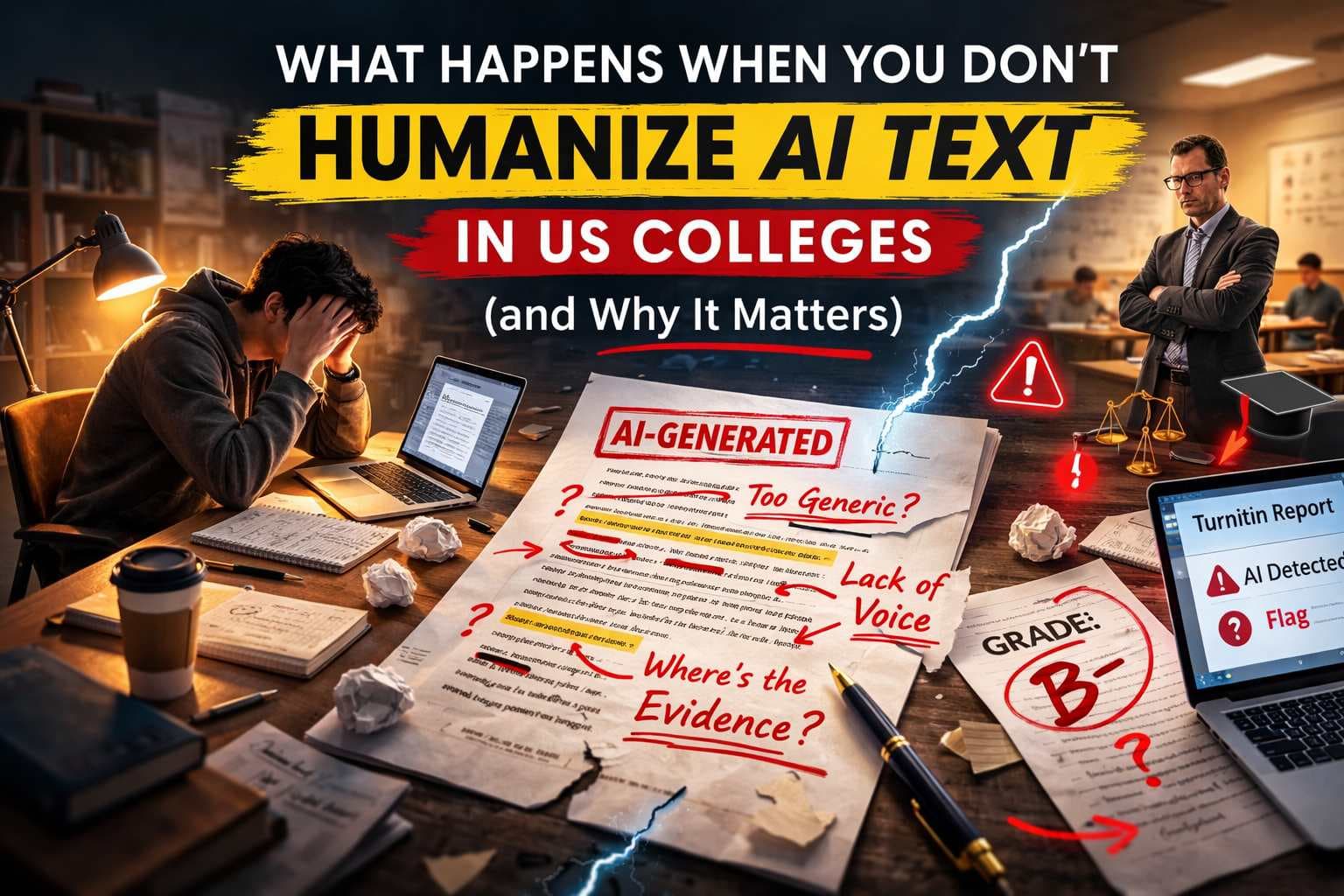
What Happens When You Don’t Humanize AI Text in US Colleges (and Why It Matters)
AI text that sounds too uniform or robotic can raise academic concerns in US college classrooms. Lea...
Lucas Grant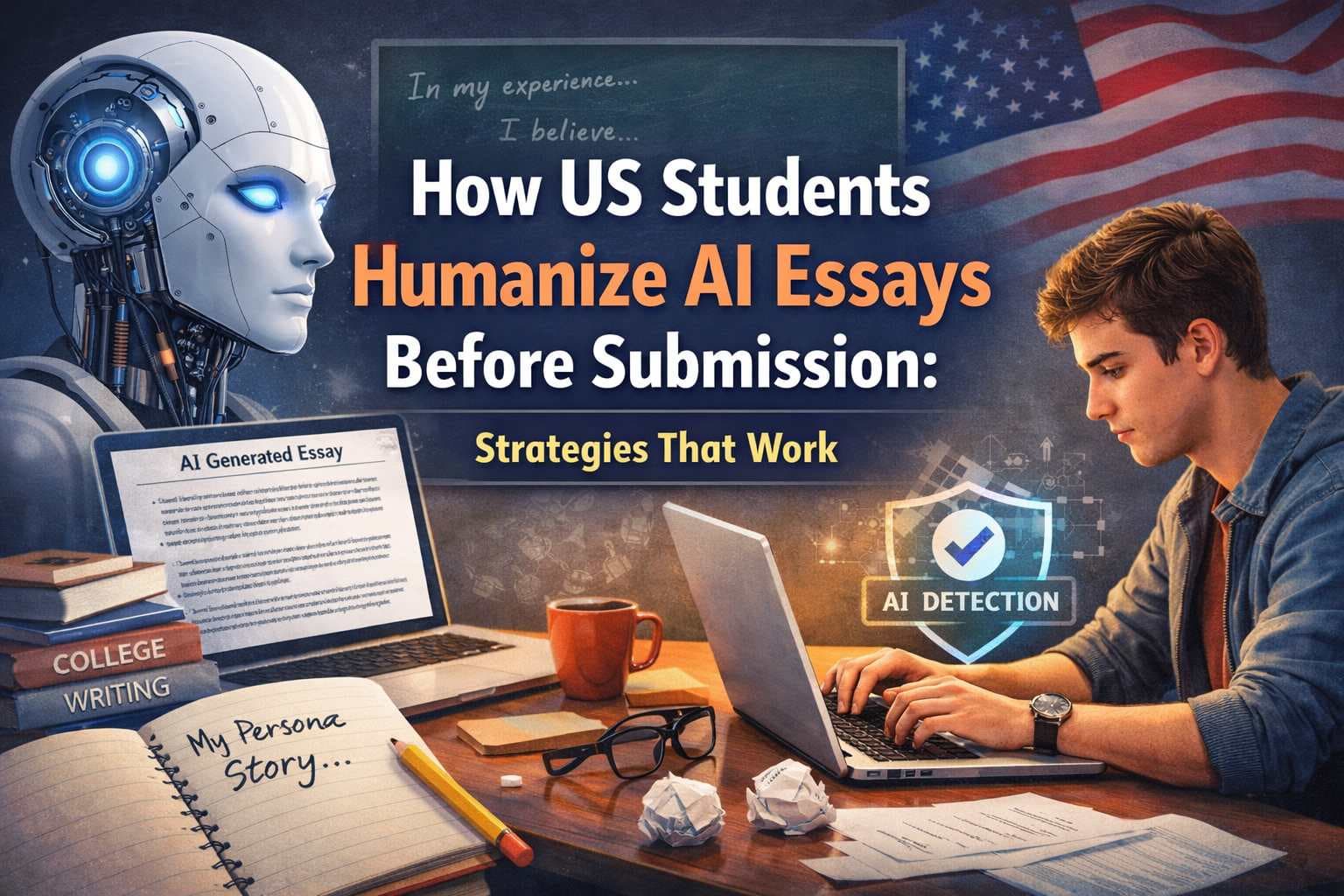
How US Students Humanize AI Essays Before Submission: Strategies That Work
Discover how American college students humanize AI-generated essays so they read naturally, reflect ...
Lucas Grant
How I Humanize AI Writing for US College Assignments (2026 Guide)
A practical US-focused guide on how students humanize AI writing to improve clarity, preserve meanin...
Lucas Grant