
How Packback Coaching Is Redefining Academic Integrity

Summary
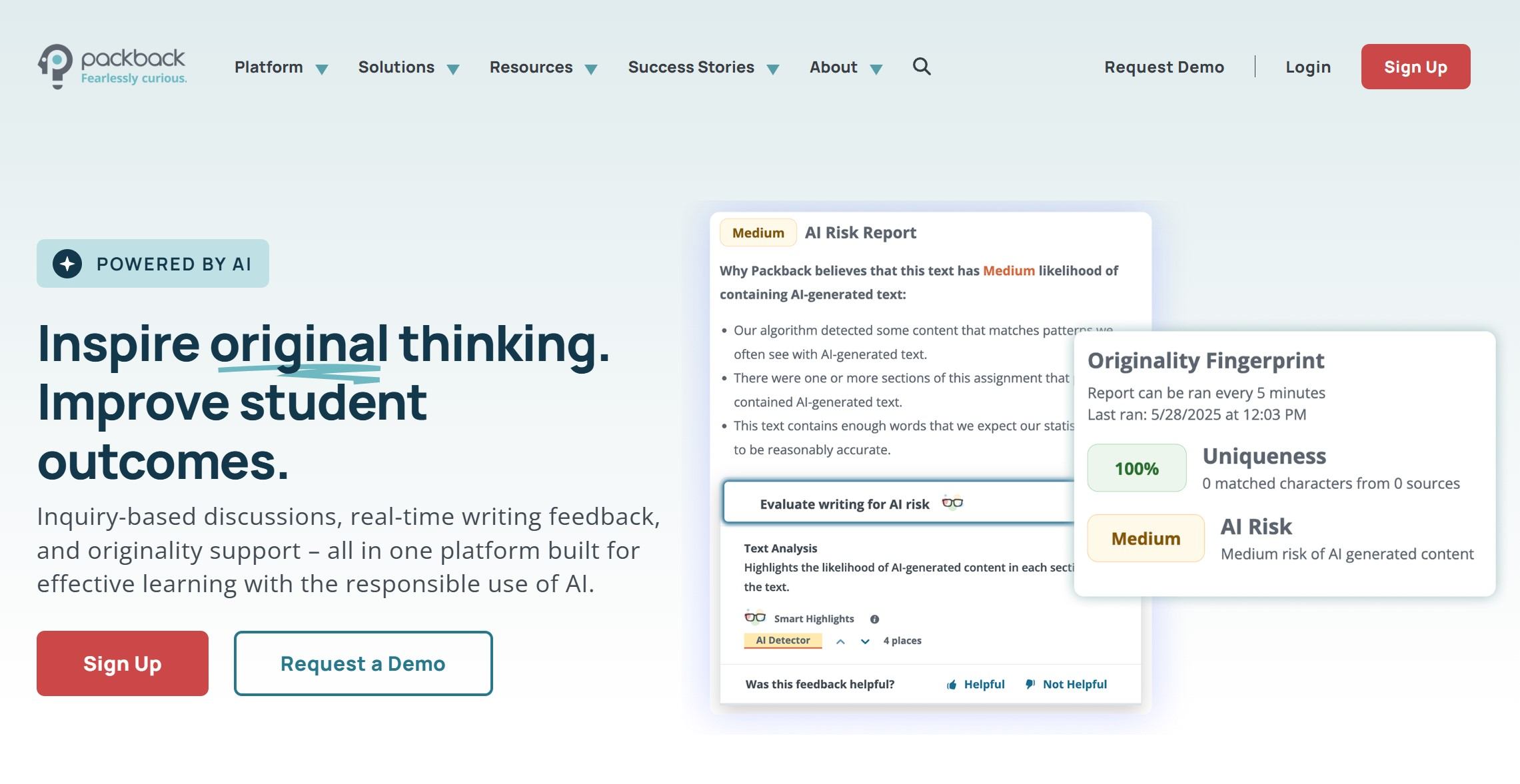
As universities cope with the reality that 89% of students now use AI tools like ChatGPT for homework, a key question arises: should educators spend time policing AI use, or be teaching students to think and write better? Packback is an answer to that question: a platform that turns academic integrity from a policing problem into a learning one. Unlike plagiarism detection software that encourages a student-instructor cat and mouse game, Packback takes a coaching angle. It offers line by line feedback helping students understand not only what they did wrong but why original thinking matters and how to do it. That shift from policing to prevention is changing how thousands of classes think about student engagement and academic integrity.
From Detection to Development: How Packback Works
Packback is an instructional AI platform that plugs into learning management systems (LMS) like Canvas, Blackboard and Moodle. Students and teachers get to the different products via the Packback login portal. The portal gives access to three products designed to help students develop higher order thinking and write better.
The discussion tool transforms a student forum post into an inquiry based conversation. Rather than just asking students to respond to a prompt, it coaches them to ask better questions and produce evidence based responses. The writing tool guides students through the process of writing their work, giving formative feedback on clarity, argumentation, research integration and citations before they submit. The originality tool does more than flag copied passages: it explains why the passages in question are problematic and how to incorporate them.
The key to this approach is the framework it applies. Packback incorporates Self-Determination Theory into the design of their tools. The theory states that students need three things to feel competent: choice, purpose, and mastery. By giving students feedback on their work before they submit it, Packback builds mastery while respecting choice. That is why teachers using the Packback Writing tool say they save 30% of grading time: by the time students submit, they have better work because they have already received feedback.
The Curiosity Score: Measuring Quality Beyond Grammar
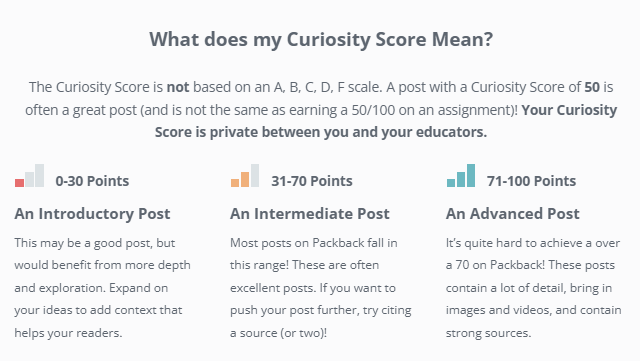
Another unique aspect of Packback is the Curiosity Score. These are the four different ways that student posts are scored: curiosity, credibility, communication and convention. Curiosity Score is the best example of the way Packback works and what they value about their student contributions.
The curiosity score is awarded to questions that are more open ended and invite discussion. Packback gives more points to questions that start with the words why or how, because these types of questions cannot be answered with a simple yes or no. It is also more likely that a question starting with why or how will create a conversation rather than an exchange of facts.
Another area to which students should pay attention to is the credibility score. Credibility points are awarded to questions that are backed up with research papers, news stories or even textbooks rather than an opinion.
The communication score is awarded based on the readability and structure of the post, so students are encouraged to break their question into separate paragraphs and add multimedia. The convention score is awarded based on spelling and grammar. However, this will not affect the overall score.
The convention score is for English language learners who want to discuss their ideas, but may not have mastered the language. This is a great way to teach students that quality writing is more about the content than the form. Indeed, more than 55% of students using Packback reported that they feel more confident in their writing.
Does Packback Detect AI? Understanding the Platform's Approach
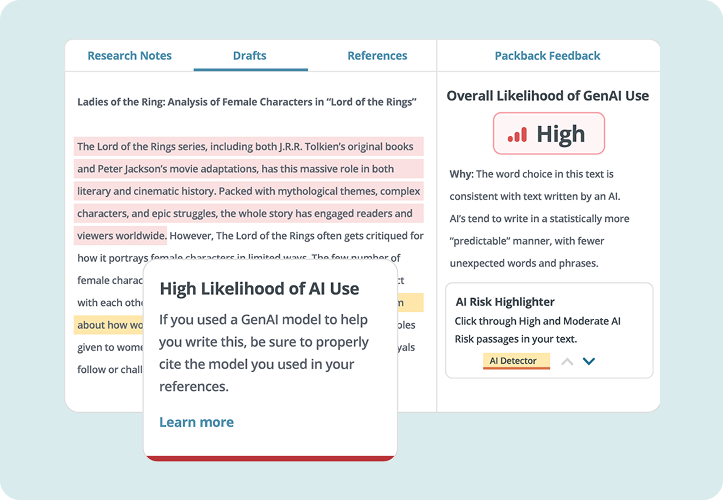
AI detection is no longer optional in education. Yes, Packback does detect AI generated content by pattern recognition detecting repeated phrases, structure that is too predictable and lack of original content. Packback also compares what is being submitted by the student to previous work they have done to detect differences in writing style that could indicate the use of AI or plagiarism.
The way Packback's AI detection works is fundamentally different from Turnitin. While Turnitin produces a report for a professor to accuse a student of cheating, Packback allows the student to view their own originality report and see what is being flagged before it is submitted. If the content could have possibly been produced by AI or if plagiarism has been detected, the student will be given a report of what was detected originally. They will also be given guidance on how to fix the content before resubmitting and learning from the feedback.
Packback is avoiding the problem many AI detection tools face, that is false positives. Many detection tools claim 99% accuracy but that means that for every 100 students, one student will have false allegations of the usage of AI in their content. As well as students being flagged, who write clearly and accurately about well known, established topics, because their work is statistically probable.
Packback is preventing the creation of a student being falsely accused and losing the trust and respect of their teacher or professor. Packback also checks for plagiarism or copy and paste content by comparing what is submitted to millions of web sources, academic databases and previous work by the student. Anything that is less than 60% original content or has text that has been matched and not cited will be flagged for the student to revise.
Moving Beyond the Cat-and-Mouse Game
The point is bigger than any one platform. One teacher said the whole idea of academic integrity detecting and punishing has become an "endless cat and mouse game" where students find new ways to cheat and teachers have to try to catch them. It's all a waste of energy for both the student and the teacher but it doesn't solve the problem. Why we want them to think for themselves, and how they can do that. It's 2025 and the academic integrity space is at a crossroads; the arrival of generative AI has exposed the limits of detection based solutions, and the uncomfortable reality that if students can push a button and generate acceptable work, we have not been clear enough about the value of authentic work.
Those platforms that help students find their authentic voice are not just relevant, they are vital. This is where a tool like GPTHumanizer AI is inserted into a broader conversation about the appropriate use of AI. Instead of helping hide the fact that the student has written something produced by AI, it could be part of a legitimate writing process: helping them refine ideas they've genuinely come up with while maintaining the voice that is authentic to them.
That's the difference: using AI to articulate your thinking versus using it to generate thinking and then claiming it as your own. Packback has already shown that there is a way forward where AI can help education. It's not about how to block generative AI, it's about how to deploy instructional AI that makes authentic learning more rewarding than the alternative.
The Verdict
If we can understand Packback, we gain insight into a fundamental shift in how we view academic integrity. Instead of seeing students as cheaters to be caught, Packback's model treats them as learners to be coached. With the emergence of generative AI, this line between students who cheat and students who learn becomes increasingly vital to academic success.
Frequently Asked Questions
Does Packback detect ChatGPT and other AI tools?
Yes. Packback uses pattern recognition and the style of writing to detect content created by AI. But rather than using any flags for punishment, it simply tells you what was found and offers to help you produce something more original.
Can Packback detect copy and paste?
Yes. Packback checks your work against millions of sources on the web, academic databases and previous student work submitted by Packback users. If it finds copied content that hasn't been cited, you'll see it in your originality report before you submit it and have the chance to revise your work.
How much is Packback?
Packback usually costs around $25-39 per course per semester. The institution may have an extended license that gives all its students access to Packback at no cost. Students who can't afford Packback can also apply for a fee waiver.
Does Packback check for plagiarism?
Yes. The originality tool checks your work against millions of web pages, academic databases and previous student work. The difference between Packback and traditional plagiarism checkers is that you see the result before you submit and get coaching on how to cite your sources and create an original analysis.
