
The Technical Evolution of AI Humanizers: From Paraphrasing to Neural Editing (2026)

What this article explains
What it does not claim
How this information should be used
0. Reader Guide
0.1 Who this guide is for
If you’re a student, researcher, marketer, creator, or product team trying to answer any of these questions:
● “Why did my ‘humanized’ version get less accurate?”
● “Why does it read like an alien rewrite even when the AI score drops?”
● “What does a real AI humanizer do under the hood—beyond synonym swaps?”
● “How do I evaluate quality without getting obsessed with one detector?”
…this is for you.
0.2 What you’ll learn (and what you won’t)
You will learn:
● What an AI Humanizer actually is (and what it’s not)
● The major research “building blocks” behind modern humanizers
● A practical system architecture (a pipeline you can implement and test)
You will NOT get:
● “Magic” detector-bypass tricks or instructions. The goal here is editor-grade clarity, integrity, and readability, with detectors treated as risk signals, not as the finish line.
0.3 The core idea in one sentence
A good AI Humanizer is not a disguise artist. It’s a Master Polisher: it makes text feel more human while preserving meaning, protecting key facts, and keeping structure usable.
0.4 How to read this pillar article
● Ch. 1 defines the goal and draws boundaries.
● Ch. 2 maps the research methods (style transfer, paraphrase, editing, GEC).
● Ch. 3 turns those methods into an engineering pipeline you can build.
(Chapters 4+ will go deep into evaluation, risk management, and reproducible testing. For now, we’re building the foundation.)
1. What Is an AI Humanizer?
1.1 A practical definition
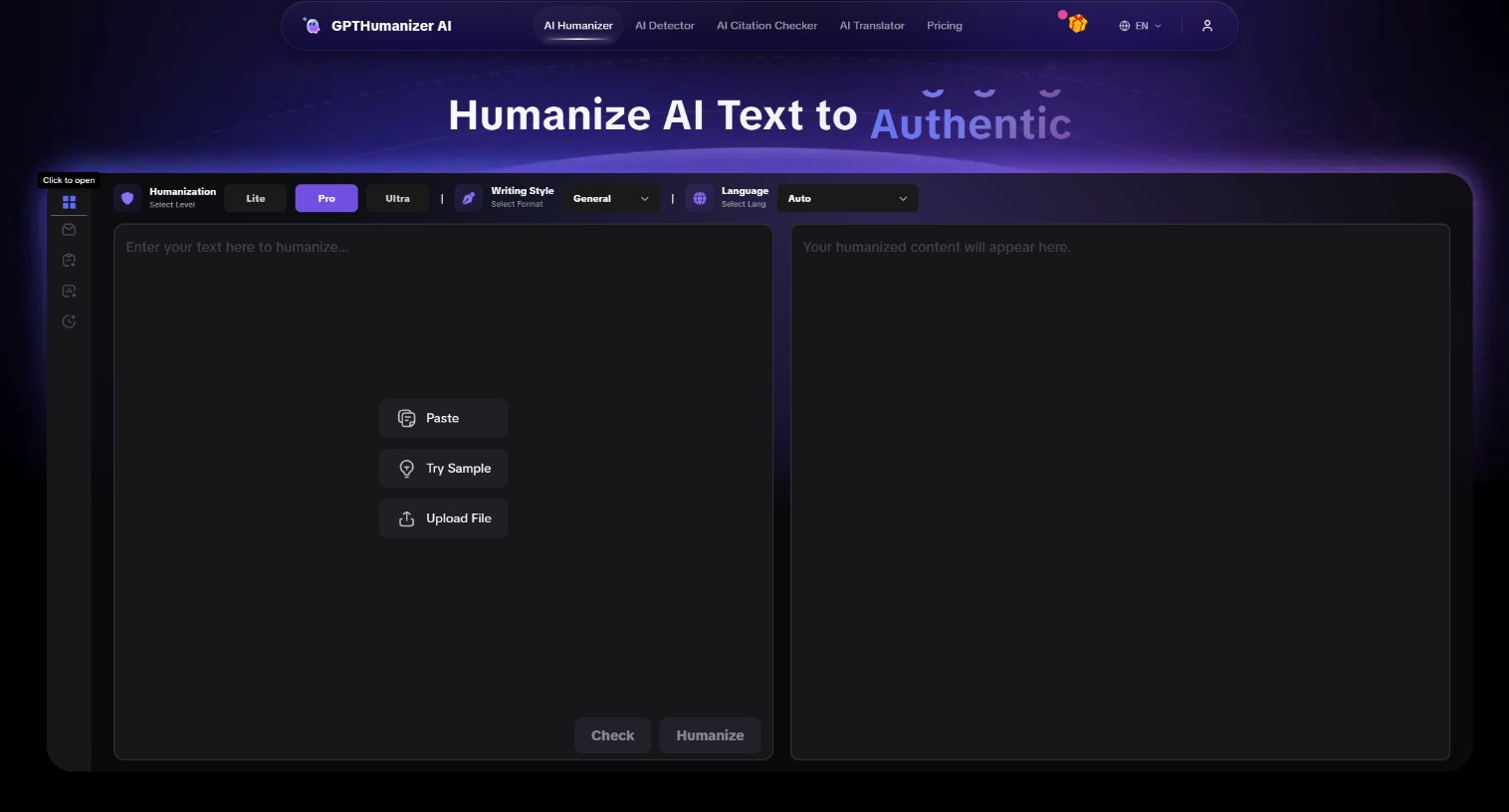
An AI Humanizer is an editing workflow for an existing draft. Its function is not to create new ideas. Its function is to take a piece of text, often a piece of “AI-flat” writing, and transform it into something that would be realistic for a real person to publish under his or her name.
That means it enforces smooth transitions, eliminates if-not-you-are-not-using-the-same-pattern-too-often sentence patterns, smooths rhythm, and enforces tone (academic, professional, casual, marketing). But it does all of this while trying to preserve the core message and usability of the text, if the input had such indicators as headings, lists, or Markdown.
So if you are picturing “one model rewrites everything,” you are usually picturing the wrong thing. Most high-quality humanization systems behave like a pipeline: protect the data at risk, rewrite in controlled steps, polish, then verify.
1.2 What an AI Humanizer is not
Much of the confusion comes from applying the same name to very disparate tools.
It’s not some nostalgic synonym spinner. Even offering the mere prospect of word changes can damage logic, subvert the expected tone, and corrupt technical specificity.
It’s not a “make it vague to make it safe” engine. One common failure mode is zeroing-out: numbers evaporate, technical terms get softened, and bold claims quietly become modest ones. That may entrench the detector, but ruins the writing.
And it is certainly not a format shredder. Given an input that is an academic outline, a technical report, or even Markdown, “humanization” should not be free-form prose.
1.3 The goal redefined: editor-grade polish under constraints
Here’s the hard truth most people avoid saying out loud: lowering an AI score is easy compared to doing high-integrity editing.
A professional humanizer has to obey three “hard constraints”:
1. Meaning Preserved: the argument, stance, and claim strength shouldn’t drift.
2. Information Retained: entities, numbers, dates, and terminology must remain precise.
3. Engagement Improved: the output should feel more readable, more natural, and more human.
That third point is why “just be faithful” isn’t enough. Humanization is not merely “don’t break the meaning.” It’s also “make the writing worth reading.”
2. Method Map: An AI Humanizer Isn’t a Single Algorithm , It’s a Stack
Once you’re done using humanization as an adjustable magic button, the picture starts to become clearer. Most contemporary humanizers draw from four major research trees. Each solves a different part of the humanization puzzle. Each has a predictable set of failure modes.
2.1 Style transfer: not saying what it says, but saying what it says differently
Style transfer is a paradigm of rewriting as the re-shaping of attributes, formality, sentiment, politeness, “academic tone” etc. while maintaining underlying content.
A popular paradigm in non-parallel style transfer is Delete, Retrieve, Generate: the deletion of content phrases associated with the original style, retrieval of target-style markers, synthesis of a fluent sentence recombining content and target-style markers.
Why this is interesting for humanization: lots of “AI tone” is a style signature, over-safe transitions, monotone cadence, and bland phrasing. This is a way of changing voice without rewriting facts, in the language of style transfer.
You can predict exactly where the products make mistakes too: they either handle essential facts as “style fluff” and tinker too harshly, or they fetch the same trite phrases that sound condescending, like “an AI assistant”.
2.2 Generation of paraphrases: expressing the same idea in different ways
Paraphrase is the engine of “same meaning, different surface form.” It’s also where most low-quality tools go bad, because redraw guardrails, paraphrase turns drift.
A big resource here is ParaNMT-50M, a set of 50m+ English–English paraphrase pairs generated from machine translation pipelines.
Paraphrase generation allows a humanizer to do more than just replace synonyms. With it can achieve structural variation, paraphrasing clauses, altering emphasis, changing sentence patterns so that it does not feel like it has been templated.
But failure is brutal: unchecked paraphrase can mute causality (causes becomes is associated with), weaken quantification (some), or render technical terms inlayless English. That’s why it’s a killer when it’s subject to locks and logical tests.
2.3 Edit-based rewriting: fixing a rough draft rather than starting from scratch
This is the most "product-shaped" set of methods.
Edit-based systems seek to augment a (potentially imperfect) draft with some needed changes to make it clearer, more cohesive, more formal, shorter, more natural, without triggering a complete rewriting. EditEval explicitly models the task as instruction-driven edits, such as cohesion edits and paraphrasing.
Why it matters: humanization is an editing problem. People don’t want new articles. They want their articles to sound better.
The right balance is the hard part. If you edit too light, it stays “AI-flat.” If you edit too much, it’s a rewrite engine that misfires. The best systems treat edit depth like a dial. Not a mystery.
2.4 GEC and post-editing: the final polishing layer.
Even the strongest rewrites can be non-human in small ways: little agreement splits, awkward wording, or cumbersome constructs that check gramar, but smell “off.”
And that’s where post-editing and grammatical error correction (GEC) come into play. For example, GECToR approaches correction as a tagging/editing task (“Tag, Not Rewrite”) – a controllable and efficient one, in particular.
In a humanizer pipeline this is the silent hero. It’s smooth but does not achieve big semantic drift. It’s fantastic for ESL polishing and naturalizing for professional writing, while not changing much.
3. System Architecture: From Input to Output (A Practical Humanizer Pipeline)
If you want humanization that doesn't crumble under scrutiny, you don't want a single step, you want a pipeline. Like an editor would: fix the facts, improve the writing in layers, and then check that nothing slid off the page.
3.1 Routing intent & style: what “better” means?
You need to know what you’re writing for. “Human” isn’t an option. Academic writing wants precision and limitations. Marketing wants punch and personality. Technical writers want structure, consistency.
In other words, a sturdy humanizer first dispatches target tone, target audience, how much rewrite strength, and how hard to preserve the integrity constraints.
This is also where tiered modes (light polish vs deep rewrite) make sense, as you only get the unanticipated drift with one rewrite strength.
3.2 Constraint locking: lock what must not be changed
This is where most tools butcher it because it is boring engineering not sexy generation.
Before rewriting, the system can identify and protect the “high-value” spans: numbers, units, dates, named entities, product names, technical terms, and any “must-keep” phrases that you identify. The goal is not “freeze everything”; the goal is so that the humanizer doesn’t “improve” your writing by throwing away those details that make your writing accurate.
In essence you pull out these spans (NER, regex for number/units, term lists) and then consider them as anchored and locked. You rewrite around them, not through them.
3.3 Multi-stage rewriting: polishing → re-ordering → style matching
One big rewrite? Often, strong systems are like one long sequence.
They start with local polishing. “Bite the beak.”: clear up repetition, smooth transitions, eliminate clunky phrasing/clunking. Then they may do structural editing: adjust cadence, rearrange clauses, rearrange sentence groups, dwell less on the “even bar” cadence. In the end, they apply style leveling so voice is consistent with target genre.
This is where the method stack from chapter 2 takes shape: paraphrasing for variation, style transfer for voice, rewrite by edit to insure edits remain deliberate.
3.4 Post-editing: grammar, readability, “don’t force rhythm”.
Post-write cleanup: Great passes after postwrite cleanup. Grammar passes gently correct the rewritten content to a level of natural fluency, and rhythm passes against the dreaded “forced burstiness” fallacy where sentence variety is technically there, but not really smooth.
This is the point that a humanizer gains credibility. The writing should sound natural, not “randomized.”
3.5 The evaluation loop: checking constraints before deciding to try again
Finally, you're done. what you've verified is what matters. has the meaning shifted? did you lose any crucial information? is the structure still useable? if any of these are no then system should try again, either with tighter bound or lower rewrite depth.
This is the difference between a rewriting tool that rewrites and waits on hope and one that acts like a real editor: try, review, tweak.
3.6 Human-in-the-loop: an honest safety layer
Even the best systems for high-stakes writing, academic submissions, claims with real-world implications, legal and medical software less human review is the safest final checkpoint.
Just because a good humanizer doesn’t admit it… It helps make review easier by pointing out what changed, what was locked, and where meaning might have gone astray.
4. Core Features: What a “Good” Humanizer Is Expected to Do
By now you'd become familiar with the shape of the system: rout the intent, lock what must not change, rewrite in carefully paced stages, then verify that it's still what you intended. The reason that pipeline works is that it is based on a core set of abilities, that distinguish between “polishing to editor grade” and “paraphrase roulette.”
4.1 Context comprehension & semantic planning
Human writing has a hidden superpower: it's constant from sentence to sentence. The claim you make in line one is still the claim you make in line eight, even after a detour.
There is a thoughtful consistency that has to be modeled by a humanizer. One that keeps tabs on what the passage is actually doing, explaining a process, stating a proposition, presenting evidence, convincing the reader, and then pick edits that make it better, keeping intent constant. In practice, this is where modern sentence-level semantic representations come in handy: instead of comparing raw words, compare meaning in the embedding space and use that as a navigational cue for “did we drift?” (Sentence-BERT is a good point-of-reference for fast, useful sentence embeddings that you can compare by GLUEmatite cosine similarity).
This is where it’s most useful for long-form writing.It’s where a rewrite can become “locally fluent but globally confused.” The paragraph sounds good, but the argument is beginning to fall apart.
4.2 Information Integrity Triage Guidelines
This is the low life part of humanization, the part that doesn't look great in demos, but it's the top of trust.
The great humanizer, or great? Treats certain elements of content as “structural beams,” not paint. Numbers, dates, units, named entities, product names, and domain concepts cannot be “quietly” “humanized.” If the source says 1.5°C, the humanizer doesn’t get to decide that “temperatures changed somewhat” sounds more natural. That is not humanization, but destruction of value.
So you need explicit guardrails in the system. You don’t have to describe implementation line-by-line. But in the blog, you do have to describe the principle: lock the important spans and rewrite around them. This is also where, again, an editing-first mindset helps, because editing benchmarks explicitly name that attack vector of writing is iterative improvement not unconditional regeneration (EditEval is a good anchor for that “text improvement” framing).
4.3 Logical Consistency: Quietly Disrupt the Rule of Causality
One of the more unpleasant failure modes in “AI humanization” is logical weakening. It’s subtle enough to evade the unexamined reading, but destructive enough to alter the substance of a text.
We all know this pattern: “X causes Y” becomes “X is associated with Y.” Or a strong claim becomes a suggested trend. Or a causal “if/then” relationship becomes an associative “this/that” relationship. The original meaning is gone, but the rewrite still “sounds convincing.”
This is why the best systems reason about E and contradiction, but not just “similar words.” The research area called NLI is the framing for this, and MultiNLI is a foundational dataset that broke entailment-style evaluation into the mainstream.
You don’t have to hand-hold your blog readers step-by-step through an NLI tutorial. A single paragraph of bulleted fiords should suffice: semantic similarity can be deceived by synonyms alone, so we are also concerned with how well the paraphrase persists in the causal, conditional and claim-strength directions from the original.
4.4 Control of document structure: make the document usable.
A structure-breaking humanizer is like an editor that “enhances” your article by tearing out the headings.
Technical content lives inside formatting: markdown, doc templates, reports, academic sections, numbered lists, bullet hierarchies, citations. You can’t humanize that the “formatting” is optional. The system has to recognize heading levels, list nesting, code blocks, quote blocks, any formatting tokens that are meaningful.
This is something I want to flag as a capability because it’s one of the easiest “red flag” things for low-quality tools. When the output looks like “It forgot what a document is”, the tool is unconstrained in rewriting.
4.5 Controllability: Editing is a Dial, Not a Coin Flip
Writing edits are a coin flip, not a dial
If you ask two human editors to “polish this paragraph,” they’ll produce two different versions, and neither one should arbitrarily double the length, remove half the facts, or transform the genre.
That's what controllability means in a humanizer: behaving as you intend it to under simple rules. Readers want you to be more human, sometimes just a little light polish, sometimes major restructuring, and sometimes a real rewrite. No surprises.
This is also a place where "edit-centric" research framing helps. Benchmarks such as EditEval consider writing to be a collection of separate bookkeepers: improving the writing, cohesive edits, paraphrasing, error-free style, updating information, etc., rather than a monolithic single "generate".
In product terms it's where you built in tiered modes ( light/ balanced/ deep) because the single strength rewrite pushes every use case onto the same risk profile.
4.6 Fluency & Final Polish: Grammar Fix, No Meaning Drift
Even if the rewrite looks up to scratch, the last 5% makes the difference. Minuscule awkwardling, agreement, tense, non-native phrasing can make a passage feel “AI-ish” even if it looks good on logic.
That’s why many toolkits have a last-gasp grammar and fluency pass that is specifically low-risk. GECToR is probably the best-known example of “Tag, Not Rewrite” – that is, representing correction as efficient edit operations rather than regeneration – which can help minimize accidental semantic change.
5. Places where AI Humanization helps (and hurts).
The best way to describe “humanization” is this: human doesn’t mean the same thing everywhere. What feels human on a marketing landing page can feel tacky in an academic abstract. What feels human on a support reply can feel verbose in technical doc. So the aim is not “humanize it more” in abstract, it’s “humanize it more in this context while preserving meaning, facts, structure.”
5.1 A quick mental model: humanization is context-specific editing
In practice, we can see that humanizers make their living in three different cases.
First, when the draft, technically perfect, still empty, those paragraphs that are perfectly grammatical, but still constructed as essentially safe transitions and middling-length sentences. Second, when the writing needs to match a specific genre, be it academic constraint or brand voice or developer-doc clarity, and the author hasn't had a chance to spend down their paperclip-machine polishing stick. Third, when the writing needs to be usable as a document: you can't throw away headings, lists, and structure just for “better vibes.”
That's why the same humanizer can be 'amazing' in one use, and 'dangerous' in the next. The difference is usually protecting what needs to stay flat, and your rewrite depth when the stakes are tall.
5.2 Academic Writing: Permission first, integrity first
Where humanization makes the most sense is academic use, and it is there that cheap tricks damage most.
When used carefully, a humanizer helps ESL writers and researchers on tight deadlines tighten grammar, eliminate clunky phrasing, and improve clarity without changing the substance of the contribution. That framing is starting to appear in the real world. For example, the University of Edinburgh has recently provided student-facing guidance on using generative AI in studies, including bounds and restrictions that depend on the course. Similarly, some publication policies distinguish between grammar and editing assistance and using an LLM as a part of the method. For example, the NeurIPS LLM policy states that if you use LLMs for any editing purposes (e.g., grammar checking), you don’t need to declare that in your manuscript, and any methodological use should be described.This distinction is explicitly stated in NeurIPS’ official Large Language Models (LLMs) policy , which separates language editing from methodological use.
The trick, figuring out what academic readers actually punish. Not “a sentence sounds sophisticated.” Unmerely one of three failures: (1) claims bend their strength in silence, (2) details of fact lose their cutting edges, or (3) citations and fact anchors loosen. If your humanization workflow shovels numbers, terms, and claims into beams you can’t adjust, and if you edit for clarity work, not something that could change the idea, you’ll be on the safe side of that line.
Another ground reality: schools run on Turnitin, and Turnitin itself says their AI writing detection is a feature to help the teacher figure out if a text was generated by a generative AI app or theory, a chatbot, a word spinner, a “bypasser” tool, etc. That’s what you want to keep your head straight on: it’s about more than just shooing away molehole scores. It’s about submitting writing you can bluff, and that is accurate, properly cited, and within the institution's guidelines.
5.3 Marketing and content: voice, momentum, and “people-first” goodness
Marketing is where “AI beat” is most obvious. The words are good but the flow is corporate, the transitions are safe, and the copy makes no point of view. Humanization is often the quickest way to move from “draft” to “ready to post.”
But here’s the danger: marketing humanization works when it’s not meandering “more words” for “more persuasion.” What often works is the inverse, tighter sentences, keen sequencing, sparser generic qualifiers, a human voice with opinions, not a committee trying not to hurt any feelings.
This is the place where SEO also intersects with quality writing. Google's own advisory is consistently nudging writers towards writing that humans enjoy, content that's designed for humans, content not designed to rank. So humanizing content for marketing's sake isn't about making a "different version." It's about making the version that some actual visitor will actually read: more clearly articulated value, more specific claims, fewer base layers, a brand-consistent tone.
The “humanizer advantage” of writing at scale is consistency. It means you can maintain voice across writers, regions, and formats, while still maintaining the personal touch you need (product names, pricing, feature truth, and settings).
5.4 Writing technical docs and product communication: more clarity than style.
Humanization should look as unexciting as possible in technical documentation: clearer, more straightforward, more consistent, less ambiguous.
That’s why docs aren’t measured by how warm they feel; they’re measured by how easily a reader can do the thing. That’s what the big documentation style guides say, too. Google’s developer documentation style guide is literally about clear, consistent technical writing for other practitioners. Microsoft’s Writing Style Guide presents modern tech writing as succinct, useful, and – yeah – helpful.
So a technical-doc humanizer would have to emphasize structure control (headings are still headings), terminology consistency (don’t “simplify” into the wrong term), and plain-language usability. Plain language rules, popularized in the public and govt. sectors, advocate clear, concise, well-organized text written for a target audience. That’s basically the humanizer goal state for docs: less frustration, more accuracy, fewer “AI-ish” digressions.
5.5 Respond to support, email, and UX microcopy: Human is respectful and actionable
Support writing is where humanization is easiest to overdo. You don’t need to be poetic. You need to make sure the reader feels respected and knows what’s next.
A good humanizer in support workflows does three things: it deflects blame (‘you did it wrong’), clarifies (‘here’s what happened’), and gives a next step (‘here’s how to fix it’). Nielsen Norman Group’s error-message guidelines, for instance, underscore constructive communication that acknowledges user effort — a tone you’re sure to want in support and microcopy.
This is where plain-language thinking is also beneficial: start with the main point, one idea per paragraph, write for the reader's mental state (usually stressed, in a hurry, confused), etc. Humanizing is not ‘being more personal’. It’s about less friction and a bit more dignity.
6. Evaluation Framework: How to Judge a “Good Humanizer”
If there’s one reason the AI humanizer market feels confusing, it’s this: most people evaluate the output with one number—usually an “AI score”—and call it a day. That’s like judging a car by top speed alone. You’ll eventually buy something fast that handles terribly, and you won’t notice until it’s too late.
A serious evaluation framework does something more boring (and more useful): it turns “sounds human” into a multi-dimensional quality profile. The goal isn’t to win a scoreboard. The goal is to produce writing you can confidently publish, submit, or ship.
6.1 Why single-metric evaluation breaks in practice
Detectors, perplexity stats, readability scores, embedding similarity—each captures one shadow of the problem. If you optimize only for that shadow, the system starts gaming itself. That’s why purely statistical detection approaches have historically required constant updating as generation improves (GLTR is an early example of pairing statistics with interpretability for humans). And it’s also why newer detector research continues to explore different signals—like probability curvature in DetectGPT—because no single cue stays dominant forever.
Even outside detection, “one metric” still fails. You can raise lexical diversity and still produce incoherent text. You can keep semantic similarity high and still weaken causality. You can improve readability and still lose key facts.
So the framework below starts with what you actually need: faithfulness, information integrity, quality/style, and controllability/structure—the same “hard constraints” you’ve already positioned as the gold standard.
6.2 The 4D radar model (the version that matches real-world failure modes)
Think of this as the simplest “radar chart” that doesn’t lie.
1) Faithfulness: did the meaning stay put?
Faithfulness is about preserving the author’s intent, not just “similar words.”
A practical baseline is embedding-based similarity using sentence embeddings (Sentence-BERT is the canonical reference for producing sentence vectors that can be compared via cosine similarity efficiently). If you want a stronger modern embedding backbone, E5 is a well-known family designed for general-purpose text embeddings across tasks.
But here’s the trap you already called out in your drafts: similarity alone can be fooled by synonym stuffing. That’s why faithfulness should also include a logic check when claims matter.
A clean way to explain this in a technical-but-readable manner is Natural Language Inference (NLI): does the rewritten statement still entail the original, or did it contradict or weaken it? MultiNLI is a foundational dataset that pushed broad-coverage entailment evaluation forward.
This is where you catch the most damaging humanizer failure: “causes” turning into “is associated with,” or “must” turning into “might.”
2) Information Integrity: did we keep the important details?
This is the “do we still have the valuables?” dimension.
Most humanizer disasters aren’t dramatic. They’re quiet. Numbers become approximations. Dates disappear. Technical terms get replaced with generic language. Named entities get softened into “a company” or “a study.”
Your evaluation here should be explicit: check whether key spans survive the rewrite. You don’t need to over-technicalize it in the pillar; it’s enough to define the rule: if the source contains critical facts (numbers, units, names, terminology), the output must retain them. Anything else is not polishing—it’s distortion.
3) Quality & Style: does it read like a human would write it?
This is where most people either get mystical (“vibes”) or get trapped in brittle stats. You want something in between.
For semantic-aligned quality scoring, it’s reasonable to reference learned evaluation metrics that correlate better with human judgments than pure n-gram overlap. BERTScore evaluates similarity using contextual embeddings rather than exact matches. BLEURT is a learned metric built on BERT and trained to model human judgments with a pretraining scheme on synthetic data plus fine-tuning.
For readability, you can include a simple, widely understood baseline like Flesch–Kincaid. It’s not perfect, but it gives readers a concrete “did this become clearer?” indicator.
And for “human rhythm,” you can discuss perplexity and burstiness carefully—without promising magic. Perplexity-based feature approaches are commonly discussed in detection contexts, which is part of why people associate them with “AI-ness.” The key point for your pillar is the balance: if perplexity is extremely low, the text can feel templated; if you chase high perplexity blindly, you can create awkward, disfluent writing. Humanization should make rhythm feel natural, not randomized.
4) Controllability & Structure: can the output be used as-is?
This is the dimension that decides whether a humanizer is a tool or a toy.
If the input is a Markdown doc, a report, or an academic structure, the output must preserve heading hierarchy, lists, quotes, code blocks, and overall organization. This is also where length control matters: a humanizer shouldn’t silently inflate the text or compress it so aggressively that nuance disappears.
In other words, the rewrite should be predictable under constraints. If the user asks for “light polish,” they should not get a deep rewrite that drifts.
If you only remember one thing:
A good humanizer must score well enough on all four dimensions.
Maximizing one (like “AI score”) while sacrificing the others is how bad tools are born.
6.3 Where “AI detection” belongs: risk signal, not victory condition
It’s completely reasonable for users to care about detection—especially in academic contexts. But the honest framing is: detectors are risk indicators, and they evolve.
Even Turnitin frames its AI writing detection as a capability designed to help educators identify text that might be prepared by generative AI tools, including “word spinners” and “bypasser tools.” That “might” is doing a lot of work: it’s not a courtroom verdict; it’s a signal that can be wrong and must be interpreted responsibly.
Turnitin’s own documentation describes AI writing detection as an assistive signal—text that might have been prepared using generative AI—intended to support educator review rather than serve as a definitive judgment.
From a technical standpoint, detection research keeps shifting targets. DetectGPT, for example, proposes a curvature-based criterion using model log probabilities and perturbations—another reminder that detection is an evolving measurement problem, not a fixed rulebook.
So in a professional humanizer workflow, detection fits at the end of the pipeline as a quality-control input, alongside the other four dimensions—not as the main goal.
6.4 The user-side acceptance test (the “would I sign my name?” filter)
After all the metrics and models, the final test is still human. A practical acceptance routine can be phrased like an editor would phrase it:
Does the rewrite still say the same thing—at the same strength?
Are the key details still present and still precise?
Does it read more naturally without sounding weird or “over-edited”?
Did the structure survive so I can paste it back into my doc/CMS without cleanup?
And most importantly: would I publish or submit this version under my name?If you want to make this pillar feel real, the best move is to include one small “reproducible demo”: a short paragraph with a number, a causal claim, and a bit of structure, then show how you score it across the four dimensions. That’s how you turn a philosophy (“Master Polisher”) into something readers trust.
6.5.1 Demo A: Academic Paragraph (Precision + Causality)
Original (Input)
Studies show that prolonged exposure to fine particulate matter (PM2.5) causes increased cardiovascular mortality. In 2021, Region X reported a 14.7% rise in hospital admissions linked to PM2.5 exposure, according to the Ministry of Health.
Humanized – Light Edit Mode
Research indicates that prolonged exposure to fine particulate matter (PM2.5) increases the risk of cardiovascular mortality. In 2021, Region X recorded a 14.7% rise in hospital admissions associated with PM2.5 exposure, as reported by the Ministry of Health.
Humanized – Deep Edit Mode
Prolonged exposure to fine particulate matter (PM2.5) has been shown to elevate cardiovascular mortality risk. Official health data from Region X show that in 2021, hospital admissions related to PM2.5 exposure increased by 14.7%.
4D Evaluation (Reproducible)
Dimension | Check | Result |
Faithfulness | Causality preserved (“causes” → “elevate risk”) | ✅ Pass |
Information Integrity | PM2.5, 2021, 14.7%, Region X retained | ✅ Pass |
Quality & Style | Smoother academic cadence, no vagueness | ✅ Pass |
Structure | Paragraph intact, citation anchor preserved | ✅ Pass |
6.5.2 Demo B: Marketing Copy (Voice + Momentum)
Original (Input)
Our AI platform provides advanced solutions that help teams improve productivity, streamline workflows, and achieve better results across different use cases.
Humanized – Light Edit Mode
Our AI platform helps teams work faster by simplifying workflows and improving productivity across everyday use cases.
Humanized – Deep Edit Mode
Our AI platform cuts through workflow friction—helping teams move faster, stay focused, and get measurable results without adding complexity.
4D Evaluation
Dimension | Check | Result |
Faithfulness | Core value proposition preserved | ✅ Pass |
Information Integrity | No invented features or claims | ✅ Pass |
Quality & Style | Stronger voice, less generic phrasing | ✅ Pass |
Controllability | Length reduced intentionally | ✅ Pass |
What these demos show
Humanization succeeds when variation is controlled, not maximized. The goal is not to sound “more AI-safe,” but to sound publishable under constraint.
7. Challenges & Ethical Issues (Why “Better Writing” Remains a Risky Issue)
If you create (or depend on) a humanizer AI long enough you eventually figure out the big, ugly lesson: the hardest part isn’t producing fluent text. The hardest part is producing fluent text that’s also faithful, precise and responsible in the real world.
That’s why “humanization” isn’t just about engineering. It’s about trust. And trust fails in systematic ways.
7.1 The key problem: naturalness vs. accuracy
The market pays for what sounds good in a quick demo, fluent sentences, assertive voice, fewer blatant “AI-isms.” But a bit of editing that focuses on surface naturalness can silently inflict damage to accuracy. Precision fades away. The strength of claims is diluted. Causality turns into “correlation.” Numbers become “some.” It is more gentle to read, and more difficult to defend.
In a mature humanization workflow, "natural" never means "vague". Naturalness must be earned under constraint: the transformation may change the phrasing, meter, structure, but it must not change the intellect of the passage. And it is precisely why the guardrail layers (information lock, logic check, structure check) are an integral part of the process and not an afterthought; they are what keep the process from being mere polishing versus distortion.
7.2 Privacy and data security: the part users never see, but always care about
You have sensitive drafts: student work, internal business documents, product plans, client correspondence. That means privacy isn’t just a legal compliance box. It’s your product’s reputation.
It’s more like a risk-managed system than “trust us”: Data minimization, scripts for how long you keep it, access control, and knowledge of what you do with inputs. The NIST AI Risk Management Framework defines trustworthiness as a design objective—covering governance, risk identification, measurement, and mitigation—rather than a marketing claim.
In practice, even if you don't want to publish deep implementation details, you should be able to say plainly what you do and don't do with user text, how long you keep it around, and what protections exist. The lack of that is itself a risk indicator.
7.3 Fairness and bias: “human” is not a one voice
One of the most egregiously ignored ethical issues in humanization is that “sounds human” can unfortunately quietly mean “sounds like a limited concept of standard writing.” That’s a mistake. Real human writing includes dialect, cultural rhythms, and meaningful variation, and especially for ESL writers, they may want clarity while also not being boxed into one dull voice.
This is where the bias could appear: system over-compensates, eliminates personality, or thinks that certain phrasing tendencies are “less human” just because the training distribution is biased towards other ones. A correct approach treats voice as a preference that can be controlled, not an implicit standard. Again, NIST AI RMF-like frameworks clearly state that trustworthiness (including possible negative impacts) should be considered in design and evaluation rather than assumed to be the default.
7.4 Detectors and compliance: stop making it into an arms race
It’s totally natural for people to be concerned with AI detection, especially in academic settings. But the most unrealistic framing, in the way that’s most dangerous, is markets framed as detectors as win conditions.
In its own words, Turnitin is careful to state that its AI writing detection is meant to support educators in flagging content that “may have been written using generative AI tools” (see categories for large language models, chatbots, word spinners and “bypasser tools”). That may makes a big difference. It suggests dynamic methods and begets human brainpower.
So the best thing humanizers can do is not promise “passing” anything but instead help create successful workflows that have few obvious machine like signatures without distorting meaning and that promote users following their institutions' rules. To re-author: risk management, not try-scoring. And that, incidentally, is how NIST frames responsible AI work, identify risks, measure, mitigate them and transparently communicate the limits.
7.5 Provenance and watermarking: a future without mere hypotheses about detection
Zooming out, the long-term answer to “is this AI-generated?” isn’t infinite rounds of detector-vs-rewriter titration. It’s provenance: systems that make it easier to track AI assistance.
Two prominent watermarking directions to showcase the idea.Arthurliche Moth et al. introduced a watermarking framework that modifies the token generation process to generate text that contains a hidden, statistically detectable signal with minimal biases. The recent Nature paper on SynthID-Text describes a production-oriented watermarking scheme, designed to have minimal impact on quality but still be easily detectable, again through sampling modification rather than meaning rewrite.
Watermarking is no silver bullet, heavy rewriting, translation, post-editing can eliminate signals. But it is a different mindset entirely: instead of trying to deduce authenticity from surface cues, you put provenance in at generation time. That can be important as policy and platform expectation changes.
7.6 The trust-breaking anti-patterns (even if the output is “good”)
In the end, most of the "humanizer harm" is caused by a handful of repeatable mistakes.
The first I've run into is the synonym trap: rewording things so you don't understand the claim and because the result sounds too weird, it's wrong. The second is forcing the rhythm: chasing burstiness too hard you get a jumpy, incoherent prose. The third is information dilution: deleting or generalizing the granular details that make a paragraph worth reading. And the fourth a form neglect: ripping apart document structure so the output is no longer a report, a doc or a paper.
A humanizer that resists these anti-patterns is more than just a pretty demo. It’s an editor you actually trust.
8. Humanizers vs. Paraphrasers: The Technical Distinction (and Why It Matters)
People lump “paraphraser,” “rewriter,” and “humanizer” into the same bucket because, on the surface, they all produce a different version of the same text. But under the hood, they’re aiming at different outcomes—and that difference shows up fast the moment you care about precision, structure, or accountability.
A paraphraser is typically optimized for variation: say the same thing in a different way. In research terms, this is strongly connected to paraphrase generation and paraphrase datasets like ParaNMT-50M, which provides massive scale for learning “many ways to express similar meaning.” The upside is obvious: you can break repetition and avoid template-like phrasing. The downside is equally obvious: if you don’t add constraints, the system will sometimes “paraphrase” what it shouldn’t—claim strength, numbers, entities, and domain terminology—because those details are statistically easy to smooth away.
A humanizer, at least the version we’ve defined in this pillar, is not primarily chasing variation. It’s chasing editor-grade polish under hard constraints. That means it behaves more like instruction-driven text editing (the kind of framing benchmarks like EditEval focus on), where the model is evaluated on targeted improvements such as cohesion, paraphrasing, and updating—without turning every edit into a full rewrite. And it usually adds a “final polish” layer like grammatical correction via edit operations (GECToR is a well-known example of the “Tag, Not Rewrite” mindset), because the last 5% of fluency is where text stops feeling AI-flat.
To make this concrete, here’s the simplest comparison that doesn’t lie:
Dimension | Typical Paraphraser | High-integrity Humanizer |
Primary goal | Generate a different wording | Make the draft publishable as a human would |
What it optimizes | Surface variation | Readability + rhythm under constraints |
Relationship to meaning | Often “close enough” | Explicitly guarded (meaning must stay stable) |
Facts & details | Can get diluted or generalized | Protected (numbers/entities/terms treated as anchors) |
Structure (Markdown, docs) | Often not preserved reliably | Preserved intentionally (format is part of correctness) |
“Editing depth” | Unpredictable; can over-rewrite | Controllable (light polish → deep restructure) |
Quality control | Usually none beyond fluency | Multi-step pipeline + checks + fallback |
A small example (the kind that exposes the difference)
Original (high precision):
“Studies show smoking causes increased lung cancer risk. In 2023, Country A reported a 12% rise in incidence.”
A generic paraphraser might output something like:
“Research suggests smoking is linked to higher lung cancer rates, and a country saw incidence increase in recent years.”
Notice what happened. The sentences are fluent. The phrasing is different. But the meaning changed in two quiet ways: causality softened (“causes” → “linked to”), and a specific numeric fact (“2023” and “12%”) got washed into a vague summary. That’s classic paraphrase drift—totally predictable when the system’s objective is “reword this” without guardrails.
A humanizer, as we’ve defined it, should behave differently:
It might improve flow and rhythm, but it should keep the beams:
“Evidence indicates smoking causes a higher risk of lung cancer. In 2023, Country A reported a 12% increase in incidence.”That’s the whole point: you still get smoother reading, but you don’t pay for it by losing precision.
Why this distinction is becoming more important in 2026
As rewriting tools get more capable, “fluency” stops being a meaningful differentiator—almost everything can sound grammatical now. The real differentiators become the boring ones: constraint handling, structure stability, and editing controllability.
That’s also why modern humanizers borrow from multiple method families rather than betting on one trick. Style transfer approaches like Delete–Retrieve–Generate exist precisely because “change tone while preserving content” is a real technical problem, not a synonym problem. Edit-based evaluation exists because writing improvement is an iterative editing process, not a one-shot generation task. And tag-based correction exists because “polish without semantic risk” is a legitimate design goal.
If you want a clean rule of thumb:
A paraphraser is judged by whether it’s “different.”
A humanizer is judged by whether it’s “better”—while still being the same document.
9. Conclusion: The “Master Polisher” Standard (What Matters in 2026)
If you do not take anything else from this pillar, take this: humanization is not a detection game. It’s an editing discipline.
The internet trained the masses to chase one number, the “AI percentage”, because it showed up easily in a screenshot, and because it’s sellable. But humanization is a quieter, more demanding process. You want to produce a piece of text that reads like a piece of text, but you also don’t want to sabotage what the text is for. That means you need a system that mimics a good human editor: it should make the text flow smoother and make the rhythm better, without changing the meaning, without changing the facts, and without making the document unreadable.
That’s why this pillar kept bouncing back to the same three hard constraints: meaning preserved, information retained, engagement improved. Treat them as non-negotiables and your technical roadmap is clearer: you don’t put all your eggs in one algorithm duck. You stack a paraphrase stack (ParaNMT-50M is a good example) for controlled variation, an editing stack (EditEval is a good framework of tasks) for iterative correction, and then a very risk-averse final polish layer such as tag-based grammatical correction (GECToR), because you only need 5% polish and you don’t want to change the meaning.
And because no single number tells the truth, you evaluate like a pro: you use a 4D radar (faithfulness, information integrity, quality/style, controllability/structure), and you treat detector outputs as risk indicators rather than “wins”. This is the same script that detections research follows: we have DetectGPT, because signals change and we need detectors that adapt.
And because there are no more endless “guessing games”, we will probably instead focus on provenance. Watermarking with Kirchenbauer et al. and production-scale watermarking with SynthID-Text both indicate that the question “was AI involved?” will become a question with a thumbs up or thumbs down, rather than a probabilistic inference.
And that is the thesis we build our GPTHumanizer around: not “make the score go down”, but “make the writing worth signing”, clear, accurate, structured, and readable.
10. Appendix
Appendix A. The 5-Minute Acceptance Routine (Reader-Side)
When you get a “humanized” output, don’t ask “what score did it get?” first. Ask five questions an editor would ask:
1. Did it keep the same claim strength?
2. Watch for silent weakening: “causes” → “is linked to,” “will” → “may,” “must” → “can.”Did it keep the valuables?
3. Numbers, dates, units, names, product terms, citations—if any of these got generalized, treat it as a failure.Did it get easier to read without getting weird?
4. Natural rhythm is not randomness. If it feels jumpy or overly “performed,” it’s not better.Did the structure survive?
5. Headings still make sense, lists are intact, Markdown hasn’t collapsed.Would you publish or submit this version under your name?
This is the most honest filter. If the answer is “not yet,” the tool did not finish the job.
FAQ
Does X automatically lead to Y in all cases?
No. X is treated as a risk-elevating factor, not an automatic or universal outcome. How it is interpreted depends on context, methodology, and institutional standards. This article explains why X matters and how it is commonly evaluated, not a guaranteed verdict.
Is this considered a violation or misconduct by all institutions?
Not necessarily. Policies and enforcement thresholds vary by institution, discipline, and use case. Most academic and professional guidelines assess issues like this case-by-case, focusing on intent, disclosure, and methodological transparency rather than applying a single universal rule.
What is the appropriate way to use this information in practice?
This information is best used as a risk-awareness and review aid—for example, to help identify areas that may require closer scrutiny before submission or publication. It does not replace official reviews, institutional checks, or final editorial decisions.

Related Articles

Best Free AI Humanizer for ESL Writers: Fix Awkward English Without Changing Meaning
Compare the best free AI humanizers for ESL writers. See which tools fix awkward English, preserve m...
 Ethan Miller
Best Free AI Humanizer for Marketing Copy: Landing Pages, Ads, and CTAs
Looking for a free AI humanizer for marketing copy? Here’s my honest take on what actually works for...
Ethan Miller
Best Free AI Humanizer for Work Emails and Follow-Ups
Looking for the best free AI humanizer for work emails and follow-ups? Here’s what actually works fo...
Ethan Miller
Why Most Free AI Humanizers Aren’t Really Free
Most free AI humanizers are only free in a limited sense. Here’s why many feel disappointing, and wh...
Ethan Miller