
Is AI Detection Accurate? Truth, Myths & Real Stories

Summary
Is AI Detection Accurate? (A Friendly Deep Dive)
Imagein you write something for your website, someone runs it through GPTZero or Turnitin, and it says, “This is probably AI.” You’re shocked. Are these detectors always right? Do they get it wrong? Can they claim you cheated when you didn’t?
I’ll explain how detectors work at a basic level (no formulas), what studies and users say about their accuracy, some real user stories, common mistakes with examples, and what you should think if you run into this issue.
What’s AI detection?
“AI detection” means software designed to tell if text was written by a human or by a language model like ChatGPT. It scans for patterns - word choice, how sentences are built, grammar methods - and spits out a score.
It’s a bit like a lie detector. It’s trying to get a “sense” of whether something feels more human or more machine-like. But “sense” doesn’t mean “certainty.”
How do AI detection tools ‘guess’ AI vs. human?
AI detectors work based on subtle statistical and linguistic signals. They look for things like:
how predictable a word choice is, how “varied” or “surprising” the writing feels, how complex the sentences are, etc. AI language models tend to write in long, grammatically-smooth sentences that “flow,” but can sometimes be too consistently “clean.”
Humans, by contrast, occasionally make odd word choices, use sudden transitions, or shift emotional tone. These “errors” make a person’s unique voice.
In short: detectors are trying to tell “how human” your voice sounds, but this is not an actual science — because human writing is extremely varied, and because modern tools let you “style” AI to sound more human.
Real performance: the rough battlefield
You might be wondering if AI detectors are as good as they claim. Well, research says otherwise.
There was a huge research called Testing of Detection Tools for AI-Generated Text, which looked at a lot of these tools. The study found these detectors are not only bad at catching AI text, but also bad at IDing human writing. They get confused, making lots of mistakes in both directions. Another researcher, van Oijen (2023), tested several hot detectors and found the average was only 27.9% correct. Their best detector only had about 50% accuracy, not much better than random guessing.
Tests with different versions of the same text and off-topic text found by another paper, A Practical Examination of AI-Generated Text Detectors for Large Language Models, found the detectors fared much worse.
These findings match what everyday users are saying online on Reddit:
“They are not reliable. I used several AI detectors for written releases in my work and found that several detectors have a bias to claim AI use …”
— user on r/content_marketing
“The general accuracy is somewhere between disappointingly poor and completely garbage.”
— comment from r/writers
“No they aren’t reliable… they also tend to produce a lot of false positives.”
— user on r/Teachers
“The overall accuracy of the AI text detectors is 39.5%. Adversarial text attacks could reduce this to 22% …”
— discussion on r/LocalLLaMA
In short: the people using these detectors daily find them unpredictable at best, and dangerously inconsistent at worst.
Common problems (with examples)
False positives (flagging human text as AI)
One of the biggest problems is the false positive, when a tool says that a piece of real human writing was AI-generated. Imagine working really hard on an essay, structuring it well, and then being punished for it because your writing happened to be clean, grammatical, and clear. Sadly, this doesn’t seem to be out of the ordinary.
The paper The Problem with False Positives found that these kinds of mistakes tend to disproportionately penalize non-native English speakers (and even led Vanderbilt University to stop using Turnitin’s AI detector after the tool unjustly flagged a student’s legitimate work), and Turnitin itself admits that a little over 4% of its sentence-level detections are false positives.
False negatives (missing AI-written text)
The opposite issue is the false negative, when a detector judges AI-generated writing to be human-written. Consider the following scenario: You draft a blog post in ChatGPT and swap out only a sentence or two, maybe throw in a typo somewhere. Many detectors will suddenly decide that the text is human-written.
Several studies have shown that not only is it easy to prompt an LLM to create more natural-sounding text, it’s also quite simple to rephrase a sample of AI-generated text so that the detector suddenly believes it’s human-written. Furthermore, you don’t even need an LLM or special prompting. The study Testing of Detection Tools found that simply paraphrasing a few sentences could dramatically reduce accuracy.
Inconsistency and instability
Another common issue is inconsistency. Try pasting the same text twice into a detector. The first time you’re told “80% AI.” You refresh, paste the exact same text, and get “30% AI.”
In fact, many social media users have remarked on this phenomenon, declaring that “AI detectors can’t even agree with themselves.”
Bias toward certain styles
Finally, there’s bias. Technical or highly structured writing often gets flagged just because it’s too organized. Academic texts, scientific articles, and non-native English essays are all frequent victims. Research like GPT Detectors Are Biased Against Non-Native English Writers has proven this bias, and another study in Behavioral Health Publications found that even scholarly papers were often misclassified as AI.
Why are AI Detection tools so unreliable?
The main reason is that human and AI writing is so close now. AI is very advanced today. It can write in a conversational way, sound emotional, a little off, or even weird—ways that we once thought to be special in humans. Linguistic “fingerprints” that the detectors use are simply fading away.
Additionally, the cues detectors use, such as how predictable a sentence is, or the variety or structure of words, are also noisy signals. A careful human writer may appear too “perfect.” An AI model may simply add a few random errors and look “human.” Many of these tools are also trivially easy to trick through paraphrasing or changing the format, as we show in DUPE. And because detectors are usually trained based on very narrow data, they perform poorly when they encounter a style they haven’t seen before (like creative fiction or marketing copy).
There’s also the problem of bias: non-native speakers are often flagged more just for writing a little differently. Finally, opacity aggravates the above—most of these tools give little to no explanation for why something was flagged, making them difficult to trust or dispute.
Real consequences: when mistakes hurt
There can be real consequences to false positives. In classrooms, students have already been falsely accused of academic dishonesty based on error-prone AI detectors. The emotional and reputational impact of these accusations can be serious. Some schools, such as Vanderbilt University, have shut off AI detector tools entirely due to these fairness issues.
In the workplace, the risks are different but real. Imagine a journalist or marketer being charged with plagiarism when their content was entirely human. According to Inside Higher Ed, even Turnitin admits its detector may miss around 15% of actual AI writing. That means both false positives and negatives are occurring constantly.
The result is a blanket climate of distrust: Students worry about unfair detection. Teachers question their students’ integrity. Professionals fear false labels. And non-native speakers face disproportionate consequences.
So… is AI detection accurate?
If you’re still reading, you probably guessed the answer: not very. AI detectors can sometimes catch purely machine-generated, untouched writing. But as soon as a human starts editing, adding detail, or messing with the tone, the detectors fall flat. They could be a vague “early warning” signal, but they’re not anywhere close to being good enough to base a serious decision on.
And AI detection is only going to get worse as LLMs like GPT-4, Claude, and Gemini continue to improve. The tools get smarter, and the line between human and machine gets fuzzier.
Tips if you must use AI detectors
1.Treat their output as a hint, never as evidence.
2.If you really need proof, ask for drafts or a previous writing sample.
3.When permitted, be open and transparent about how you use AI to help you write.
4.If you have to verify results, check them with several AI detectors.
5.Use results with context—never take one number or “result” as the full truth.
6.Promote fair and reasonable policies: AI flags shouldn’t become accusations.
Final thoughts
AI detection is like a slightly inaccurate weather forecast: sometimes it’s totally correct, sometimes it’s totally wrong, and sometimes it warns you about a coming disaster that doesn’t exist. It’s helpful, but not even close to an exact tool.
If you’re a writer, keep focusing on your own take and style. If you’re an educator or editor, use any detection tool as a conversation starter, not a judge. The reality is, AI detection isn’t fully accurate yet—and maybe never will be. But knowing that is the first step in using it responsibly.

Related Articles
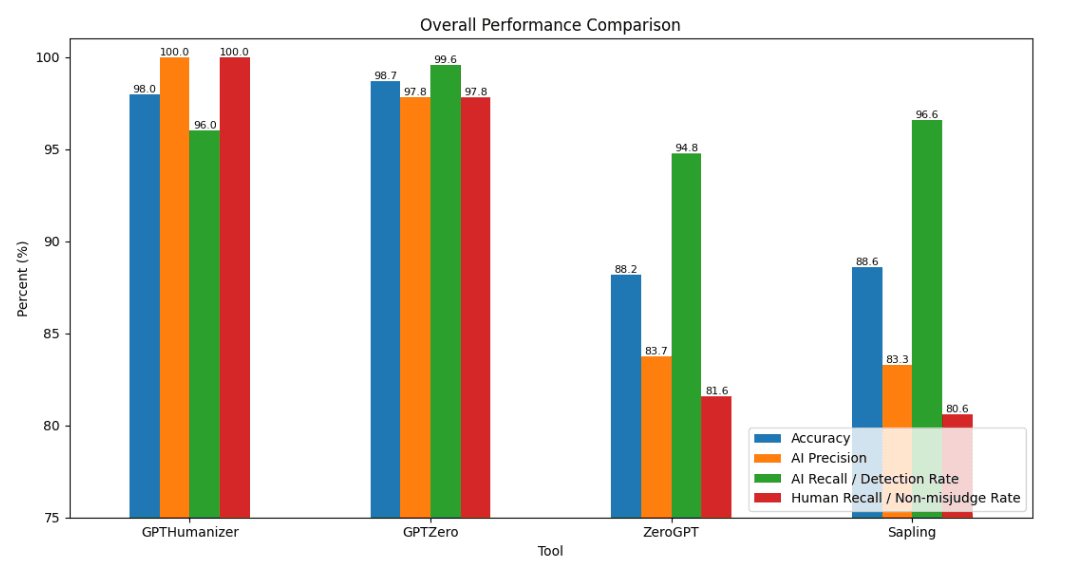
2026 AI Detector Benchmark: Can You Really Trust AI Detectors?
We tested GPTHumanizer, GPTZero, ZeroGPT, and Sapling on 1,000 English texts to compare AI detection...
 Ethan Miller
GPTinf AI Detector Review: Is Its Checker Actually Reliable?
GPTinf AI Detector review with real tests on AI text, human writing, GPTinf output, GPTHumanizer AI ...
Ethan Miller